RADIO
RADIO






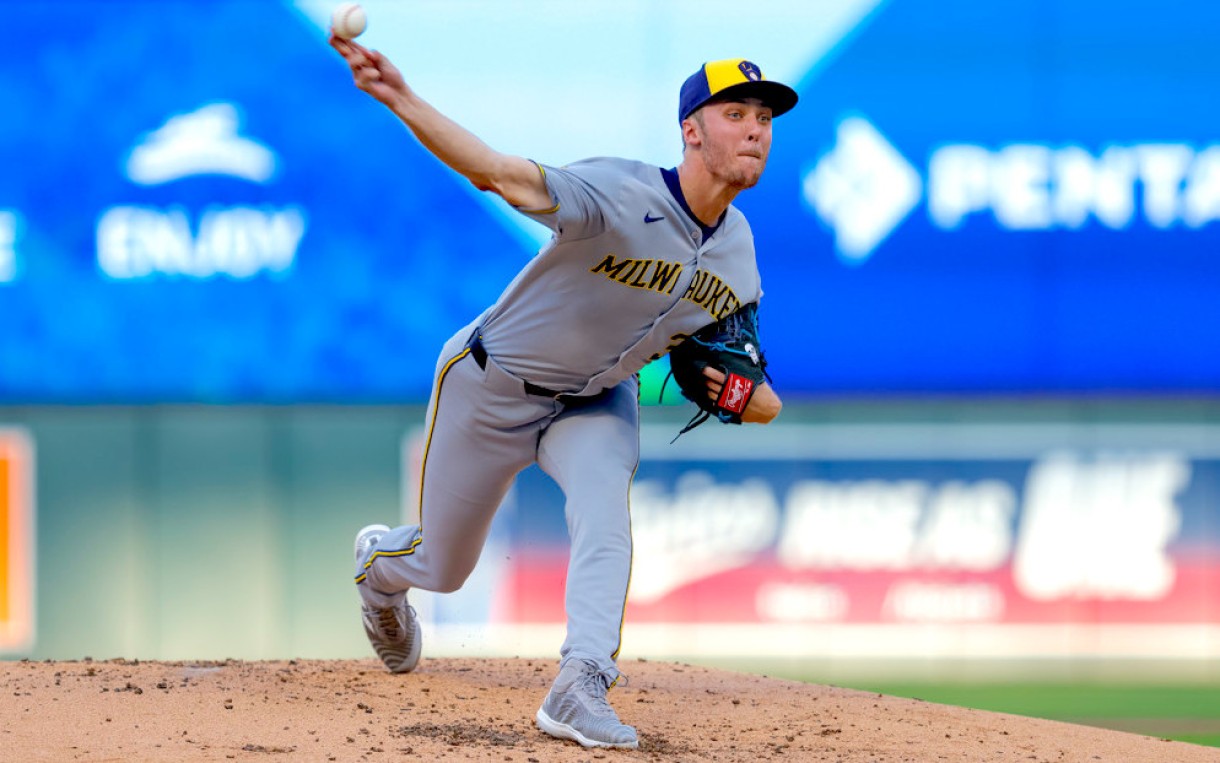
Want to find the next ace? Dan Palyo uses advanced fastball metrics like Stuff+, Induced Vertical Break (IVB), and Velocity to identify 2026 fantasy baseball breakout pitchers before your league-mates do.
If you're tired of reading article after article that just touts individual players for the upcoming season, then why not take some time to dig into some advanced metrics with me in the second part of my research-based series on starting pitcher statistics?
If you're looking for part one, you can find it here. I enjoy a good deep dive as much as the next writer and was lucky enough to be a finalist for the FSWA research article of the year award for some of my baseball work last year.
In this article, I am going to discuss the importance of having a good fastball as a foundation for success as a starting pitcher. I'll take a look at several different metrics to identify which starters had some of the best (and worst fastballs) last season, and while I'm at it, I just might have a few more touts up my sleeve!
Featured Promo: Save 50% off the regular price with discount code CHAMP, for a limited time. Exclusive access to our Team Sync platform, DFS cheat sheets, Lineup Optimizers, betting/prop picks, and exclusive content from Nick Mariano and Eric Cross! GAIN ACCESS NOW
Why Are Fastballs So Important?
So I set out on this project with the idea that having a good fastball was one of the more important aspects of being an effective starting pitcher in the big leagues. I'm not saying that it's impossible to be good at the MLB level without a great fastball, but I think the margin for error gets pretty slim for pitchers who rely more heavily on offspeed pitches and pinpoint location.
A good fastball accomplishes several important things for a pitcher.
- Fastballs make secondary pitches more effective by forcing hitters to be ready to swing early. The bigger the gap in velocity from a pitcher's fastball to their breaking pitch, the more the hitter has to account for with the timing of their swing. Sequencing pitches is simply easier when you can mix fastballs with offspeed pitches.
- Fastballs are usually the easiest pitches to consistently throw for strikes. Pitchers who can command the zone with their fastball are going to work ahead in the count more often.
- A good four-seamer allows a pitcher to throw up in the zone. With so many hitters now focused on launch angle, pitchers have to use the upper half of the strike zone. Uppercut swings on high fastballs can result in easy pop-ups and plenty of whiffs.
- Throwing a four-seam fastball is less stressful on a pitcher's arm. Starting pitchers are throwing 80-100 pitches per outing every fifth day. Fastball mechanics are repeatable and bode well for durability.
I wanted to find some data to back up my assertion, so I attempted to quantify the effectiveness of every starting pitcher's fastball (among those who threw at least 40 innings last season). But which criteria should I use to evaluate a fastball's effectiveness?
In the charts, you'll see I landed on seven different stats - Statcast run value, whiff rate, expected slugging percentage (xSLG), expected weighted on-base average (xwOBA), and fastball-specific grades in Stuff+, Location+, and Pitching+.
I also included each pitcher's SIERA, strikeout rate (K%), and four-seam fastball velocity for reference. There was a strong negative correlation (-0.64) between SIERA and my fastball grade, meaning as the fastball grade went UP, a pitcher's SIERA was likely to go DOWN.
Paul Skenes, 98mph Fastball Movement. 😲
21 Inches of Run. pic.twitter.com/UxT9A0u3R2
— Rob Friedman (@PitchingNinja) May 18, 2025
Other statistics that I considered but ultimately didn't use were Barrel% and induced vertical break (iVB). I think the xSLG and xwOBA both have the barrel rate baked into them enough, and I'm counting on the Stuff+ and Pitching+ to help capture the movement and velocity of the fastballs. Not every fastball needs a high iVB to be effective; consider Paul Skenes, who has one of the flattest fastballs in the league (it makes up for it with elite velocity and excellent horizontal movement).
Best Fastballs Among MLB Starters
So let's take a look at some of the best four-seam fastballs according to my ratings. The yellow column shows the overall grade I calculated by averaging the percentile ranks for every pitcher across all categories. This first group represents the top 14 pitchers (rating of .80 or better) of over 200 that were eligible.
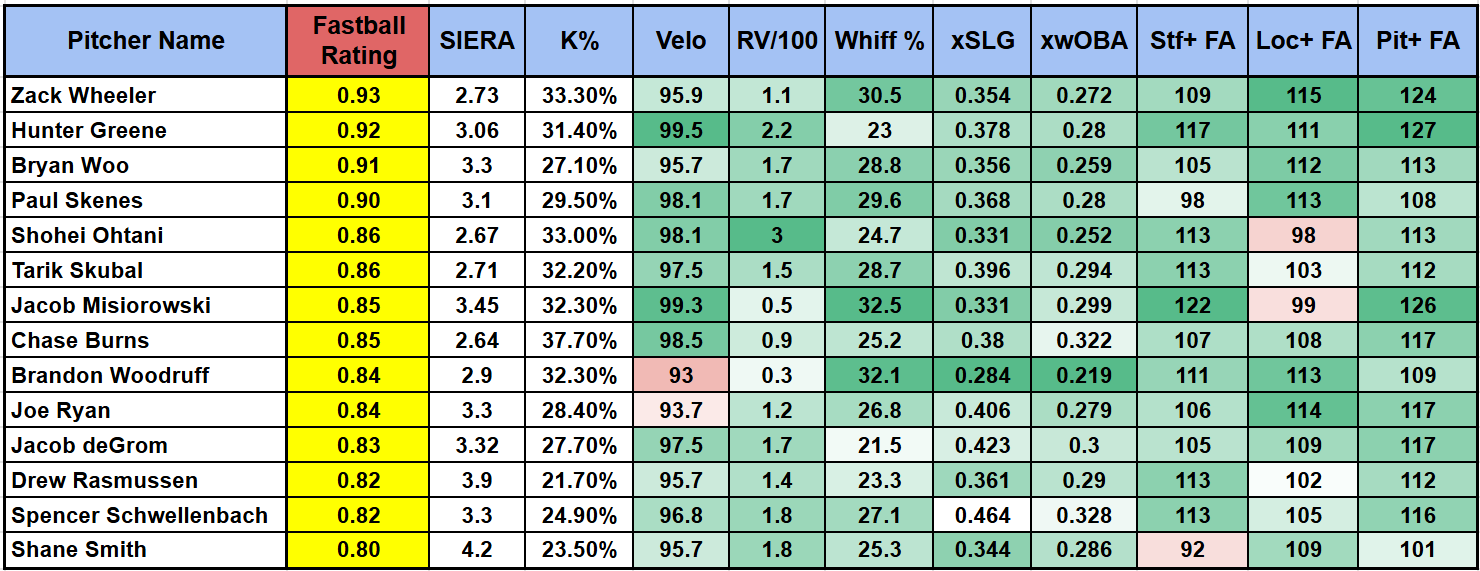
Here are some observations about our "cream of the crop" fastball throwers.
First of all, these are strikeout pitchers - without a doubt. The average strikeout rate among this group is 29%, and the average SIERA is an impressive 3.18.
Velocity certainly matters. Most of these fastballs are 97+ in average velocity, and only two (Joe Ryan and Brandon Woodruff) were lower than 94 mph. The average four-seam velocity across the league continues to increase, and if you can't bring it at least 93-94 consistently, you're going to have to have some elite movement and pitch sequencing to get hitters out.
The ability to miss bats with the fastball (Whiff%) is pretty common among our leaders, but not mandatory. Hunter Greene's 23% Whiff% is only slightly above average, but he had a 75.7% Strike% and a 29% foul-ball rate, both among the best in the league. Jacob deGrom checked in with just a 21% Whiff% but also a 27% foul ball rate.
Both pitchers lived in the zone with their heater, forced a lot of weak contact, and therefore didn't need to blow it by hitters every time.
Stuff+ measures the physical characteristics of the pitch, not just the velocity, but also the movement. With fastballs, we love when pitchers have a lot of iVB (induced vertical break), which hitters see as rising action, and allows pitchers to throw up in the zone successfully. Greene, Tarik Skubal, Chase Burns, and Drew Rasmussen all have well above-average iVB on their four-seamers.
The rest of the pack grades out much closer to average, with Skenes (who I mentioned earlier) having very poor iVB on his fastball, but 14 inches of arm-side run and elite velocity.
Not much separates our top four pitchers, with Wheeler, Greene, Woo, and Skenes all sitting a good bit ahead of the rest of the pack. What do they all have in common - elite Location+ grades. The only two pitchers from this group with similar scores were Ryan and Woodruff, who both have good shapes to their fastballs but lack the velocity to be elite.
If location is one of the most important variables here and the one that is the most "fixable" with changes in mechanics, then Shohei Ohtani and Jacob Misiorowski stand out in a big way. Ohtani only threw 47 innings for the Dodgers last year, but was still incredibly sharp with a 28.2% K-BB% and 16% SwStr%.
If he did that with a below-average location on his fastball, what could he do in a full season on the mound and another year separating him from the Tommy John surgery that prevented him from pitching in 2024? I know, I know...innings limits for the Dodgers and a six-man rotation...
Misiorowski really intrigues me, however. He's in only his second big-league season, and his fastball is dynamic. The shape is good, and he consistently touches 100 mph. The pitch had a 16.2% SwStr% and 33% CSW%, but just a Zone% of 53%. If he can make gains with his control, the sky is the limit. We saw what happened when Hunter Greene started pounding the zone with his 99 mph fastball more consistently.
If I just showed you this list and asked you, "Which of these is not like the others?" I'm guessing you would have said, "Shane Smith." And you'd be right since his 4.20 SIERA and 92 Stuff+ grade stick out like a sore thumb. But then again, his cost is significantly cheaper (NFBC ADP of 257 over the last two weeks).
Shane Smith, Filthy 90mph Changeup. 👌 pic.twitter.com/gT3x7tcUZO
— Rob Friedman (@PitchingNinja) May 11, 2025
I think he's likely an outlier here, as his fastball rates as pretty average in terms of velocity and movement, yet he had really good batted ball results on the pitch. My theory is that the rest of his arsenal has downward movement (sinker, curveball, and an elite 90 mph changeup) that helps his fastball sneak up on hitters a bit. So while he's "only" bringing it 96 mph, it can feel more like 98-99.
The Next Tier of Good (But Not Elite) Fastballs
So there are 18 pitchers with a grade of between .70 and .79 in this tier. We get a lot more variety in terms of velocity, whiff rates, Stuff+ grades, and definitely the Location+ grades. Unlike the first group, who are all mainly being drafted in the first six rounds in redraft leagues, we have a much wider variety of ADP represented here as well.
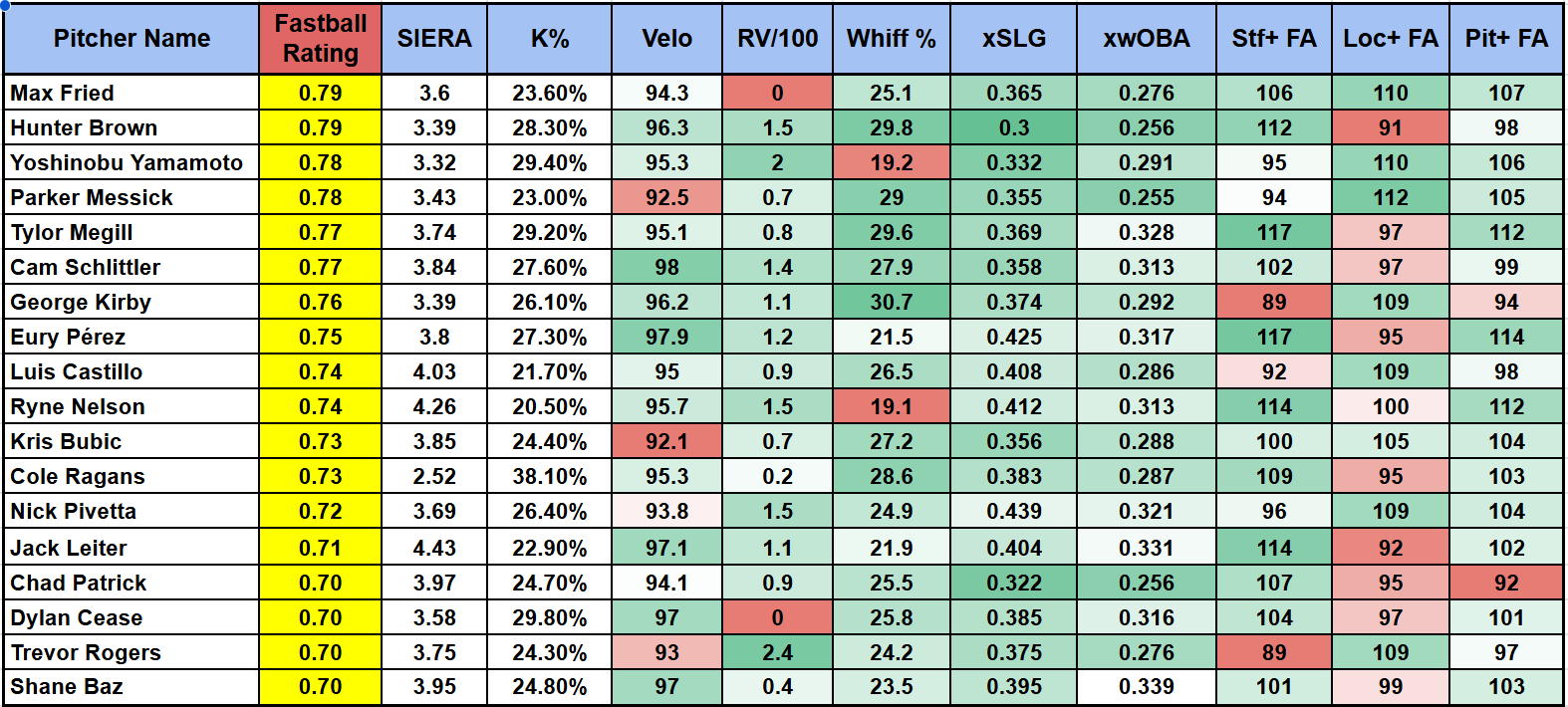
Our group SIERA here jumps up a bit to 3.69, and the collective K% is 26.2%.
I've written about a few of these guys already this season, specifically Eury Perez, Cam Schlittler, Ryne Nelson, Shane Baz, and Jack Leiter, all as potential breakouts. It's easy to see the formula here. Really good stuff + room to improve location = potential that we are looking for in a starting pitcher.
I also highlighted Parker Messick as a late-round value and compared him to Kris Bubic, as both are lefties with below-average velocity on their fastballs, but good movement. Bubic gets an elite 18 inches of iVB on his fastball, while Messick is at 16.7 inches, but he also throws from a slightly higher arm angle (45 degrees).
Both guys, along with fellow lefty Trevor Rogers, are proof that you don't need to be a flamethrower to have a good fastball if you can locate it consistently with good movement (and perhaps that being left-handed is an advantage in of itself).
Yamamato helps reinforce that point as well, and I was a bit surprised to see him with such a low Whiff% compared to other guys with good fastballs. But he had some very good batted ball metrics on his heater, as did Luis Castillo, who isn't missing bats like he used to earlier in his career.
Someone explain how George Kirby has the best Whiff% of this group at 30.7% but the worst Stuff+ grade on his fastball? My best guess is the Stuff+ model hates his fastball because of its shape, but the pitch's velocity and his ability to sequence it properly with a plus slider, curveball, and splitter all really help him get whiffs.
If I had to pick a "who seems like they don't belong here" guy from this group, it would probably be Chad Patrick. The poor Location+ grade isn't as big of a deal as the Pitching+ grade of 92. His fastball produced good batted-ball results, but it isn't dominant enough to support the rest of what is a fairly weak group of complementary pitches (mainly cutter, sinker, change-up).
The Worst Fastballs Among Starters
So what I won't do is look at the results of every single pitcher from the sample - that article would get pretty long! But I do think it's worth looking at some pitchers who graded out with the worst fastballs according to my ratings. Most of these pitchers are not on your radar for upcoming drafts, but some of them most certainly are, and it's worth digging in a bit on a few of these guys to see if we should avoid them or not.
Since we found the average rates for the first two groups, here they are for the bottom group of 19 starters.
- SIERA: 4.46
- Strikeout Rate: 20%
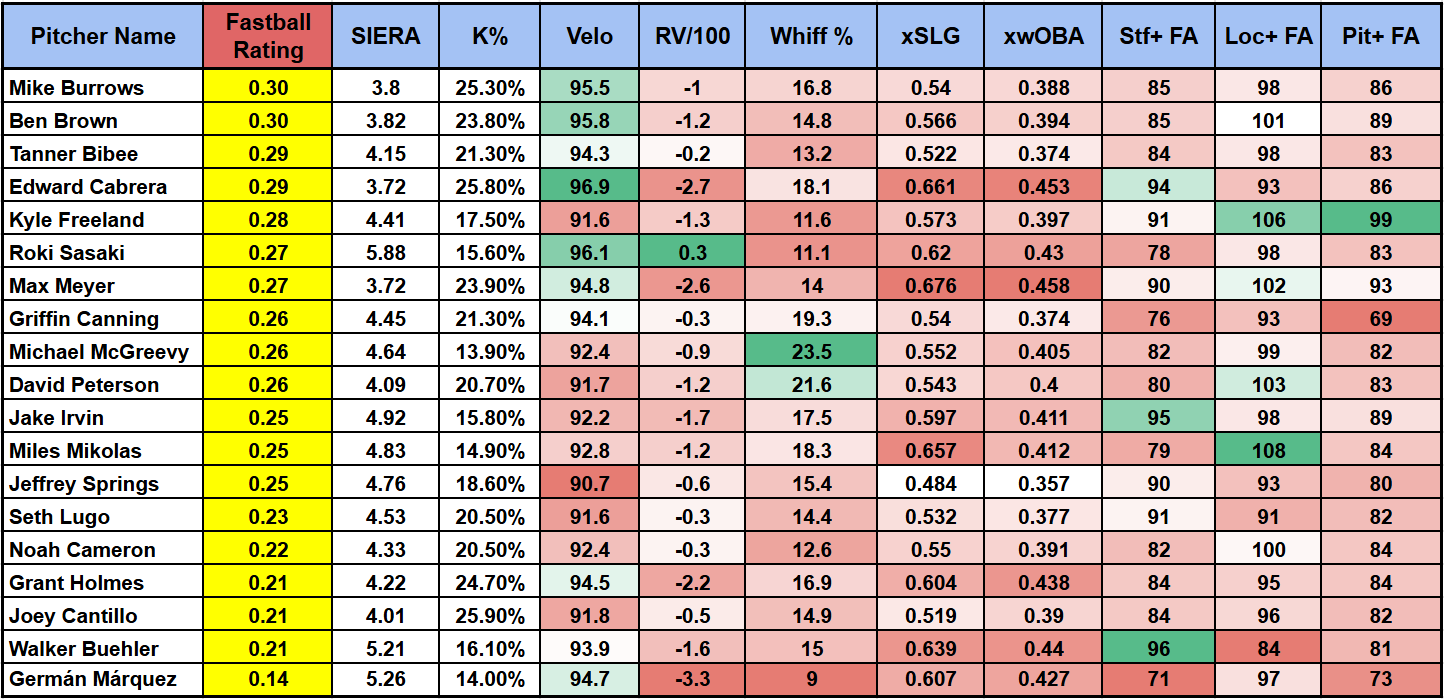
My first disclaimer here is that pitchers who rely heavily on a sinker (or two-seam fastball) as their primary pitch are going to show up on this list. A few pitchers who fit that criteria are Edward Cabrera and David Peterson, neither of whom threw a four-seamer as their primary pitch. If a pitcher knows his four-seamer isn't good, but can get another high velocity pitch like a cutter or sinker to be effective in its place, then we shouldn't punish them for it, right?
Tanner Bibee kind of fits into this category, as he throws six different pitches and relies on his heater only 28% of the time. I like Bibee quite a bit at his cost this year, and I think his cutter is really good, which helps to make up for a mediocre four-seamer.
We see four-seam velocities much more commonly down in the 90-92 mph range here, except for a few guys like Cabrera, Roki Sasaki, Ben Brown, and Mike Burrows. I know there are a lot of folks on the Sasaki bounce-back train this year, but I'm just not sure I can get behind him as a three-pitch guy who threw his fastball over 50% of the time and had it obliterated by opposing hitters.
I can at least get on board with Burrows, who has some really good offspeed stuff (curveball + changeup) to help keep hitters off the fastball.
I already expressed my disdain for Noah Cameron here in my SIERA overachievers article. Maybe he can pull off some Andrew Abbott magic again this year, but the advanced stats all mainly hate his arsenal.
Cleveland Guardians' starting pitcher Joey Cantillo is somewhat strange since he throws a low-spin four-seamer while generating 7.5 feet of extension, meaning the fastball tends to drop more than it "rises."
Cantillo's changeup elicited a 47.4% swinging-strike rate on Sunday… pic.twitter.com/KJ3bEkaWR4
— Corbin (@corbin_young21) March 9, 2026
I think the most polarizing pitcher in this group has to be Joey Cantillo, who I have seen touted as a breakout candidate by several well-respected writers. And while I want to get on board with Cantillo and his dynamic changeup, I definitely worry about his very weak fastball. It's not just the low velocity, since I mentioned that other lefties have shown they can get away with a 92 mph fastball; it's that hitters absolutely drilled this pitch last season.
Perhaps Cantillo will be a good test case this season to see how far a dominant offspeed pitch can take a starter with a subpar fastball. I think it creates some narrower margins for success, as he'll need to demonstrate some really good command to keep hitters from squaring him up often. He's done it in small sample sizes in the past; let's see if he can do it for a full season!
Conclusion
In the end, I am not sure if I discovered anything earth-shattering in terms of takeaways, but it was certainly a lot of fun working my way through the data and seeing where it led me.
First of all, I don't think that I would draft anyone (or fade anyone) specifically based on their fastball metrics.
Additional context is always needed, and a healthy fastball might be more important to some pitchers than others, depending on the strength of their secondary pitches and/or their command of their pitches.
But the data certainly does suggest that it helps your chances of getting MLB hitters out if you have a strong fastball with elite velocity, movement, or both!
The fastball ratings correlated well with lower SIERAs and higher strikeout rates. We all love strikeouts, not only for their value as a category of their own, but as a tool that pitchers can use towards run prevention.
Good luck this draft season, and make sure you keep checking back for the latest articles in my series on starting pitching.
More Fantasy Baseball Advice
Download Our Free News & Alerts Mobile App
Like what you see? Download our updated fantasy baseball app for iPhone and Android with 24x7 player news, injury alerts, sleepers, prospects & more. All free!