



 RADIO
RADIO










Frank looks at the difference between franchise tags and transition tags in regard to NFL free agency. What do they mean and which players have gotten one in 2024?
The Kansas City Chiefs are Super Bowl champions once more, but now it is time to start looking ahead to 2024 and who will be crowned the next Super Bowl champions. That journey begins on March 13 with the start of the official league year and the beginning of free agency. The concept of free agency is rather simple: unsigned players can sign with new teams for more money. Players get paid for their performance, and teams can improve by adding talent to the depleted positions on their roster. However, the process of free agency is intricate and quite complex, but fear not, I am here to break it all down for you in my NFL Free Agency Primer series.
Players become free agents for a variety of different reasons. Some players’ contracts are expiring, some players are cut from their teams, and some players can only be signed to contracts with new teams under certain conditions. Furthermore, there are two designations of free agents, restricted and unrestricted free agents. Perhaps the most complex aspect of free agency is the variety of ways that teams can protect themselves from losing a valuable player. Teams can apply the franchise tag or transition tag as well as a first, second, or Right of First Refusal tender depending on their free-agent status. Now, let's dive in so you can follow along when free agency kicks off and breaking news starts dropping every hour. It is one of the best times of the year and I can’t wait to see the madness that ensues.
In the next article of the Free Agency Primer series, let’s discuss the franchise tag versus the transition tag. When it comes to players with four or more accrued seasons, NFL teams have two options to prevent their superstar players from becoming unrestricted free agents and signing with another team when their contracts are about to expire. The first option is the franchise tag, which can be exclusive or non-exclusive, and the second option is the transition tag.
Editor's Note: The FFPC Baby Gorilla Tournament is now open, featuring a $100,000 grand prize and a $675,450 total prize pool! This 12-team, Tight End Premium contest uses a 20-round draft format, with the overall winners determined by total points scored during Weeks 15–17. Get $25 to use toward your first entry by signing up through our link. Grab your team now! Sign Up Now!
Franchise Tag
A franchise tag is essentially a one-year contract. The NFL predetermines the salary for players who play under the franchise tag based on position, and the player must either sign the tag and play for that salary or negotiate a long-term deal with his team before July 15, 2024.
The salary for a franchise-tagged player is set in one of two ways, either by averaging the top-five salaries by position for the previous league year, or if it’s higher, 120% of a player’s salary from the previous season. This means players like quarterbacks and defensive ends will have a significantly higher salary under the franchise tag than positions like tight end or running back.
Teams can franchise tag a player up to three times if a long-term deal cannot be reached; however, subsequent franchise tags result in a significant increase in salary for the player. The second franchise tag on a player requires a 120% increase from the player's salary under the initial franchise tag.
However, if a team wants to franchise tag a player three years in a row, the player’s salary is either an increase of 144% from the second franchise-tag salary or an average of the top-five salaries at the highest-paid position, whichever is higher.
Take a second and read that again. The average of the top-five salaries at the highest‑paid position, not the same position. This means that if a team wanted to franchise tag a tight end for three years straight, his third year under the tag would pay him the one-year salary of a franchise-tagged quarterback. That is why you never see a player tagged three years in a row.
The last thing to note about the franchise tag and transition tag is that a team can only use one each season, not both. If an NFL team franchise tags their quarterback, they cannot use the transition tag on another player and vice versa.
Exclusive Tag vs. Non-Exclusive Tag
The franchise tag can be either exclusive or non-exclusive. An exclusive franchise tag is equivalent to putting the player in jail. He is not allowed to negotiate with any other teams and must either sign a long-term deal by July 15, 2024 or play under the franchise tag for one year and accept the predetermined salary.
A non-exclusive franchise tag allows the player to negotiate with other teams but protects the original team by giving it a Right of First Refusal, similar to restricted free agents (discussed further in the next article in this series), but with much more significant compensation if they lose the player. If another team reaches an agreement with the non-exclusive franchise-tagged player, they must sign that player to an offer sheet that lays out the full terms of the proposed contract.
The Right of First Refusal gives the original team the right to match any offer made to the franchise-tagged player. If the team matches the offer, then it creates a contract with a franchise-tagged player. If the team does not match the offer, then the original team receives two first-round picks as compensation from the new signing team.
You will rarely see an offer sheet signed for a player with the non-exclusive franchise tag because teams are very reluctant to give up two first-round picks for any player that is not a franchise quarterback.
Fortunately for us fans of the complexities of the NFL rules and regulations, we got to see this exact situation play out last year. Baltimore Ravens quarterback Lamar Jackson wanted a long-term deal that fully guaranteed him close to $200 million, but the Ravens did not want to guarantee that much.
Confident that no other team would want to guarantee that much money to Jackson and give up two first-round picks to the Ravens, the team gambled and placed the non-exclusive franchise tag on Jackson, allowing him to negotiate with other teams.
There was no downside for the Ravens as they could match any offer that Jackson agreed to, and if the offer was too steep, the team would receive two first-round draft picks in return.
It also allowed time to show Jackson, as the Ravens had hoped that other teams were not willing to guarantee the amount of money he wanted, which would essentially prove to him his actual market. Well, lo and behold, it worked out exactly as the Ravens had hoped, and no other team even attempted to negotiate with Jackson, at least not publicly.
Note: The team signing the non-exclusive franchise-tagged player to an offer sheet must have a first-round pick in both of the next two upcoming drafts to be eligible to negotiate with that player.
Transition Tag
The second option an NFL team has to protect their superstar player from leaving is the transition tag. The transition tag is essentially a poor man’s non-exclusive franchise tag. The transition-tagged player has the right to negotiate with other teams, and if another team signs the player to an offer sheet, the original team has a Right of First Refusal to match the offer.
The difference is that if the original team does not match the offer, the player signs with the new team, but the original team receives zero compensation in return. So why would a team use the transition tag instead of the non-exclusive franchise tag?
First, the predetermined salary for a transition-tagged player is significantly less than that of a franchise-tagged player. Second, the transition tag allows teams to test the market for a given player because prospective teams usually will not sign a non-exclusive franchise-tagged player to an offer sheet given the two first-round picks they will have to give up if they did so (i.e. the Lamar Jackson situation).
If another team knows it doesn't have to give up anything in order to sign the transition-tagged player, they are much more likely to make an offer, which gives the original team a very good idea on the player’s market without making him available or negotiating trades.
However, there was a drastic decrease in the use of transition tags until 2011 because prior to that, prospective NFL teams started adding language to their offer sheets that basically made it a guarantee that the original team would not or could not match the offer. These terms were known as “poison pills” in an offer sheet.
The best example of a poison pill happened in 2005 when the Seattle Seahawks placed the transition tag on offensive guard Steve Hutchinson. The Minnesota Vikings signed Hutchinson to an offer sheet for $49 million with $16 million guaranteed, but they included language that said the entire $49 million contract was fully guaranteed if Hutchinson were not the highest-paid offensive lineman on the team he signed with. He would have been the highest-paid offensive lineman on the Vikings, but he would have been the second-highest-paid offensive lineman on the Seahawks.
This offer sheet basically meant if the Seahawks wanted to match the offer, Hutchinson’s $49 million was fully guaranteed. The Seahawks challenged the language in binding arbitration pursuant to the collective bargaining agreement (CBA) and lost. As a result, they did not match the offer sheet and the Vikings signed Hutchinson without having to give anything up in compensation to the Seahawks. Poison pill clauses have thankfully been banned since the 2011 CBA.

Salaries referenced from overthecap.com
Notable NFL Players That Have Been Franchise/Transition Tagged
Unlike last year, only two fantasy-relevant players have been franchise tagged this offseason.
Michael Pittman Jr., WR, Indianapolis Colts - Non-Exclusive Franchise Tag
First time the Colts have used the franchise tag since 2013 with …. Pat McAfee. pic.twitter.com/rdOFKniGu2
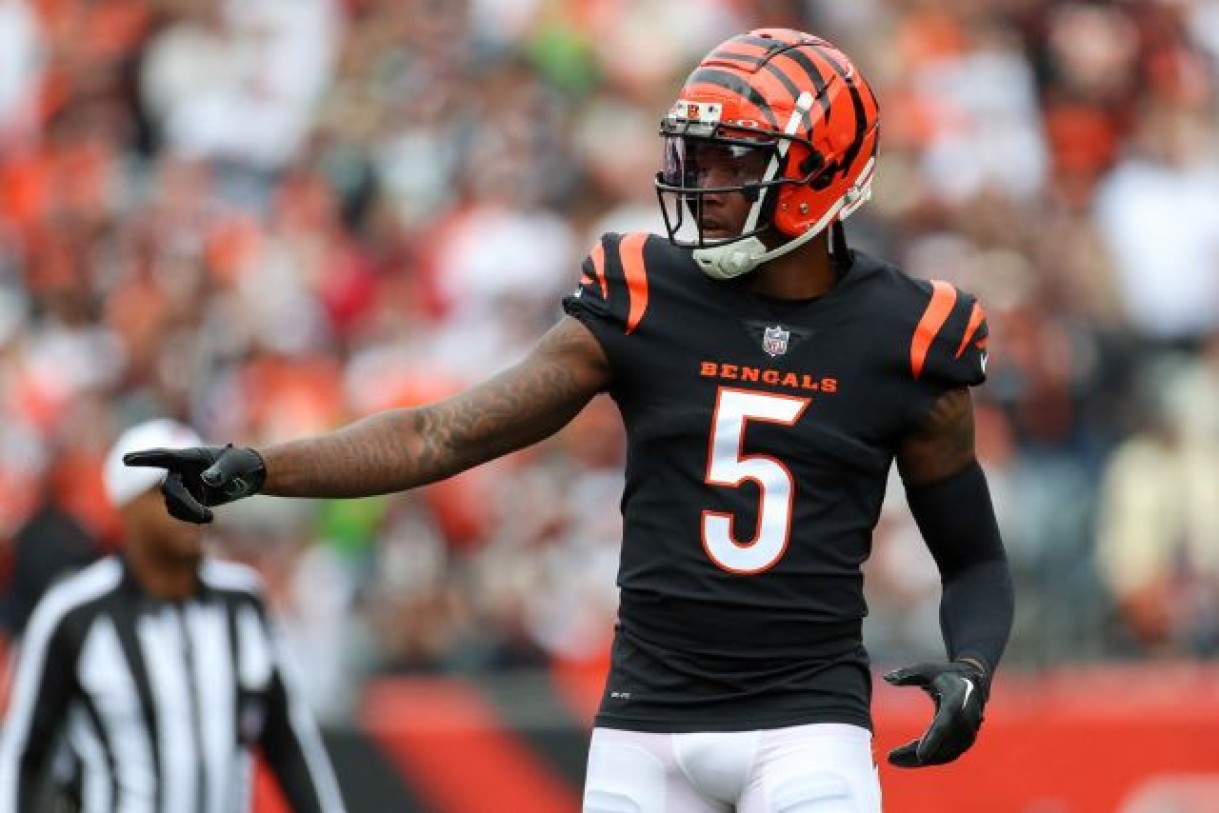
Tee Higgins, WR, Cincinnati Bengals - Non-Exclusive Franchise Tag
— Adam Schefter (@AdamSchefter) March 5, 2024
Bengals head coach Zac Taylor on franchise player Tee Higgins. “Tee has done an outstanding job for us since we drafted him in 2020. I’m glad that he’ll continue to be a big part of our offense and our team.”
— Adam Schefter (@AdamSchefter) February 26, 2024
Download Our Free News & Alerts Mobile App
Like what you see? Download our updated fantasy football app for iPhone and Android with 24x7 player news, injury alerts, rankings, starts/sits & more. All free!

More Fantasy Football Analysis