RADIO
RADIO











Antonio Losada looks at last season's top tight ends and puts them in historical context to know where they rank among the best players at the position when compared to each year starters using their Value Over Starter.
The 2019 fantasy football season is over. That is not something we like to say considering the empty path we have ahead of us until we reach draft season again in eight months. The good thing about it, though, is that we have plenty of time to analyze what happened during the past few weeks and put performances into context. As football is an ever-evolving game, though, it makes sense to assess how good players were in fantasy leagues according to how the rest of the players in the league performed. That is what I will be doing in this series of articles, one per skill position.
In order to know how well a starter (top 12 for QBs and TEs, top 24 for RBs and WRs; the number of starters per position in Yahoo! standard leagues without considering the FLEX spot) was in any given season we shouldn't just look at his numbers in a vacuum, but rather in that year's environment. To do that we can use what I've called Value Over Starter or VOS. VOS is calculated on the basis of the top performers' fantasy points obtained during the full season, so different years have different performing levels (for example, a great passing year in 2019 might look more impressive than one in 2000 in terms of counting stats, but the best 2000 passer might have had a better year when compared to his contemporaries in their context).
This article will cover the quarterback position and the top-12 players (that is, QB1s) at the position during the past 20 years going from the 2000 season to the just finalized 2019 campaign. Let's get started!
Bookmark our updated and revamped fantasy football rankings portal for all league formats!PPR rankings | Half-PPR rankings | Standard rankings | Rookie rankings | Superflex rankings | Dynasty rankings | Who To Start? | Injuries | Matchup Ratings | Strength of Schedule
Value Over Starter: A Quick Primer
As I already introduced in the first paragraphs of the article, I'll be using the Value Over Starter metric to asses how good a player was in a given season compared to the rest of starters at his position. The VOS metric is calculated following a simple set of steps:
- Divide each player's total fantasy points into three categories: passing (paPPR), rushing (ruPPR), and receiving (rePPR); knowing what each stat is worth in PPR-format fantasy leagues (0.1 points per receiving yard, 6 points per rushing touchdown, 1 point per reception, etc...)
- Calculate the total points generated by the top 12 QBs and TEs and the top 24 RBs and WRs for each category.
- For each player inside those top 12 or top 24, subtract his paPPR, ruPPR, and rePPR for the combined addition for the position/year/category, then divide that number by 11 or 23 depending on the position.
- Divide the player value for each category by the number calculated in Step 3. The resulting number would tell us if the player was dead average among starters (VOS 1), if he performed over the starters' average level in that position in that category (VOS>1), or if he performed under the starters' average level in that position in that category (VOS<1)
Quarterback VOS is based on both the passing and rushing categories, running back VOS is based on both the rushing and receiving categories, and wide receiver and tight end VOS is based just on the receiving category.
Here is an example of the calculation to make things a bit clearer and allow you to replicate the method if you want to. Take Lamar Jackson's 2019 season and following the steps aforementioned:
- Jackson scored 417.7 total points in 2019. 259.1 of those came via passing (259.1 paPPR), and 160.6 came via rushing (160.6 ruPPR).
- Top-12 QBs (starters at the position in standard leagues) combined for 3,048.2 paPPR and 664.7 ruPPR.
- If Lamar Jackson had not been part of that top 12, the average starter would have averaged (3,048.2-259.1 divided by 11) 253.6 paPPR, and (664.7-160.6 divided by 11) 45.8 ruPPR on the season.
- Lamar Jackson's passing VOS would come from dividing his paPPR by the average of the other 11 starters (259.1/253.6) and would yield a 1.02 paVOS. Same with the ruPPR (160.6/45.8) for a 3.50 ruVOS. Jackson's QB VOS in 2019 would be paVOS+ruVOS = 4.52 VOS, then adjusted for the season's environment taking in consideration the percentage of points the average starter got from passing/rushing/receiving stats. The final value comes down to 1.374 VOS on the 2019 season for Jackson, making him the leader among all starters.
2019 TE1 In Historical Context
Now that you know how the VOS metric works, we can put the 2019 tight end class in context. There have been 240 top-12 tight ends since 2000. The best of them had a 2.009 VOS (2000 Tony Gonzalez) while the worst had a 0.589 VOS (2000 Rickey Dudley), and a little but interesting detail is that both values came in the same season. It makes sense, though, as both Gonzalez and Dudley had massively high/low seasons and they made for a couple of great outliers at both ends of the TE leaderboard that year.
Moving on to year-to-year trends, here is how things look historically:
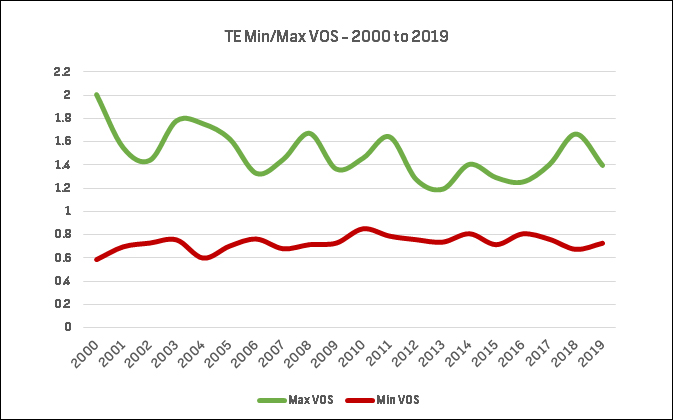
Back in the year 2000 only Tony Gonzalez (267.3) racked up more than 178 fantasy points, and two top-12 TEs fell under the 100-point mark. That made the average starter at the position rather mediocre and boosted both Tony's VOS at the top while sinking Rickey Dudley's at the bottom (as players get removed from the calculation when getting their VOS). The gap between the best and worst tight ends since then has been narrowing with each passing season as more and more players have become better at the position and the differences never grew that high/low as 20 years ago again.
The 2013 and 2016 seasons were the tightest at the tight end position in terms of the value starting players at the position provided when compared to the rest of them. In 2016, every top-12 tight end finished with a VOS between 1.252 (Travis Kelce, 223 FP) and 0.809 (Antonio Gates, 147.8). Three players (Kelce, Kyle Rudolph, and Greg Olsen) bested 200 FP on the year, and only two (Gates and Jason Witten fell under 168), packing things as much as possible.
The 2019 class of starting tight ends was top-heavy with five players inside the 200 FP on the full season but other than that it lacked the depth shown in prior years:
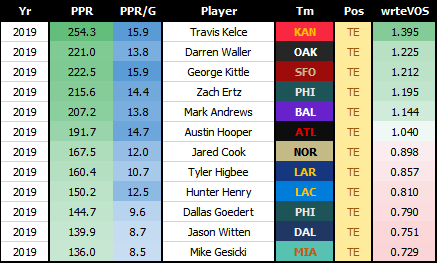
Kelce completed his third season in a row with a top-25 historical VOS at the position. Even with that, his 2019 season was lower when taking this season's TE environment into account, as it ranks just 21st overall among those 25 and is his worst of those three years even though he finished with the second-most points he's ever gotten over a full season. As you know by now, the 233.5 (2017 season FP tally) might pale compared to the 254.3 FP of 2019, but given the fact that the group of starting TEs in 2017 was much worse than that of 2019 Kelce gave his owners with a higher ROI than he did this year. Here is the top-25 in VOS at the TE position since 2000:
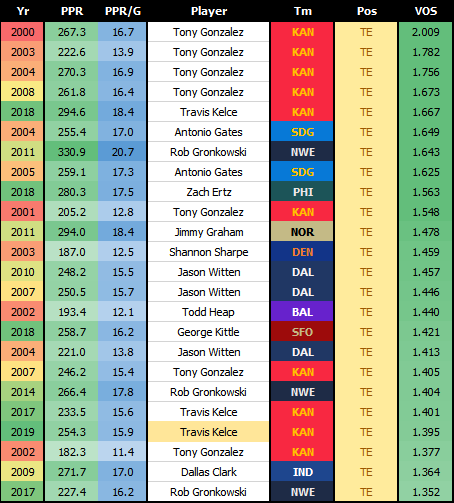
Other than Kelce, Darren Waller's second-place finish in 2019 VOS would have ranked 42nd-best since 2000, just inside the 83rd percentile. Another interesting fact is how Rob Gronkowski, even having the best TE-season ever at 330.9 FP in 2011 could only yield a 1.643 VOS that year. Truth be told, the 2011 class of tight ends was quite strong with the TE12 (Kellen Winslow) getting to 165.3 FP himself, and seven players (including Gronk) with more than 180 FP on the year. That made Gronkowski quite valuable, but not to the levels of peak Gonzalez, Kelce, and Gates.
The case of Gonzalez's excellence at the position is worth exploring on its own. Tony played 14 seasons from 2000 until he retired after 2013. In those years he averaged a 1.373 VOS, making him 37.3% better than the average starter at the position in every season he played NFL football. Here are the top-15 tight ends since 2000 by career-average VOS (active players highlighted):
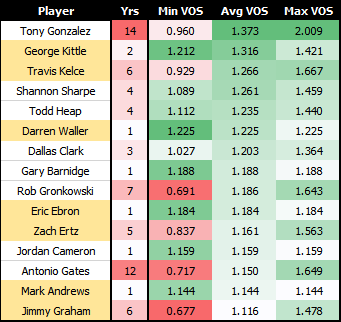
As many as seven active players are currently inside the historical top 15 at the position, but check the number of seasons they've been active and you'll start to understand Tony Gonzalez's greatness. None of those seven players have been TE1 (top 12) at the position in their careers while Gonzalez has made it 14 (!), which is to say every single season from 2000 until he retired.
Gonzalez's minimum VOS came in 2010 (171.6 FP). If we translate his value in 2010 to the 2019 environment he would have gotten 177.6 FP, which would have made him the TE7 (!) this season. Kittle's average VOS is great, but it comes from just two top-tier seasons. Kelce and Zach Ertz have the best chances to end their careers with a 1.200-plus career-VOS but the former would need to keep his level up for a while and the latter would need to raise it even more, which might turn into a hard task.
More Fantasy Football Analysis