




 RADIO
RADIO






Strikeout rate risers and fallers based on RotoBaller's premium tool. Matt Wilkes identifies some starting pitchers (SP) whose changes in K rate could make them worth adding or dropping in fantasy baseball leagues.
Due to a combination of harder throwers and hitters focusing on hitting for power, strikeouts are at an all-time high in baseball. For pitchers, this is an ideal trend. The ability to generate swings and misses is the most important skill to possess, as it's the only true way to control what happens after the pitch is thrown and eliminate the randomness that the ballpark, fielders, weather, and luck can play.
The stat is equally important for fantasy players. Not only are strikeouts a category in every league, but K-rates are often indicative of overall production. A pitcher with a 4.50 ERA with a 25.0 K% may see some positive regression in the future. On the other hand, a hurler with a 3.00 ERA and 16.0 K% may not see the ball continue to bounce their way.
In this column, we'll review two strikeout rate risers and fallers to determine if their performance will improve, hold steady, or worsen as the season moves along.
Featured Promo: Save 50% off the regular price with discount code CHAMP, for a limited time. Exclusive access to our Team Sync platform, DFS cheat sheets, Lineup Optimizers, betting/prop picks, and exclusive content from Nick Mariano and Eric Cross! GAIN ACCESS NOW
K-Rate Risers and Fallers - Premium Tool
Identifying top strikeout rate risers and fallers for each week can help you spot the best pickups before your competition. RotoBaller's Premium K-Rate Risers and Fallers tool has you covered every day. As thoughtful fantasy baseball players, we won't lead you astray. This tool will soon be active once we have a large enough sample size in the season to be considered reliable.
This type of data is available as part of our Premium MLB Subscription. Don't settle for basic stats and surface-level advice from other sites. RotoBaller brings you advanced statistics and professional analysis that you need to win your fantasy leagues and DFS games, because we're ballers just like you. We are your secret weapon!
Risers
Tyler Anderson, Colorado Rockies
2018 K-Rate: 23.1%; Last 30 Days: 30.0%
Avoiding Rockies starting pitchers has long been a strictly followed rule for fantasy owners. This year, however, the situation is a little different, and few pitchers have flown under the radar like Tyler Anderson. The southpaw boasts a 3.72 ERA in 20 starts while raising his strikeout rate for the second consecutive season. He's turned it up a notch over the last month-and-a-half, notching six quality starts in his last eight outings. In his last five starts, Anderson has fanned 39 and allowed just seven runs in 34 innings (1.85 ERA).
Anderson has always had good swing-and-miss stuff, but it hasn't resulted in a ton of strikeouts before now. He's registered an above-average swinging-strike rate in every season of his three-year career. In 2017 and '18 combined, he ranks 24th among 126 pitchers with 150 innings pitched in SwStr% (12.0%). However, only one pitcher ahead of him on that list (Jordan Montgomery) has a lower strikeout rate than Anderson (22.4%) in that time frame and 17 of those pitchers have a strikeout rate of at least 25%. What has changed over the last month to help him unlock that strikeout potential? He's doing what the analytics say he should do: throw his best pitch, the cutter, more often as each month has moved along.
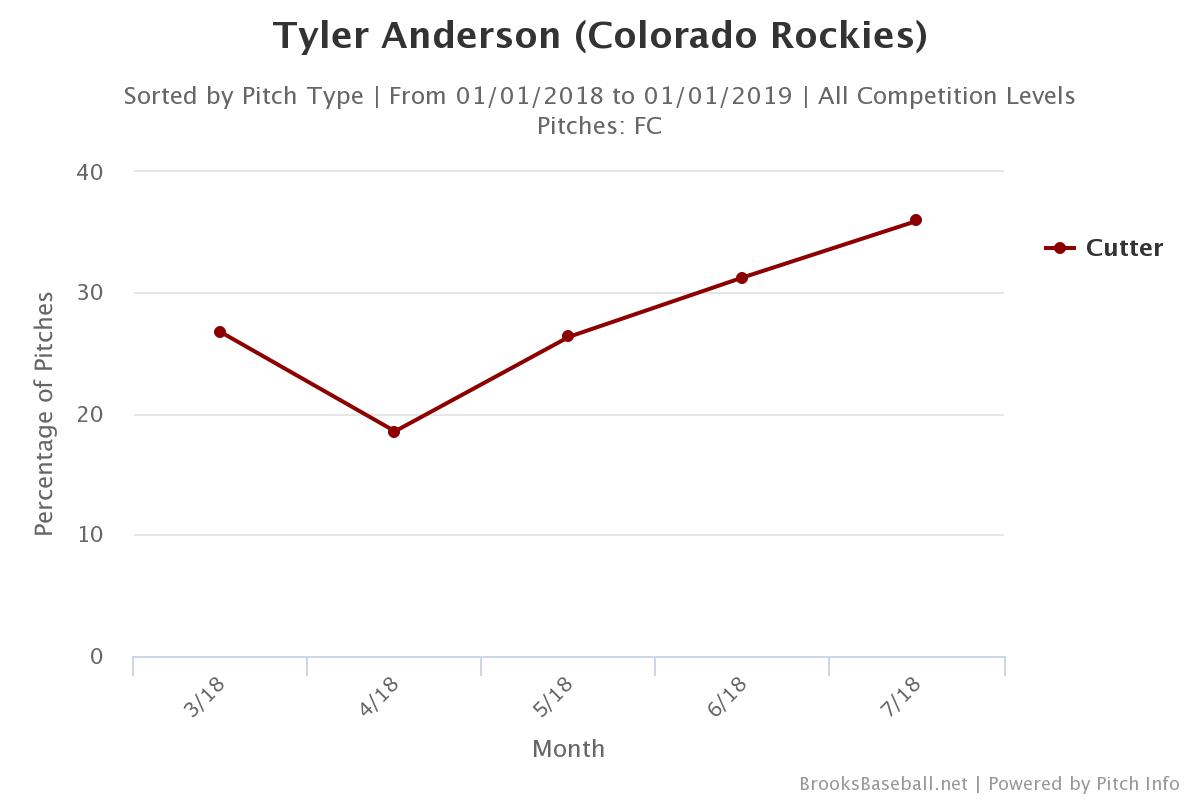
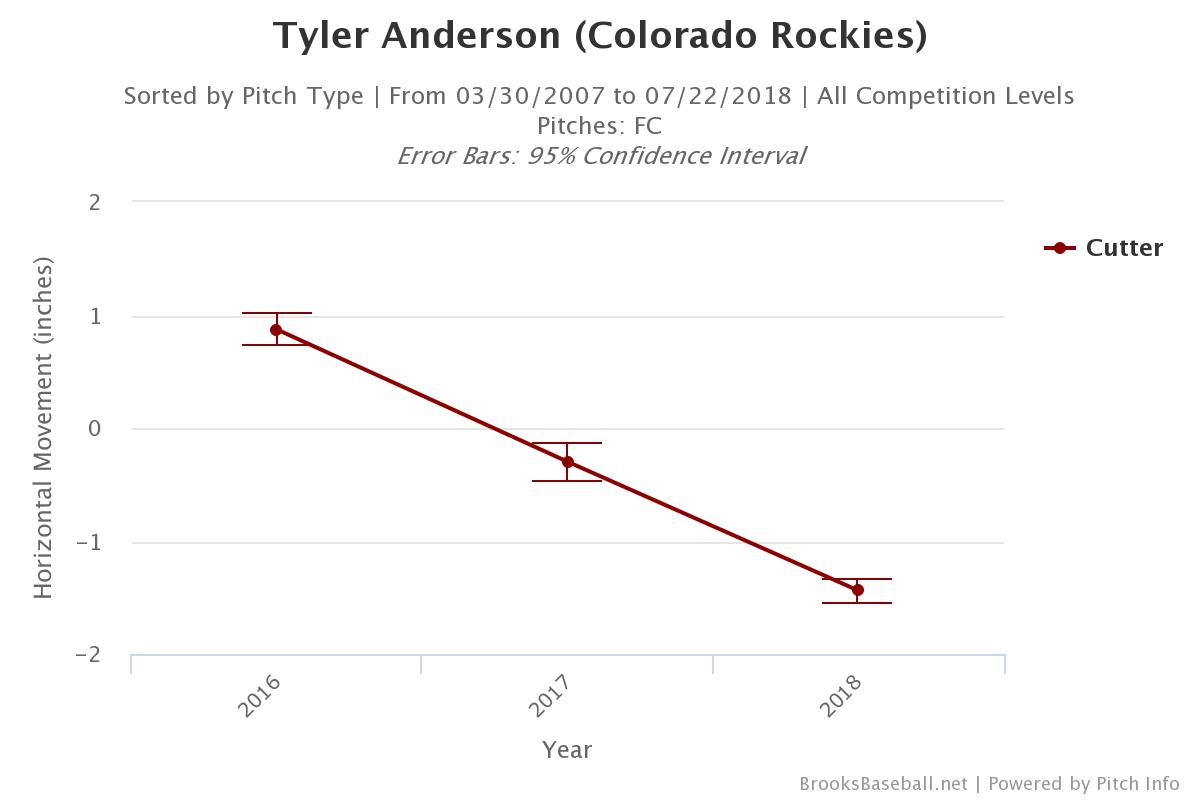
In 2017, the offering had a negative pitch value for Anderson. This year, he's turned it around and made it into the second-most valuable cutter in baseball behind Corey Kluber. Per Statcast, only five pitchers have a better whiff percentage on their cutters than Anderson this year. Hitters are averaging an exit velocity of just 86.5 mph against the pitch this season and hitting it on the ground 47.6% of the time. That's equated to a .178 batting average and .349 slugging percentage. The reason for the improved results is simple: more horizontal movement. The pitch is riding in on right-handed hitters and moving away from lefties more than before.
When paired with a changeup that gets whiffs about 17% of the time, that's a nice combination of pitches when paired with his four-seam fastball—one he has found success with even in Coors Field. Anderson holds a 3.94 ERA at home this season vs. 3.48 on the road and has a better strikeout rate (23.7%) in his home park as well. His biggest red flag is probably his 38.2% groundball rate, a decrease for the second straight year after a promising 50.9% mark in 2016. In Coors Field, that could eventually become more problematic.
It'd be hyperbolic to say Anderson is developing into the ace Jon Gray was supposed to be, but he has transformed into a more reliable fantasy starter with each passing start. His strikeout rate is backed by a change in his pitch mix, and he should be owned in most mixed leagues at this point, though it's always safe to play matchups when Rockies starters pitch at home.
Matthew Boyd, Detroit Tigers
2018 K-Rate: 21.4%; Last 30 Days: 27.1%
When the Tigers traded David Price to the Blue Jays in 2015, Matthew Boyd was considered the throw-in, with Daniel Norris headlining the trio of prospects heading back to the Motor City. Since 2016, though, Boyd has been more valuable (4.3 fWAR) to the team than the oft-injured Norris (2.3). The lefty has already been worth 1.4 fWAR this season, leaving him on pace to well outperform his 2017 season (1.9). The largest reason for that? More strikeouts. Over his last eight starts, he's fanned 25.6% of hitters he's faced, an encouraging development for a pitcher who never held better than a 19.9 K% in a season. However, his ERA has jumped from 3.20 to 4.62 in that time.
What in the world should fantasy owners do with him? First, let's focus on the positives. His rise in strikeouts is backed by an impressive 11.0 SwStr% since June 24, putting him above the league average. For the season, he's also holding a career-best 10.0 SwStr%. The primary reason is he's trusting his slider significantly more often.
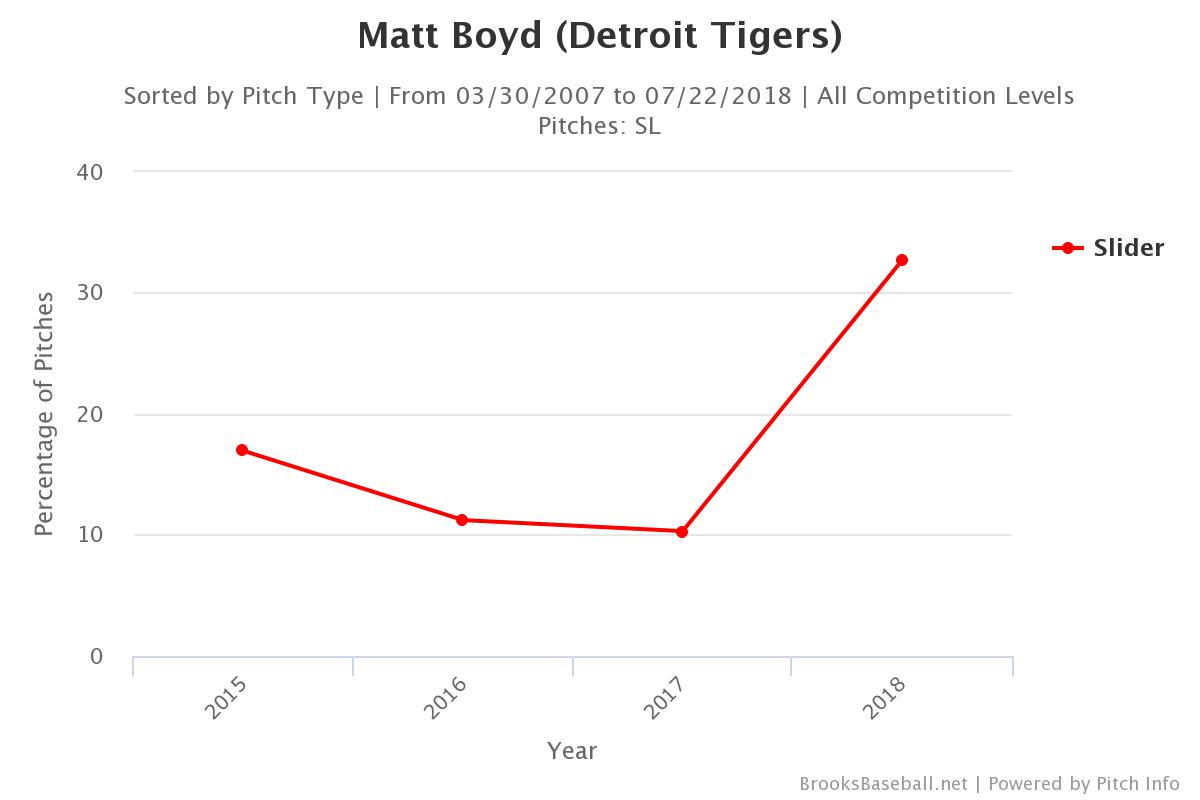
It's the only pitch with a positive value in his career and ranks sixth among all pitchers this season, according to FanGraphs. That puts him slightly ahead of Trevor Bauer, Blake Snell, and Patrick Corbin, among others. Boyd has also taken nearly 6 mph off the pitch from last year (80.7 vs. 86.0), and it's made a difference. The slider has a solid 15.4 SwStr% and a whopping chase rate of 40.1%, with batters slugging a putrid .276 against it. In his last five starts, his whiff percentage is 20.1% per Brooks Baseball. So why, then, are his results so bad? Part of it may just be plain bad luck. His slider, despite getting hit less hard (83.6 mph) than it did in his first 14 starts (84.0), has a .300 batting average on balls in play over his last five outings. He also has an unsustainably bad 44.4% strand rate in that time; nearly half the runners who got on base against him scored.
But he's also regressing from some good luck earlier in the year. Despite being a heavy flyball pitcher, Boyd allowed only three home runs in his first 10 outings. In his last nine starts, that homer-to-flyball ratio has started to normalize and he's allowed nine long balls in that time. There's also the fact that he doesn't have any other particularly strong pitches, and he's lost almost 3 mph from his fastball since last year. Although he has a positive pitch value on the heater so far this year, he also has a friendly .256 BABIP against it. Against four-seamers thrown at less than 90 mph this year, the league average BABIP is .290.
Understandably, this all makes Boyd a confusing pitcher for fantasy owners and certainly not one to trust in anything but a 16-team or AL-only league, although it's not time to write him off as irrelevant yet. His 4.44 FIP and 3.77 xFIP indicate he hasn't pitched as badly as his ERA shows in the last month, which does give him some intrigue if you're desperate for a starting pitcher. Otherwise, he's someone to throw on your watch list and keep an eye on.
Fallers
Kyle Freeland, Colorado Rockies
2018 K-Rate: 19.0%; Last 30 Days: 14.9%
While one Rockies pitcher is trending in the right direction, Freeland is moving the wrong way. While he wasn't dominating hitters earlier in the season, he was keeping his strikeout rate right around the league average of 22%. Compared to his ugly 15.6 K% in 2017, that was a significant improvement and made his early-season performance more viable. He still holds a 3.28 ERA but has only 18 strikeouts in his last 29 1/3 innings to drop his season mark over three percentage points below league average.
The numbers don't look promising for a strikeout resurgence, either. The left-hander doesn't have dominant stuff and has never been a strikeout pitcher even in the minor leagues, so the regression isn't a stunning development. Even while he was maintaining an average strikeout rate, he wasn't doing it through an abundance of whiffs. Freeland had a 9.1 SwStr% in his first 13 starts, placing him well below league average. That number dropped to 7.3% in his last seven starts. In the last 30 days, only five qualified pitchers have registered fewer whiffs per pitch.
Freeland has a good hard slider/cutter that has proven to be an effective swing-and-miss pitch. (The ambiguity of the pitch makes it difficult for the pitch systems to track its exact whiff rate on the pitch. The PITCHf/x system has him at a 14.5 SwStr% on the cutter and 10.4% on the slider, while Brooks Baseball has him at 15.3% and 10.4%, respectively. Statcast doesn't register a cutter at all.). His success has largely come against lefties, however, who whiff at his cutter 20.3% of the time according to Brooks Baseball. That falls to 11.7% against righties, who make up the majority of the hitters in baseball.
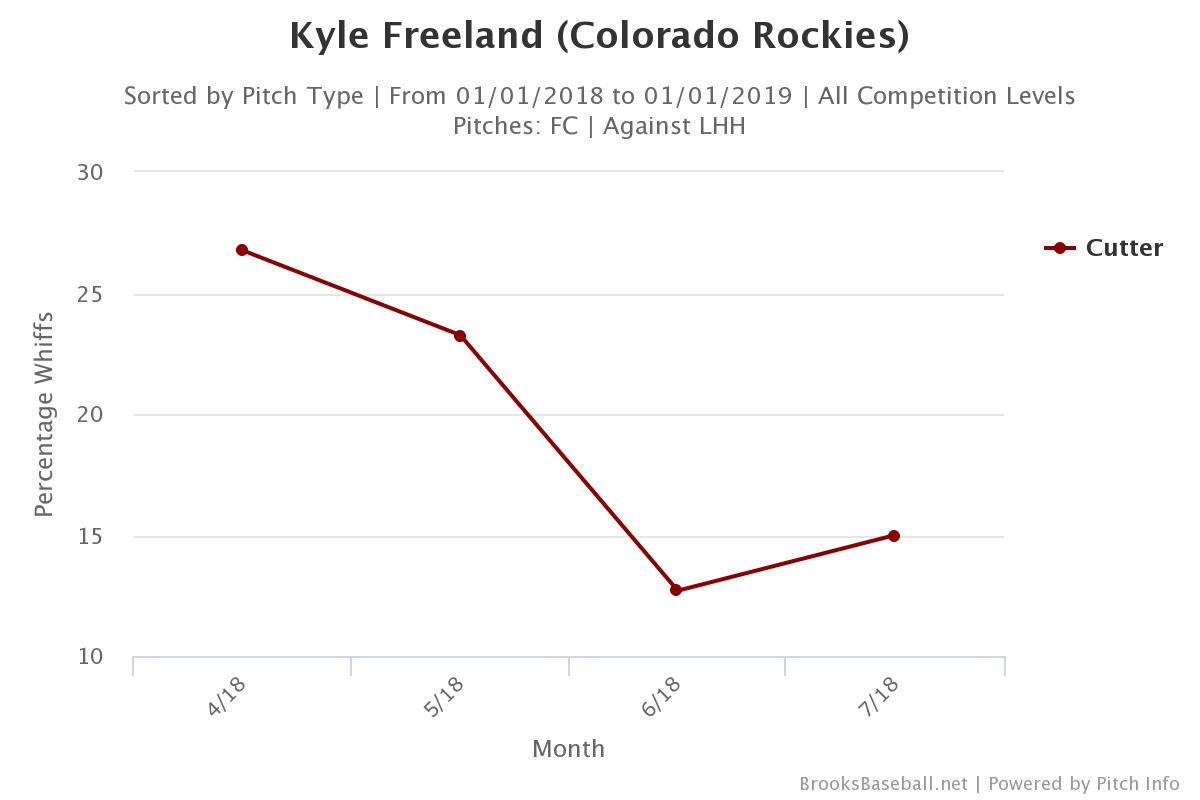
This is indicative of his overall performance. Against left-handed batters, he has a 27.8 K% this season; versus righties, he sits at a fairly ugly 16.0 K%. However, he's having trouble getting even lefties to swing and miss lately. Take a look at his cutter's whiff percentage by month this season, and note the dip in June and July:
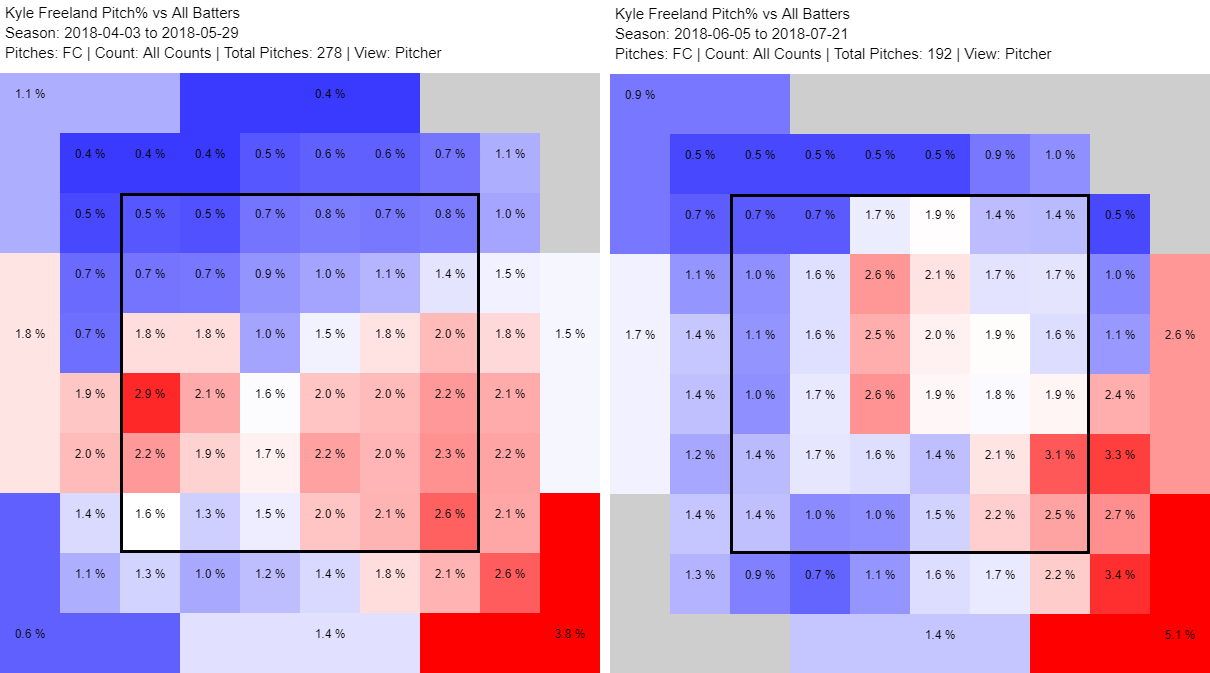
Freeland is getting slightly less horizontal and vertical movement on the pitch than he was in April and May, which is undoubtedly playing a factor. But his location has also been less crisp with the pitch in the last two months. Take a look at the heat maps below, and note how he's missing down and away to his gloveside more often (April and May on the left, June and July on the right):
Freeland has largely succeeded with command, particularly of his four-seam fastball. Control problems have crept in during certain starts, but his walk rate sits at 8.2% for the season, down one percentage point from last year and just below the league average. Unfortunately, that doesn't translate to much help in the strikeout category for fantasy owners, especially with his cutter being less effective. It also makes Freeland more prone to bad luck, and his .270 BABIP figures to come up along with an unsustainable 80.7% strand rate. He limits hard contact (30.5%) and forces a lot of groundballs, which helps him limit home runs, but the lack of strikeouts makes him more unpredictable from a game-to-game basis.
Freeland's peripherals (4.10 FIP, 4.34 xFIP, 4.47 SIERA) scream for further regression, and it figures to come one way or another even if he begins to strike out hitters at the rate he did earlier in the season. Many fantasy players try to sell Rockies pitchers high as a general rule, and that should certainly be the case with Freeland. He's a quality pitcher, but probably not as good as his ERA would lead you to believe.
All stats as of Sunday, July 22.