




 RADIO
RADIO







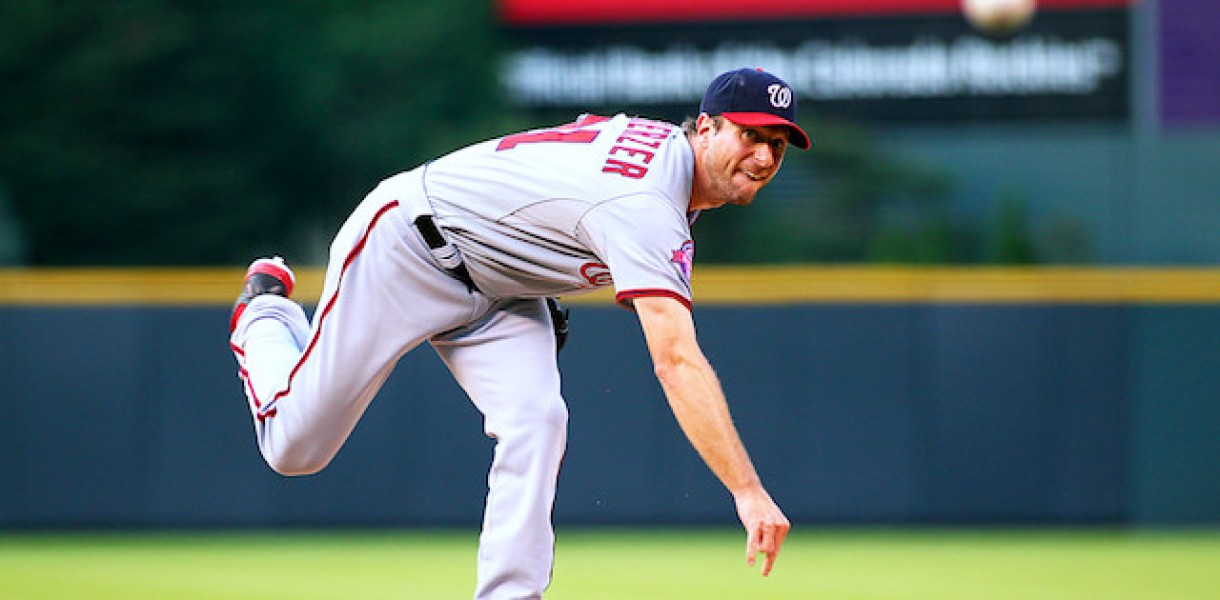
In Part 11 of his fantasy baseball strategy series to make sabermetrics accessible to fantasy owners, Rick Lucks breaks down how to use Pitch Info data to identify pitching sleepers and busts.
One of the most fundamental questions in fantasy sports is if a player's current performance is sustainable. More than any other sport, baseball has a slew of statistical measures that can be dissected in numerous ways to analyze player performance.
Pitch Info is a publicly available pitch tracking system that provides a lot of different data to help fantasy owners make this determination for mound breakouts and busts alike.
In this article, we'll look at how to effectively use this data to give you an edge in your fantasy baseball league throughout the season.
Featured Promo: Save 50% off the regular price with discount code CHAMP, for a limited time. Exclusive access to our Team Sync platform, DFS cheat sheets, Lineup Optimizers, betting/prop picks, and exclusive content from Nick Mariano and Eric Cross! GAIN ACCESS NOW
How to Interpret Pitch Info Data
The first data point, and the easiest to understand, is velocity. Generally speaking, a pitcher that loses fastball velocity is losing something to either an undisclosed injury or the aging process. Pitchers that gain velocity can expect to increase their production. For example, Seth Lugo of the New York Mets shifted to a relief role and increased his average fastball velocity from 91.8 mph in 2017 to 94.3 mph last season, striking out more batters (25.1% K% vs. 19.5% in 2017) as a result. His overall effectiveness benefited immensely (2.66 ERA in 2018 vs. 4.71 the year before).
When evaluating a pitcher's velocity, you should always look at his baseline velocity as opposed to an arbitrary league average. Lugo's 94.3 mph wasn't all that impressive by modern standards, but it clearly allowed him to take his game to a new level. Other variables like movement and location also matter, but velocity is a good introduction to using Pitch Info data.
Slightly more advanced is pitch mix, or what pitches a pitcher throws and how often he throws them. A pitcher may improve his production by abandoning a poor pitch or developing a new, effective one. This is a good stat to consult if a pitcher sees a sharp change in his K%, as a change in pitch mix could represent the change in approach that supports the new number. If the change does not have a corresponding pitch mix shift, it may be less sustainable.
For example, consider Boston's Nathan Eovaldi. His K% increased last year relative to his career, 22.2% to 17.6%. Was this the result of random fluctuation, or did Eovaldi change his pitch selection to bring it about?
Eovaldi famously added a cutter to his repertoire in 2018, featuring it heavily (7.3% thrown in 2017, 32% last year) at the expense of his 4-seamer (48.1% to 39.8%), slider (17.7% to 11.8%), and split (22.9% to 13.1%). Pitch Info tracks each pitch's individual results, so any change in pitch selection can be evaluated by comparing the historical performance of the pitches in question.
At first glance, Eovaldi's cutter looks like a good fastball. It induced a decent number of whiffs (9% SwStr%) and posted an excellent 61.9% Zone%, suggesting that Eovaldi could use it effectively in the strike zone. Hitters who put it in play had middling results (.252/.299/.434). It's a solid pitch.
However, his straight fastball looked better in 2018. Its Zone% (58.3%) was comparable to the cutter's, while it was better by both SwStr% (10.7%) and results on balls in play (.206/.246/.321). You might think that Eovaldi's new cutter was nothing more than a distraction from a superior offering.
Of course, adding a new weapon is probably what made Eovaldi's fastball play up in the first place. Over his career, Eovaldi's heater has not produced many whiffs (6.8% SwStr%) and tends to get hit hard when put into play (.283/.355/.419). Adding a new weapon appears to have made Eovaldi less predictable, helping his existing pitches play up.
Pitch Mix
The same type of analysis may be performed for a number of other stats, including BABIP, FB%, LD%, GB%, and HR/FB. There is no point in looking at a league average pitch mix, as every pitcher owns a different arsenal. All of these variables may be considered over a pitcher's complete repertoire to determine how good he is (or should be) without relying on any conventional metrics. This can be good for identifying sleepers, as pitchers that have one or two standout pitches could break out by simply using them more often. Let's have some fun with our example and look at Max Scherzer's arsenal.
Scherzer threw five different pitches in 2018: a fastball 50% of the time, a slider 16%, a change 15.7%, a cutter 10.7%, and a curve 8%. All five are significant enough sample sizes to include in our analysis.
His fastball registered a Zone% of 61.9%, meaning that Scherzer never needs to walk a guy if he doesn't want to. It also generated an incredible 14% SwStr% en route to his 300 strikeout season, and batters who put it in play really didn't fare much better (.198/.248/.320). It's easily the best fastball in the game today for reasons that we will look at in a future article.
Still, Scherzer gets even more whiffs with his breaking stuff. His slider posted an insane 26.9% SwStr% last year, stealing strikes in the zone (50.6% Zone%) as well as outside of it (53.1% chase rate). If a hitter actually manages contact, he's still probably out (.193/.231/.364 triple slash line). Nor is his slider too predictable in pitcher-friendly counts, as Scherzer can also end a PA with his change (16.8% SwStr%, 32.4% Zone%, 40.7% chase, .126/.208/.192 line) or cutter (16.2% SwStr%, 49% Zone%, 50.8% chase, .205/.271/.466 line).
His curve isn't quite as good (6.1% SwStr%, 45% Zone%, 23.5% chase, .283/.327/.565), serving Scherzer as more of a show-me pitch than a real weapon. His arsenal is still elite though.
What is the baseline for this type of analysis? It depends on the observer, as there are almost as many ways to interpret this data as there are data points to consider. The league average O-Swing% was 30.9% in 2018, and most good wipeout-type pitches need to beat this number substantially. The overall Zone% was 43%, including pitches like splitters in the dirt and high fastballs that were never intended as strikes.
The fastball will always be inferior in results to pitches that do not need to live in the strike zone, like Scherzer's change, as pitches hit outside of the zone offer better results than offerings in the hitting zone when they are put into play. However, getting ahead in the count is necessary to make those pitches work as intended, making (sometimes) mediocre fastball results a necessity.
It is dangerous to generalize, but 2-seam fastballs and sinkers tend to stink for fantasy purposes. They're usually in the strike zone, but get hit harder than fastballs. They may post strong GB% rates, but also have high BABIPs and scary triple slash lines. Any sinker hit in the air was probably a mistake, so the HR/FB rate is usually high for the limited number of fly balls hit against them. Their SwStr% rates also tend to be poor. Overall, fantasy owners prefer a fastball or cutter to be the strike zone pitch in a pitcher's repertoire.
Personally, I like a fastball with a SwStr% of around 9% and a Zone% of at least 53%. Many pitchers succeed with a lower Zone%, but I can't stand watching walks. I then look for a wipeout pitch that offers a SwStr% of at least 15% and an O-Swing% of 40%. Ideally, there is a secondary K pitch, like Scherzer's change, that prevents the 0-2 pitch from being too predictable. Only aces really fulfill all of these criteria, but I can dream, right?
Conclusion
To conclude, Pitch Info tracks a lot of data of interest to fantasy owners, including average velocity, pitch mix, and individual pitch results. All of this data may be used to predict who will break out or which breakouts can sustain their current performance. The next entry in this series will discuss another variable to consider when determining the potential of a pitcher's repertoire: spin rate.