




 RADIO
RADIO






Elliott Baas looks at some starting pitchers who turned in surprising starts recently. These SP could be sleepers and waiver wire targets, or simply mirages.
Welcome to our Surprising Starts series, where every week we look at lower-owned starting pitchers who have performed unexpectedly well in their last outing(s).
Major league batters are striking out at an astounding 23% clip so far this season, which has resulted in plenty of unheralded hurlers racking up massive strikeout totals. We're looking at three high upside arms this week in Max Fried of Atlanta, Freddy Peralta of Milwaukee, and Matthew Boyd of Detroit. We've got two top prospects with a killer pitch and control issues, and one 28-year-old attempting to ascend from the ranks of junkballer to an effective starter.
Ownership is based on Yahoo leagues and is accurate as of 04/08/2019. The goal of this article is to look at pitchers widely available that could be useful in fantasy, however this week both Freddy Peralta's and Matthew Boyd's ownership skyrocketed after this analysis was written. They are still out there in over 40% of leagues, but in case you already added one these arms, this article will help you determine whether you bought a lemon.
Featured Promo: Save 50% off the regular price with discount code CHAMP, for a limited time. Exclusive access to our Team Sync platform, DFS cheat sheets, Lineup Optimizers, betting/prop picks, and exclusive content from Nick Mariano and Eric Cross! GAIN ACCESS NOW
Max Fried, Atlanta Braves
18% Owned
2018 Stats: 33.2 IP, 2.94 ERA, 3.77 SIERA, 2.2 K/BB ratio
04/04 vs. CHC: 6 IP, 1 H, 0 ER, 0 BB, 5 K
Fried turned heads in his Thursday start against the Cubs, as he was perfect through the first 5.2 innings of the game and ultimately held the Cubs to just one single over six innings. Fried mostly got it done with his fastball-curveball combination, and Fried boasts an above-average offering with each pitch. His fastball sits around 94.5 MPH and can top out around 97-98 MPH. That’s exceptional velocity for a left-handed pitcher since southpaws typically throw softer compared to right-handed pitchers. The true gem of Fried’s arsenal is his nasty curveball. Fried’s 77 MPH looping hook is the reason he got attention as a prospect, and the pitch has been quite impressive in Fried’s limited big league average. Here are a few examples from this start.
The first one to David Bote was about as pretty as curveballs get, and there’s nothing Bote can do but take a seat after that pitch. The second one to Kyle Schwarber dropped in towards the top of the zone, but Fried caught Schwarber looking fastball and tied him up with that one. That’s not something Fried could get away with against a strong righty, but Schwarber’s struggles against southpaws, and against breaking balls, have been well documented.
Sure, Fried’s curveball is pretty to look at, but just how does it measure up from a numbers standpoint? For starters, it has averaged 10.7 inches of drop throughout his big league career, which is nearly twice the league average. Furthermore, Fried’s curveball averages about 2800 RPM, which is also significantly above the league average. To put things in perspective, Fried’s curveball has better drop and a similar spin rate to Rich Hill, who’s curveball is considered one of the game’s best. Batters have struggled against the pitch as well, hitting just .188 with a 17.3% whiff rate against Fried’s curveball all time. Combined with his above average four-seamer Fried has two solid pitches to work with as a starter.
While it’s great that Fried has two effective weapons, they are his only two weapons, which could make it tough for him as a starter. His fastball and curveball are enough to get lefties out, but he could struggle against righties without a third pitch. He played around with an ineffective changeup last year, but right-handed batters hit .421 against the pitch with a 93.2 MPH average exit velocity last season. It was a small sample size. All of Fried’s big league numbers are still small sample sizes, but the pitch hasn’t proven to be the answer for Fried so far. His curveball was still effective against righties last season and in this start against the Cubs, but he could run into problems without a third pitch, especially third time through the order.
Fried’s other big flaw is his lack of control and tendency to issue walks. He routinely had a walk rate above 10% in the minor leagues and has an 11.8% walk rate in his big league career. Quite frankly, it was shocking to see him walk zero batters in his most recent start. Fried had never had a zero-walk start in the majors prior to this game. Hmm…a left-handed starter with prospect pedigree, a renowned curveball, and walk issues. This sounds an awful lot like his teammate, Sean Newcomb. We’ve seen how good things can go for Newcomb when he’s on, and how poorly things go for him when he loses control. Fried’s curveball is a little different from Newcomb’s; it’s slower and has more drop, which results in a better whiff rate and groundball rate for Fried. Newcomb has a career 11.2-degree average launch angle against, while Fried has a 0.7-degree average launch angle against. Fried will probably be inefficient with his pitches and run into walk trouble like Newcomb, but he's also better equipped to escape self-inflicted jams compared to Newcomb.
Verdict:
The curveball and fastball are legit, and Fried could be a good source of strikeouts if he remains in the rotation. His control leaves much to be desired and he lacks an effective third pitch, which could result in troublesome platoon splits and make it tough for him to make it deep into ballgames. There is upside here, but Fried is still a work in progress both from a control and repertoire standpoint. This is a really fun pitcher to watch but could be frustrating to own at times. He’s worth a speculative add for owners with a free bench spot, but his next start comes in Coors Field, and he should not be used in that game. After that, he can be used based on matchups and reassessed based on performance, if he lasts in the Braves rotation.
Freddy Peralta, Milwaukee Brewers
51% Owned
2018 Stats: 78.1 IP, 4.25 ERA, 3.99 SIERA, 2.4 K/BB ratio
04/03 @ CIN: 8 IP, 2 H, 0 ER, 0 BB, 11 K
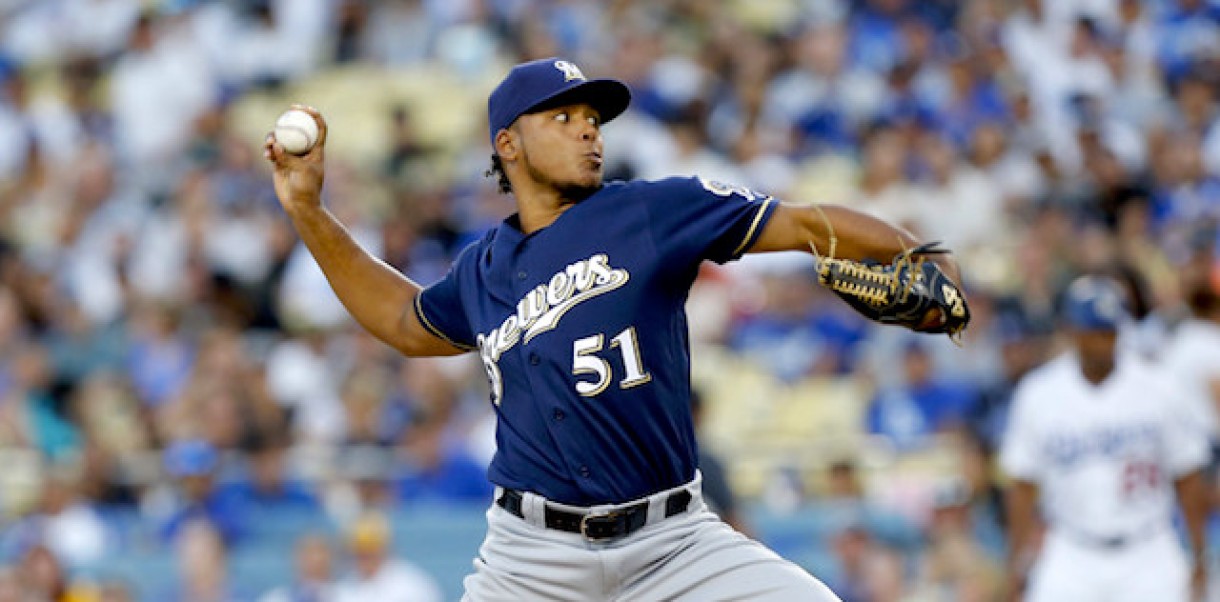
Fastball Freddy was at it again last Wednesday, absolutely dominating the Reds lineup over a career-high eight innings. The 11 strikeouts were impressive, but perhaps even more impressive were his zero walks allowed. Like Max Fried, Peralta has had control issues throughout his professional career, and this was just his second big league start where he did not walk a batter. For those unfamiliar with Peralta’s pitching style, let’s just say his catcher typically throws down one finger. Peralta threw 106 pitches in this start, 90 of which were fastballs.
For his career, Peralta has thrown his four-seam fastball 78.1% of the time, his curveball 19.1% of the time, and his changeup 2.7% of the time. He throws his changeup so infrequently it almost looks like an accident when he does throw it, like he intended to throw a fastball but didn’t get enough on it. Peralta’s fastball sits around 92-93 MPH but he can routinely crank 95-96 when needed. While his pitching style is certainly atypical, especially in today’s breaking ball heavy game, Peralta succeeds by mixing speeds and changing grips with his four-seamer.
In 2018 Peralta’s fastball had a max velocity of 96.1 MPH and a min velocity of 84.8 MPH, which lends credence to my theory that many of Peralta’s changeups are just accidental fastballs. Peralta also has a deceptive delivery that helps his velocity play up and appear like he’s throwing harder than his average of 92-93 MPH. While information like this isn’t hard, tangible data that we typically prefer in player analysis, the proof is in the numbers.
Peralta’s fastball generates whiffs and strikeouts at an above average rate, and Peralta routinely had a strikeout rate above 30% throughout his minor league career. It’s understandable for owners to be skeptical of his pitching style; this writer certainly was when Peralta first came onto the scene, but he’s maintained elite strikeout numbers throughout his professional career, and he wasn’t dominating the minors with his curveball or changeup.
Peralta’s curveball, while not his feature pitch, is better than one might think for how little he relies on it. He threw 15 curveballs in this start and got five whiffs with the pitch. The pitch has above-average drop and can catch hitters off guard after being fed a steady diet of fastballs. Here are a few examples from this start.
If you can make Joey Votto look like a fool, you’re doing something right on the mound. The second curveball to Yasiel Puig is a great pitch to deliver in a 2-2 count, since Puig almost has to sit fastball in that situation thinking Peralta wants to avoid the full count. The fastball is the main course for Peralta, but this curveball is a hearty side dish that could be featured more often if Peralta desired.
The problem with Peralta, much like Max Fried, is a lack of control and the inherent volatility that comes with it. Peralta also lacks a third pitch, and unlike Max Fried, Peralta seems uninterested in developing one. This will lead to short outings, poor outings, and frustrating days for Peralta’s owners. Part of the problem is, these bad starts could come at any time against any lineup because he could simply “not have it” on any given day. It’s also worth noting that the team Peralta carved up has been putrid to start the season, as the Reds have a .509 OPS and 32 wRC+ collectively thus far in 2019. He contributed to those poor stats considering the small sample size, but most of the Reds best hitters are slumping out of the gate.
Verdict:
There is massive strikeout upside here, greater than 30%, which would have put him in the top ten among qualified pitchers last season. There are still control issues with Peralta, and he only has two pitches, which could lead to problems going deep into games. This eight-inning start, while encouraging, doesn’t squash those worries completely. Peralta should probably be owned in most leagues, at least as a speculative bench player, but he’s one of the most volatile pitchers in baseball, and that’s not changing anytime soon. He’s got a good matchup next time out against the Angels, and he’s a good start in that game considering how bad their lineup has been other than Mike Trout.
Matthew Boyd, Detroit Tigers
58% Owned
2018 Stats: 170.1 IP, 4.39 ERA, 4.31 SIERA, 3.12 K/BB ratio
04/03 @ NYY: 6.1 IP, 5 H, 1 ER, 3 BB, 13 K
Boyd fanned a career-high 13 batters last Wednesday against the Yankees, and did it while piling up a whopping 26 swinging strikes on 100 pitches. Boyd got it done primarily with his fastball and slider, as he threw those two pitches a combined 85 times and netted 23 of the 26 swinging strikes with them. The slider has been Boyd’s key to success, and he began taking a new, slider-heavy approach in 2018. Before 2018 Boyd was the exact type of pitcher nobody wanted in fantasy. He had a strikeout rate below 20%, walked too many batters, and gave up a ton of long balls. He’s still guilty of a few of those flaws, but Boyd put up a career-high 22.4% strikeout rate in 2018 thanks to increased slider usage. He threw his slider 31% of the time in 2018 after throwing it 11% in 2017, and the pitch also changed. He slowed it down considerably, from an average of 86 MPH to 80 MPH. He also gained two inches of drop and two inches of horizontal movement with the pitch. While his overall statistics were still underwhelming, Boyd’s slider became considerably more effective in 2018. Batters hit just .172 against the pitch with a 16.5% whiff rate last year. With the changes to this pitch along with an increased strikeout rate it looks like Boyd is taking the route so many pitchers have taken over the last few years, ramping up their breaking ball usage and pitching less off their fastball.
The easiest comparison for what Boyd is doing would be Patrick Corbin. While it would be unrealistic for us to expect Boyd to put up Patrick Corbin-type numbers, as Corbin is just better stuff-wise, Boyd seems to be following the same path. Does that mean we can expect Boyd’s 48% strikeout rate to hold? Of course not, but he could potentially maintain a 23-25% strikeout rate with this approach. With just a few exceptions (Dylan Bundy, Lance Lynn, Vince Velasquez), practically every starting pitcher with a strikeout rate above 23% was worth owning in 2018. Strikeouts are such a valuable skill in fantasy baseball that’s Boyd deserves to be owned in basically every league.
There are still flaws in Boyd’s game, specifically in regard to walks and home runs. His control isn’t quite as bad as Max Fried or Freddy Peralta, but he can get a little wild at times. The real thing to worry about with him is a chronic case of Gopheritis, one that has plagued him throughout his career. Boyd has a career 1.51 HR/9, which is the third highest among active starters (min. 400 IP) behind just Dylan Bundy and Josh Tomlin. Part of it is inherent to his pitching style. Boyd is an extreme fly ball pitcher, and his 46.1% flyball rate is the second-highest among active starters behind Marco Estrada. Pretty much every pitcher with a fly ball rate above 40% either has home run issues or is named Max Scherzer or Justin Verlander. Even Scherzer and Verlander, if one had to nitpick, tend to give up a lot of home runs relative to pitchers in their tier. Playing in Detroit, and playing in the AL Central, will help Boyd limit the damage, but expect home runs to be a problem for him. He’s someone that should be sat in tough matchups and tough ballparks, which would’ve meant missing out on this great start against the Yankees, but Boyd hasn’t earned that level of trust yet.
Verdict:
Boyd has increased his slider usage to above 30% and the strikeouts have followed. He should be able to maintain an above-average strikeout rate with this approach, but problems with home runs and walks could cause trouble with his ratios. Boyd should be added in all leagues, but it’s hard to trust him in hitter-friendly ballparks against teams with lots of power hitters. The good news is that his next three starts are all at home against Cleveland, Pittsburgh, and the Chicago White Sox. Boyd can prove a lot, one way or another, in those three starts.