



 RADIO
RADIO










Jamie's fantasy baseball starting pitcher busts to bounce back in 2026. Fantasy managers should consider drafting these starting pitcher sleepers and values.
Placing your trust in a starting pitcher who burned you last season isn't easy. There's usually a reason pitchers struggle and fail to live up to expectations. Sometimes they were overhyped. Sometimes they were dealing with an injury. Sometimes they were just unlucky.
Here, we will be looking at five starting pitchers who underperformed in 2025 but are set to rebound in 2026. For whatever reason, they didn't return value last season. We'll look at what went wrong and why they are set to be a productive performer in fantasy this year. And deserve a second chance!
While we're not declaring the five as SP1's, they are all set to outperform their ADP (Average Draft Position). All ADP is taken from NFBC drafts as of March 1. Don't forget to download our free mobile app with alerts and to follow the RotoBaller team on X for all your offseason news and articles.
Featured Promo: Save 50% off the regular price with discount code SUMMER, for a limited time. Exclusive access to our Team Sync platform, DFS cheat sheets, Lineup Optimizers, betting/prop picks, and exclusive content from Nick Mariano and Eric Cross! GAIN ACCESS NOW
Dylan Cease, Toronto Blue Jays
ADP 79
Cease went from being drafted as an SP1 in 2025 to barely cracking the top-20 starters being drafted in 2026. After his numbers last season, you may have thought he'd be falling even more. In 32 starts, Cease had an 8-12 W-L record, 4.55 ERA, 1.33 WHIP, and 215 Ks (168 IP).
The reason Cease is still being drafted as an SP2 is his floor. Even with last season's disappointing ERA, he made 32 starts for a fifth consecutive season. It was also the fifth straight year in which Cease reached 200 strikeouts. To get back into the SP1 conversation, Cease needs to lower his ERA. A lot.
That might not be as difficult as it seems. Cease was actually very unlucky in 2025. His 3.56 xFIP, 3.58 SIERA, and 3.45 xERA all point towards Cease having a better ERA than he did. If we compare Cease's numbers in 2024 to 2025, we can see how similar his two seasons in San Diego were.
| Year | GS | IP | W-L | ERA | xERA | xFIP | SIERA | K% | BB% |
| 2024 | 33 | 189.1 | 14-11 | 3.47 | 3.31 | 3.44 | 3.46 | 29.4% | 8.5% |
| 2025 | 32 | 168.0 | 8-12 | 4.55 | 3.45 | 3.56 | 3.58 | 29.8% | 9.8% |
You can point to Cease's increased walk rate. That doesn't justify a jump of 1.08 in his ERA. Of the 107 pitchers who faced 500+ batters, the difference between Cease's ERA and xERA was the second-highest. Of the 52 qualified pitchers, the difference between Cease's FIP and ERA was the fourth largest.
However we look at it, Cease was unlucky. Although not quantifiable, we do have to factor in a new home for Cease. While it does give people a reason not to take Cease too early, there's little reason to believe Cease can't put up similar numbers to what he had in 2024.
If Cease's first year in Toronto is like his first season in San Diego, he will more than likely be a top-12 starting pitcher at the end of the year. If you are going to wait before taking your first pitcher in drafts, Cease ticks all the boxes to be an anchor in your rotation and move back into being an SP1.
Sandy Alcantara, Miami Marlins
ADP 150
Alcantara returned from Tommy John Surgery (TJS) last year. That resulted in him largely going right around pick 150. As you'd expect, Alcantara had a down year in 2025. However, there was enough encouragement to suggest Alcantara can get back towards something near his pre-injury self.
Despite missing all of 2024, Alcantara still made 31 starts last year. And despite constantly being rumoured as a trade target, Alcantara is still a Marlin. The consistency and reliability Alcantara provides make him something of a comfort blanket for fantasy managers. But why will Alcantara have a rebound year in 2026?
First is the health. He's another year removed from TJS. It is often mentioned that a pitcher's control is lacking when they return from TJS. That will explain Alcantara's 7.7% BB% last year. It still ranked in the 55th percentile but was his highest in a full season since 2019.
Alcantara's 19.1% K% was also his lowest since 2019. While he's never been a high strikeout pitcher, that was another disappointment. The biggest disappointment was obviously Alcantara's 5.36 ERA. Similarly to Cease, Alcantara was unlucky, given he had a 4.19 xFIP and 4.38 SIERA.
Neither of those numbers is particularly eye-catching. What is eye-catching is how much Alcantara's numbers improved as the season progressed. If we compare his first half and second half numbers (below), we can see just how much better Alcantara was as the season went on.
| Split | IP | ERA | xFIP | SIERA | AVG | SLG | K% | BB% |
| First half | 91.0 | 7.22 | 4.60 | 4.79 | .271 | .440 | 17.3% | 9.0% |
| Second half | 83.2 | 3.33 | 3.73 | 3.90 | .218 | .360 | 21.3% | 6.0% |
You could argue that Alcantara was just very unlucky in the first half and slightly lucky in the second half. But there's no disguising the fact that the further removed from TJS he was, the better Alcantara's numbers were. If we look at his last 10 starts of the season, Alcantara had a 3.70 ERA, 3.51 xFIP, and 3.67 SIERA.
I'm not suggesting that we'll see the 2022 version of Alcantara again. But a ~3.50 ERA with double-digit wins and ~160 strikeouts is certainly in play. That would provide value on his ADP. If Alcantara can rediscover some magic, he can outshine most of the 50 starting pitchers being drafted before him.
Shota Imanaga, Chicago Cubs
ADP 173
After an outstanding MLB debut season in 2024, Imanaga failed to live up to expectations last year. In 2025, Imanaga had a 9-8 W-L record, 3.73 ERA, 0.99 WHIP, and 117 Ks (144 2/3 IP). His excellent WHIP was fuelled by his elite 4.6% BB%. Nothing else was what fantasy managers wanted when drafting Imanaga.
Imanaga missed almost seven weeks with a hamstring strain. That didn't seem to impact him as he had a 2.82 ERA in his eight starts before going on the IL (injured list) and a 3.43 ERA in his eight starts after returning from injury. A stronger finish to 2025 might have seen Imanaga have a lower ADP this year.
In his final six starts of the season, Imanaga had a 5.97 ERA. He allowed three earned runs in five straight starts before ending the season by giving up eight earned runs against the Mets. It was a disappointing end to what was ultimately a frustrating season.
There is reason for optimism, though. As well as Imanaga putting up stellar numbers across all but a four-week period in the majors, he's caught the eye this spring. Not because of a minuscule ERA or striking out a load of minor league hitters. It's because of his velocity.
His fastball has been reported as sitting at around 93.0 MPH in outings. Fangraphs lists his average fastball velocity as 92.6 MPH this spring. While that doesn't seem much in today's game, it's a significant increase on his average fastball velocity during his time with the Cubs, especially when looking at the 90.8 MPH average last year.
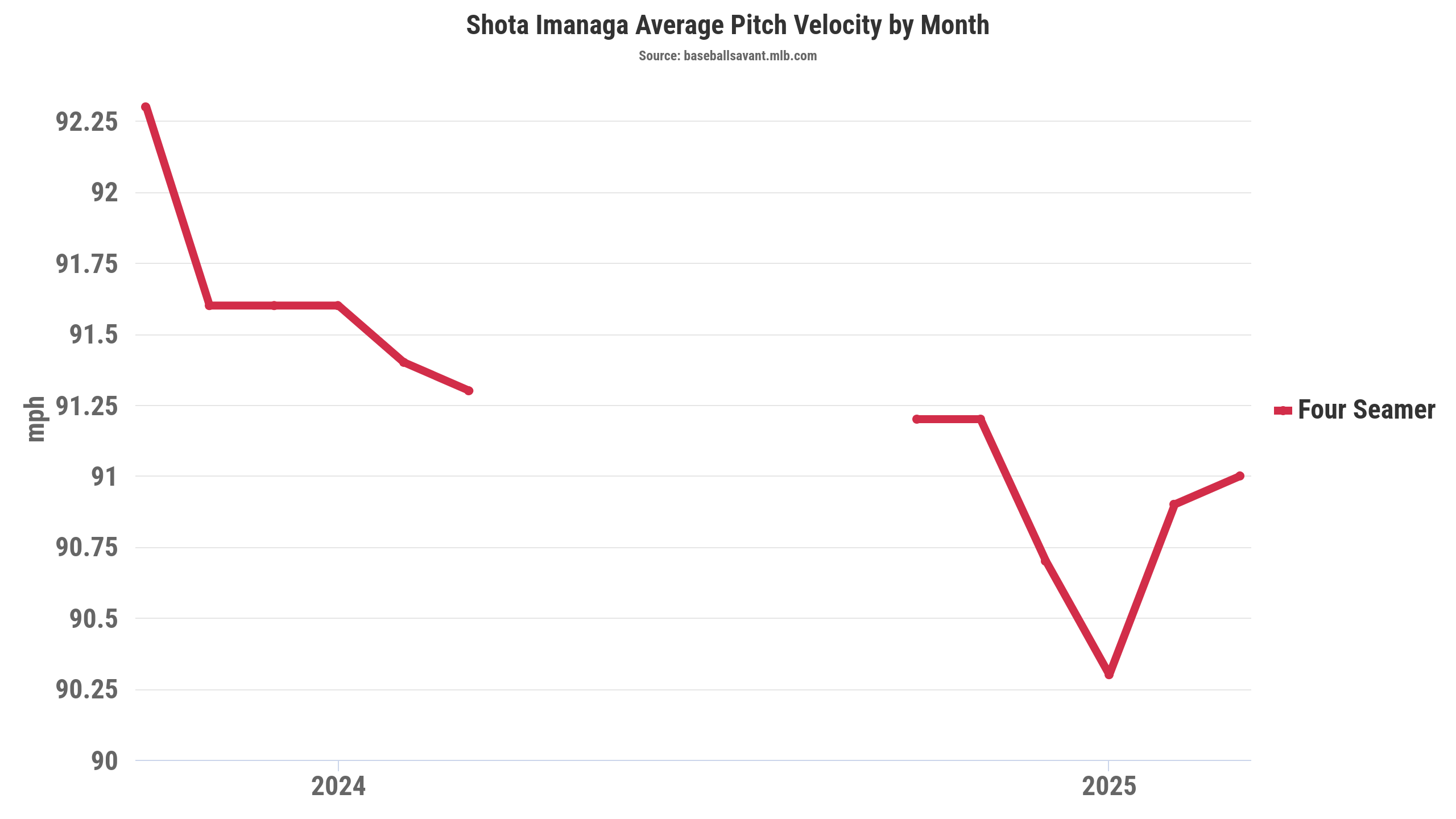
Imanaga's main secondary pitchers (a splitter and a sweeper) have also seen increases in velocity this spring. His splitter has averaged 1.4 MPH more than in 2025, and his sweeper 1.5 MPH more. While it is a small sample, velocity gains aren't something we should expect to disappear when the regular season starts.
We've seen Imanaga have success previously. If his arsenal does see a continued increase in velocity when the season starts, we could see a return to form from Imanaga. The Cubs should still win plenty of games, and that all adds up to Imanaga being set to easily provide value on his ADP.
Zac Gallen, Arizona Diamondbacks
ADP 220
Gallen's fall in the pitching rankings has been rapid. In 2024, Gallen was widely drafted as a top 10 starter. Last year, Gallen fell outside the top 30 starting pitchers being drafted. This year, Gallen is almost an afterthought, with nearly 60 starting pitchers having a lower ADP.
While that drop makes sense given his numbers last year, it might be premature to completely disregard Gallen. In 2025, he had a 13-15 W-L record, 4.83 ERA, 1.26 WHIP, and 175 Ks (192 IP). Arguably, Gallen's biggest asset is his reliability. Last year was the third time in four seasons he made at least 31 starts.
Since the start of the 2022 season, only Logan Webb (820 IP) and Framber Valdez (767 2/3 IP) have thrown more innings than Gallen (734 IP). Despite not having elite strikeout numbers, that volume also enabled Gallen to rank seventh in strikeouts in that time (743).
Of course, volume is nice. But fantasy managers will want more of a reason to draft Gallen than being one of the likeliest to make 30 starts this year. While there isn't a standout reason to suggest Gallen will return to being a top 20 starter, there isn't anything to suggest he's only a borderline top 60 starter.
Gallen's 4.12 xFIP and 4.24 SIERA last year were both better than his ERA. Not great, but still points towards some misfortune. Gallen's fastball averaged 93.5 MPH in 2025. Only slightly down from his 93.7 MPH average in 2024, Gallen had similar numbers against it.
Gallen's main secondary pitches (knuckle curveball and changeup) both had similar numbers against them in 2024 and 2025. His arsenal didn't really change, and his overall skills didn't regress by much. Certainly not to the point that his ERA should have increased by 1.18 from 2024.
We can forget about getting vintage Gallen in 2026. But the 2024 version of him was pretty good. Even with a little regression from that year, Gallen would rank better than his ADP this year. He may be a boring pick, but Gallen's volume alone offers a floor few others have that late in drafts.
Aaron Nola, Philadelphia Phillies
ADP 211
There's no possible way that Nola could have a worse year than he did in 2025. After seven consecutive seasons of not missing a start, Nola missed three months with ankle and rib injuries, limiting him to just 17 starts. When he was on the field, the results weren't good.
Nola had a 5-10 W-L record, 6.01 ERA, 1.35 WHIP, and 97 Ks (94 1/3 IP). It's fair to assume that the workload of previous seasons just wore him down. The injuries likely played a big part in his struggles on the mound. From a skills point of view, little changed last year.
If we compare his Statcast Profiles over previous seasons, there wasn't much regression in his numbers.
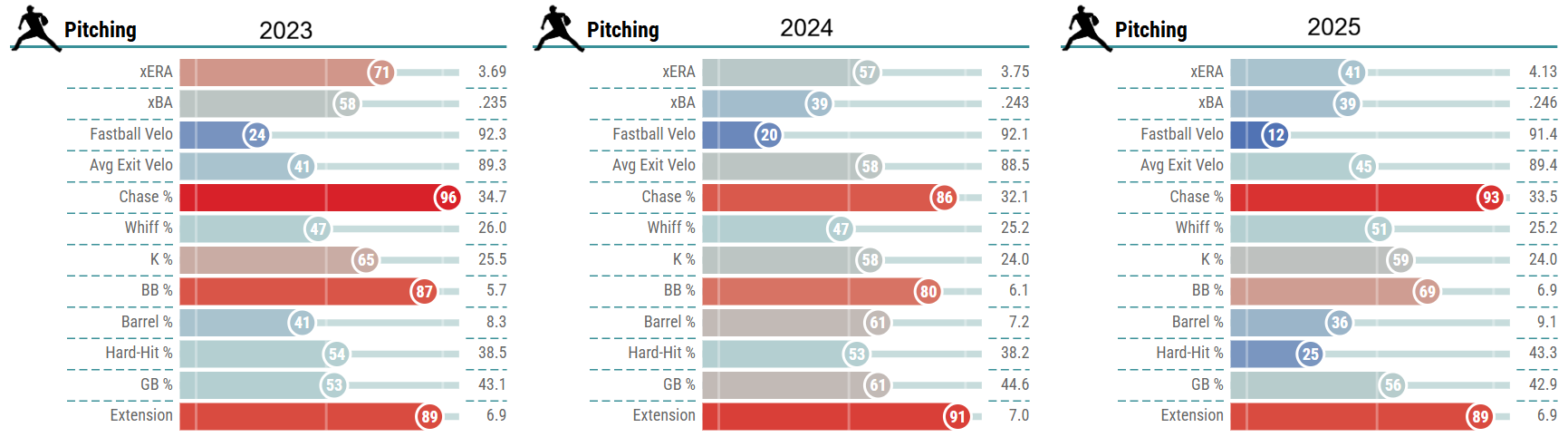
There's no point in trying to pretend there hasn't been any regression. But we also mustn't overlook some of Nola's underlying numbers. His 3.71 xFIP and 3.81 SIERA belie his 6.01 ERA. Nola still had a good command and posted decent strikeout numbers. His fastball velocity did drop, but not by much.
And the drop in velocity shouldn't be unsurprising given the injuries. It's worth noting that Nola's fastball velocity in spring has been about the same as it was in 2025. That certainly shouldn't lead to a 6.00 ERA again, and an uptick as he builds up in preseason is very possible.
Like Gallen, much of Nola's numbers and metrics last year were similar in 2024 when he had a 3.57 ERA. A return to having a 3.57 ERA might not be on the cards. Provided he can stay off the IL for a prolonged period, Nola should still be able to have a solid season and is certain to have a significantly better year than he did in 2025.
Honorable Mentions
MacKenzie Gore, Texas Rangers
ADP 175
The reason Gore isn't featured more prominently is due to the fact that his ADP is lower this year than it was in 2025. The reason that Gore is even included is down to the fact that he should improve upon his 4.17 ERA in 2025. The trade to Texas is the reason why.
The Rangers' Globe Life Field was ranked the most pitcher-friendly ballpark last year (according to Statcast Park Factors). Nationals Park was ranked the joint 11th most hitter-friendly. Gore had a 3.78 xFIP and 3.80 SIERA, so an improved ERA was on the cards. With the new home ballpark, that should be a certainty.
Will Warren, New York Yankees
ADP 307
Warren's first full season in the majors was solid. Nine wins and 171 strikeouts (162 1/3 IP) provided value to his fantasy managers. His 4.44 ERA was higher than you'd have expected given that Warren had a 3.91 xFIP and 4.08 SIERA. The problem for Warren was inconsistency.
He was prone to the occasional blow-up, something he should learn from and improve upon with experience. The biggest downside is Warren's role for the entire season. With Gerrit Cole and Carlos Rodon set to return from injury sometime in the first half, Warren may find himself in the bullpen later in the season.
Until such time, Warren should be able to put up solid numbers as a late-round pick. He'll tally strikeouts, pick up wins on a good team, and won't hurt your ERA. Warren might find himself moving up draft boards next season.
Chase Dollander, Colorado Rockies
ADP 654
This one doesn't need much analysis. Dollander's overall numbers don't warrant consideration. As you might expect, his home and road splits are stark. As we can see from the below, Dollander on the road was actually one of the better pitchers in 2025.
| Split | IP | ERA | WHIP | AVG | SLG | K% | BB% |
| Home | 46.0 | 9.98 | 1.98 | .337 | .417 | 15.3% | 10.9% |
| Road | 52.0 | 3.46 | 1.17 | .200 | .297 | 22.2% | 11.3% |
Yes, Dollander's walk rate is too high wherever he pitches. But outside of that, he can still be a fantasy asset. If you can keep Dollander on the bench at home and only start him on the road, he's well worth using your last pick of the draft on. Especially in deep leagues, ones with bigger benches, or NL-only leagues.
More Fantasy Baseball Advice
Download Our Free News & Alerts Mobile App
Like what you see? Download our updated fantasy baseball app for iPhone and Android with 24x7 player news, injury alerts, sleepers, prospects & more. All free!