




 RADIO
RADIO






Corbin's deep dive into starting pitcher fantasy baseball breakouts, waiver wire adds for Week 5 of 2026. Are these unlikely aces potential league winners?
Welcome to the fourth edition of our Unlikely Aces series in 2026. Starting pitchers have been dealing with injuries, breaking out, and struggling early in the 2026 fantasy baseball season. It's fun to stream starting pitchers and find success. However, sometimes streaming pitchers can destroy the ratios. We should have a process for any waiver wire move, start/sit decision, or player examination.
Some pitchers possess high-end skills but don't perform well. There are instances where the data and research indicate this pitcher shouldn't perform well, but the outcomes look good. After a quality outcome, fantasy managers need to decide whether it's sustainable. Throughout the season, we'll highlight starting pitchers who have been performing well and examine whether we should buy, sell, or hold.
Are these unlikely aces for real, or is it safe to leave them out on the waiver wire, with negative regression surely coming? Let's take a deeper look!
Featured Promo: Save 50% off the regular price with discount code CHAMP, for a limited time. Exclusive access to our Team Sync platform, DFS cheat sheets, Lineup Optimizers, betting/prop picks, and exclusive content from Nick Mariano and Eric Cross! GAIN ACCESS NOW
Casey Mize, SP, Detroit Tigers
59% Rostered
Editor's Note: Mize left last night's start (Tuesday April 28th) in the third inning with a groin injury, and was placed on the IL on Wednesday.
Mize has been throwing slower across the board. That's usually not an optimal approach. Mize specifically lost over one mph via the four-seamer, splitter, and slurve. Meanwhile, Mize's slider maintained a similar velocity within one mph. He has been throwing more sliders to right-handed hitters (19.5%), up from 11.7% in 2025.
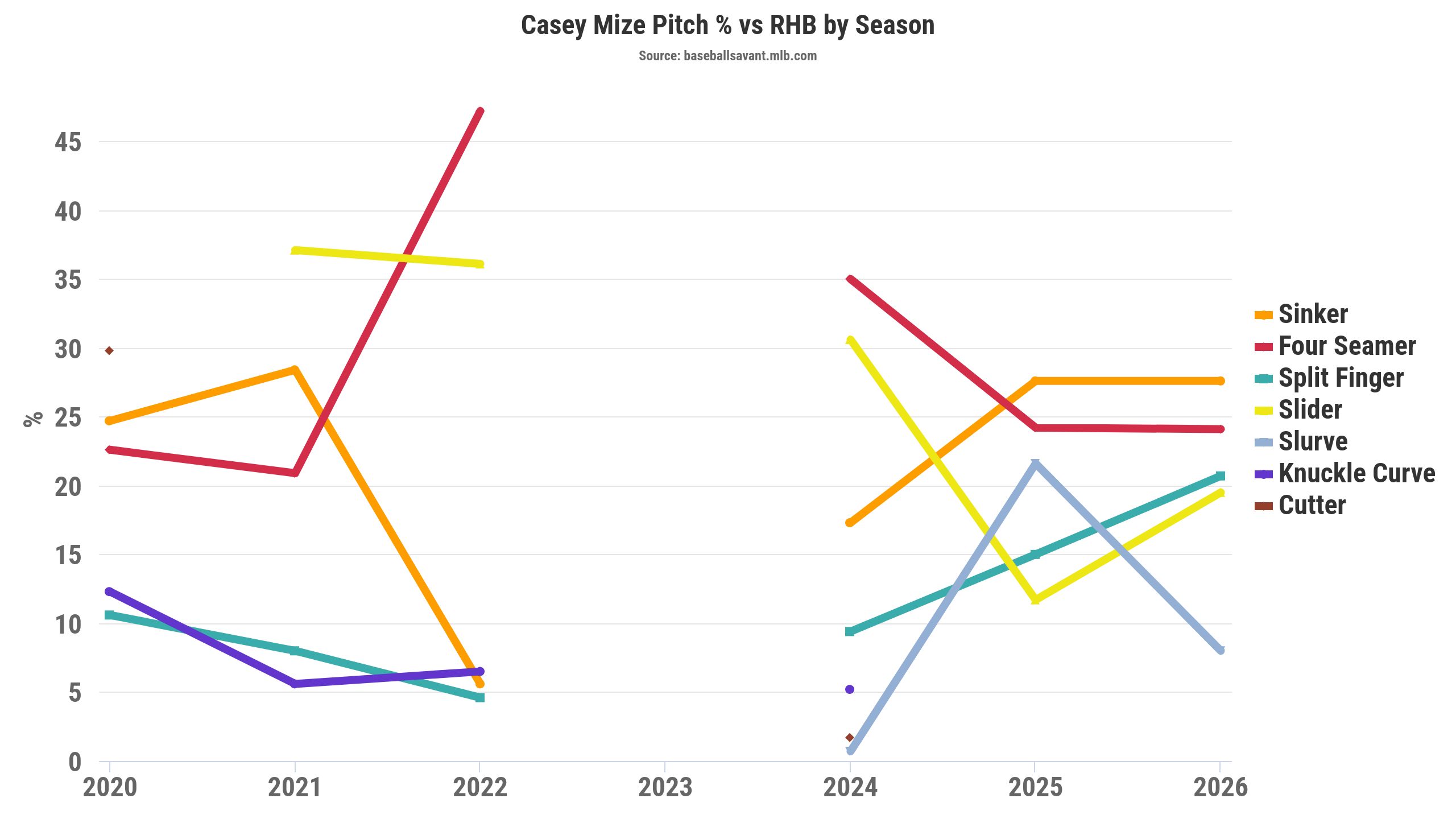
Unfortunately, Mize's slider has been hit hard, with a .455 wOBA (.475 xwOBA) against right-handed hitters. In fact, most of Mize's arsenal against righties performed poorly. For context, Mize's sinker, slurve, and slider were his three best pitches in 2025 against right-handed hitters, and most had a wOBA under .300.
Mize maintained his pitch mix against lefties, throwing the four-seamer, splitter, and slider 99% of the time. All three pitches have been more successful against left-handed hitters in 2026 than in 2025. The most significant change for the four-seam and splitter involves over one inch of arm-side fade on both pitches.
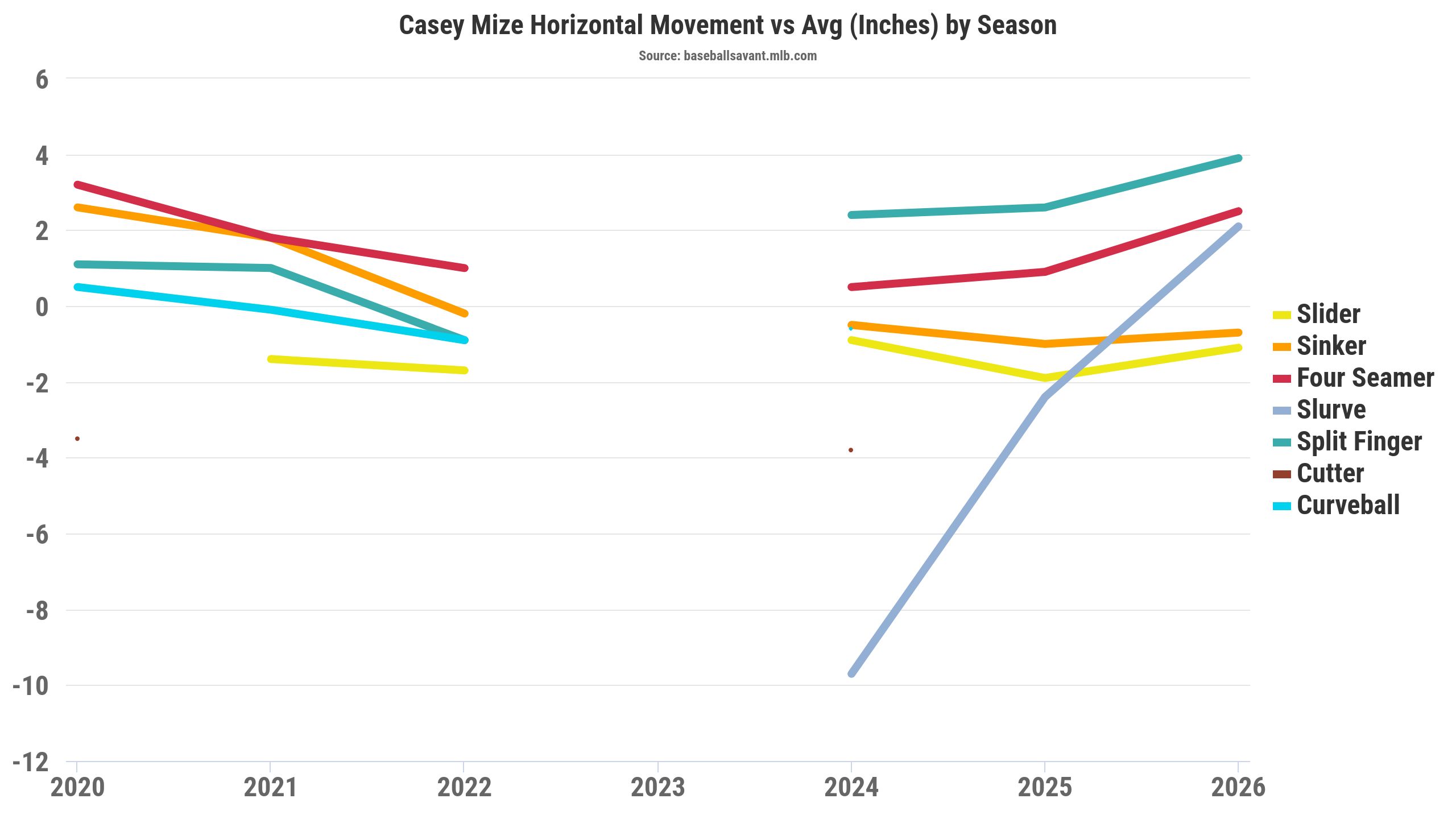
Theoretically, pitches that add horizontal movement should elicit weak contact. That's been the case via the four-seam (.250 wOBA, .287 xwOBA), splitter (.114 wOBA, .119 xwOBA), and slider (.115 wOBA, .236 xwOBA) against left-handed hitters in 2026. We could speculate on the four-seamer location changes.
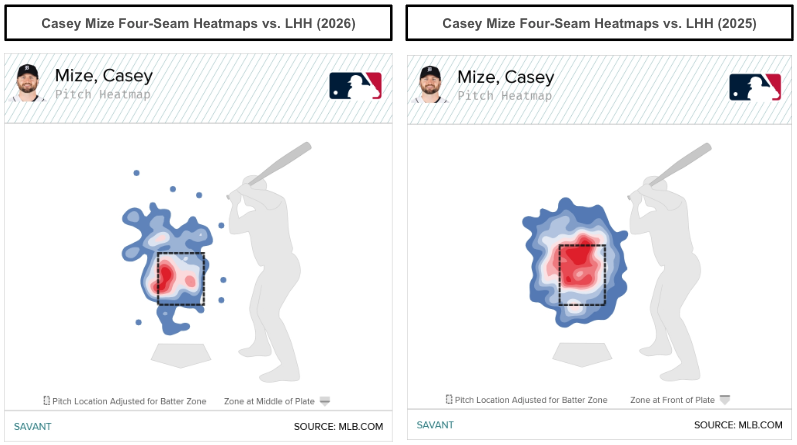
The four-seam heatmaps against left-handed hitters show Mize locating the heater mostly away from them in 2026 compared to 2025. Interestingly, the average horizontal location has only shifted 1.4 inches farther toward the outside corner.
The Location+ grades only shifted by one point, but the heatmaps look significantly different against lefties in 2026 via the four-seamer. Meanwhile, Mize's slider locations against lefties in 2026 have been similar to 2025. That said, Mize's splitter shifted slightly in terms of location in 2026.
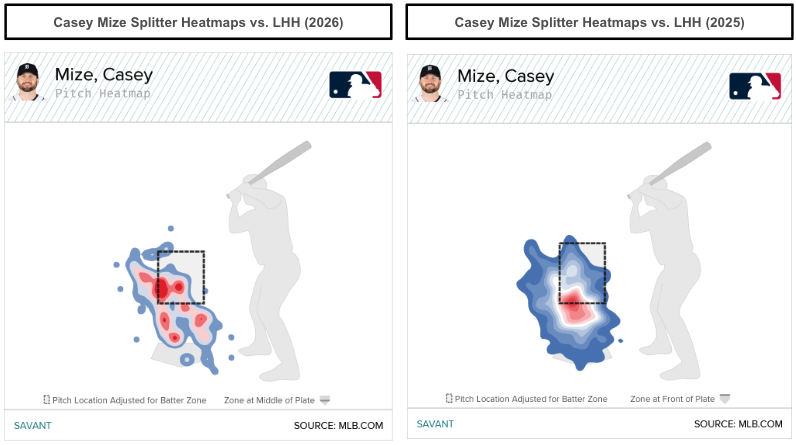
Mize's splitter has been thrown one inch lower and one inch closer toward the edge of the zone against left-handed hitters. However, it's worth highlighting that the horizontal and vertical locations were an average, and the splitter results have been nasty when in the zone.
That's evident via Mize's splitter results, given a .082 wOBA (.145 xwOBA) against left-handed hitters when thrown in the zone in 2026. For context, Mize's splitter allowed a .479 wOBA (.391 xwOBA) when thrown in the zone in 2025.
Let's discuss Mize's slider. His slider doesn't generate whiffs with a 9.4% career swinging-strike rate. However, Mize's slider locations have been consistently on the outside corner for left-handed hitters. Meanwhile, Mize's slider has been located low and inside toward right-handed hitters, but gets crushed.
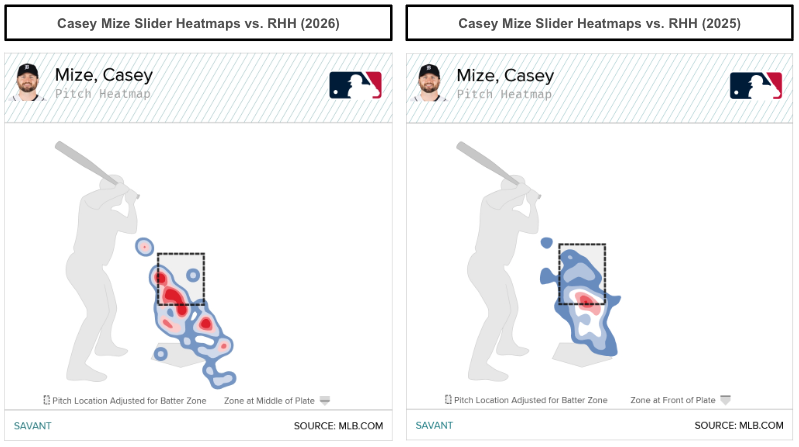
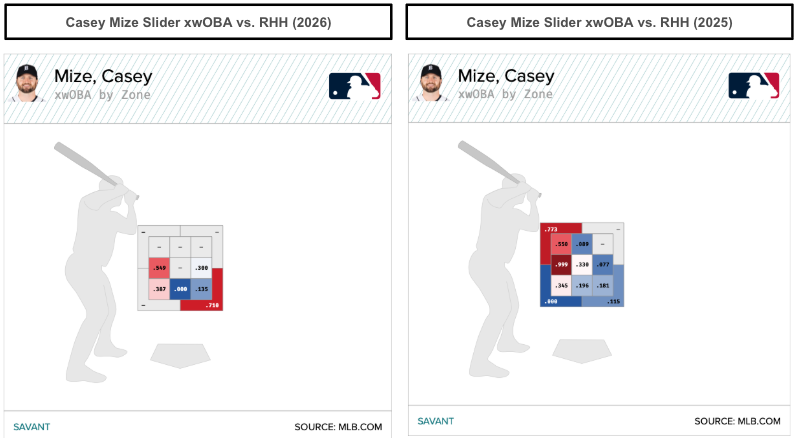
Mize's slider allowed a .455 wOBA (.473 xwOBA) against righties in 2026, significantly worse than in 2025 (.267 wOBA, .306 xwOBA). Though the slider locations work well for lefties (low and away), they don't work well against righties, as seen in the slider locations above and outcomes below.
The slider Location+ grade at 122 was the highest since 2022, showing Mize could be commanding them better in 2026. With better slider command, his Location+ fell via the splitter and sinker in 2026, leading to a six-point decline in his overall Location+.
Mize has been fortunate in the strand rate (80%) and home run rate (5% HR/F), being 7-8 points better than his career averages. The velocity dip is a slight concern. However, Mize's different pitch locations could help him outpitch his expected ERA metrics. Hold and enjoy the ride.
Jack Kochanowicz, SP, Angels
19% Rostered
Kochanowicz has been somewhat of an afterthought in most leagues, as a late-round or waiver-wire pickup. However, Kochanowicz is performing well early in 2026. He has been fortunate via the BABIP (.223) and strand rate (69.7%). Kochanowicz's BABIP has been better in 2026 compared to his career averages in BABIP (.296), with a similar strand rate (68.1%).
Kochanowicz struggles with control yet lacks whiffs. That's evident in Kochanowicz's 37-38% ball rate and 9-10% swinging-strike rate over the past two seasons. However, it's worth highlighting that Kochanowicz's changeup leads his arsenal with a 16.7% swinging-strike rate in 2026, nearly two points above his career average.
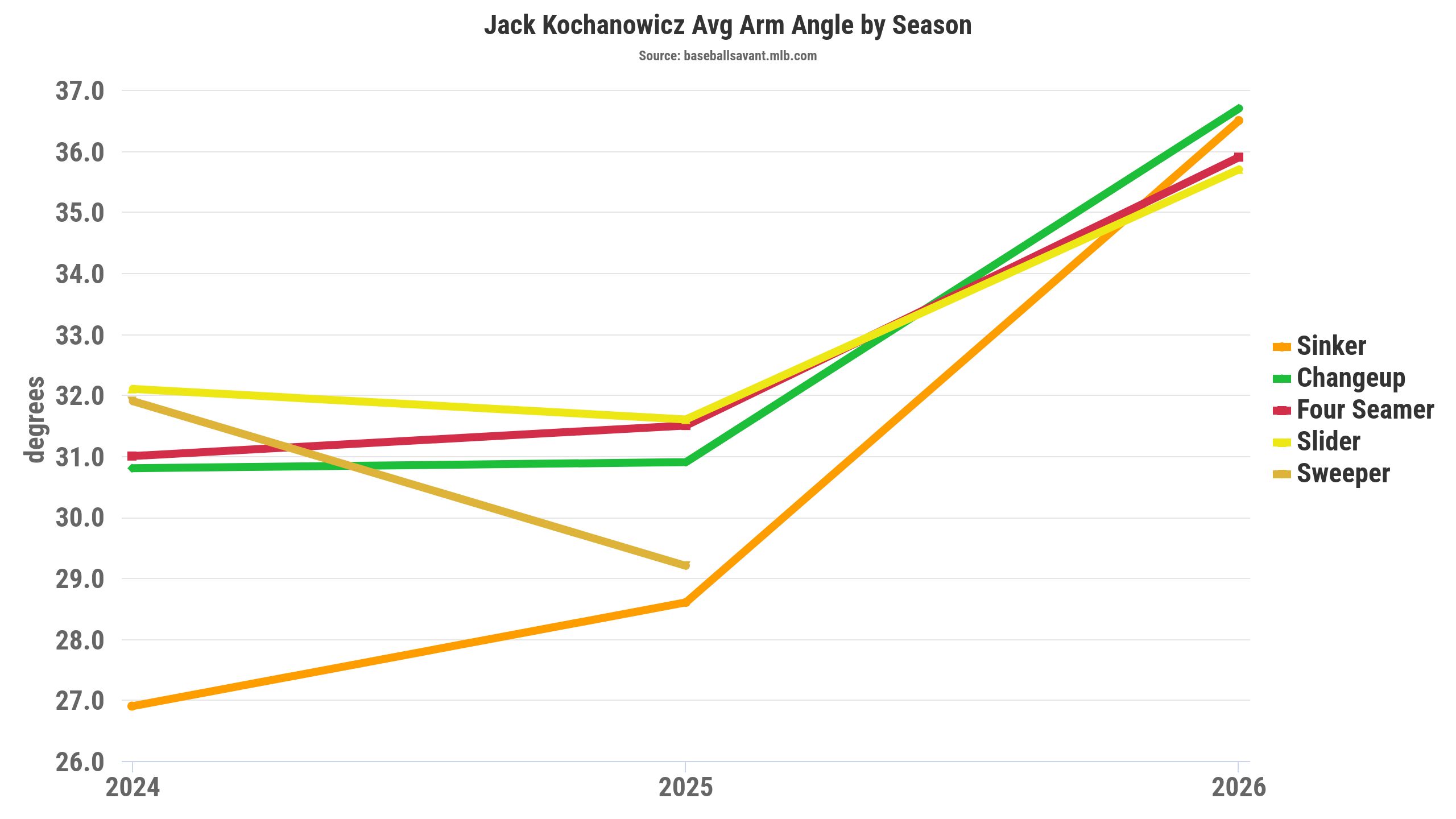
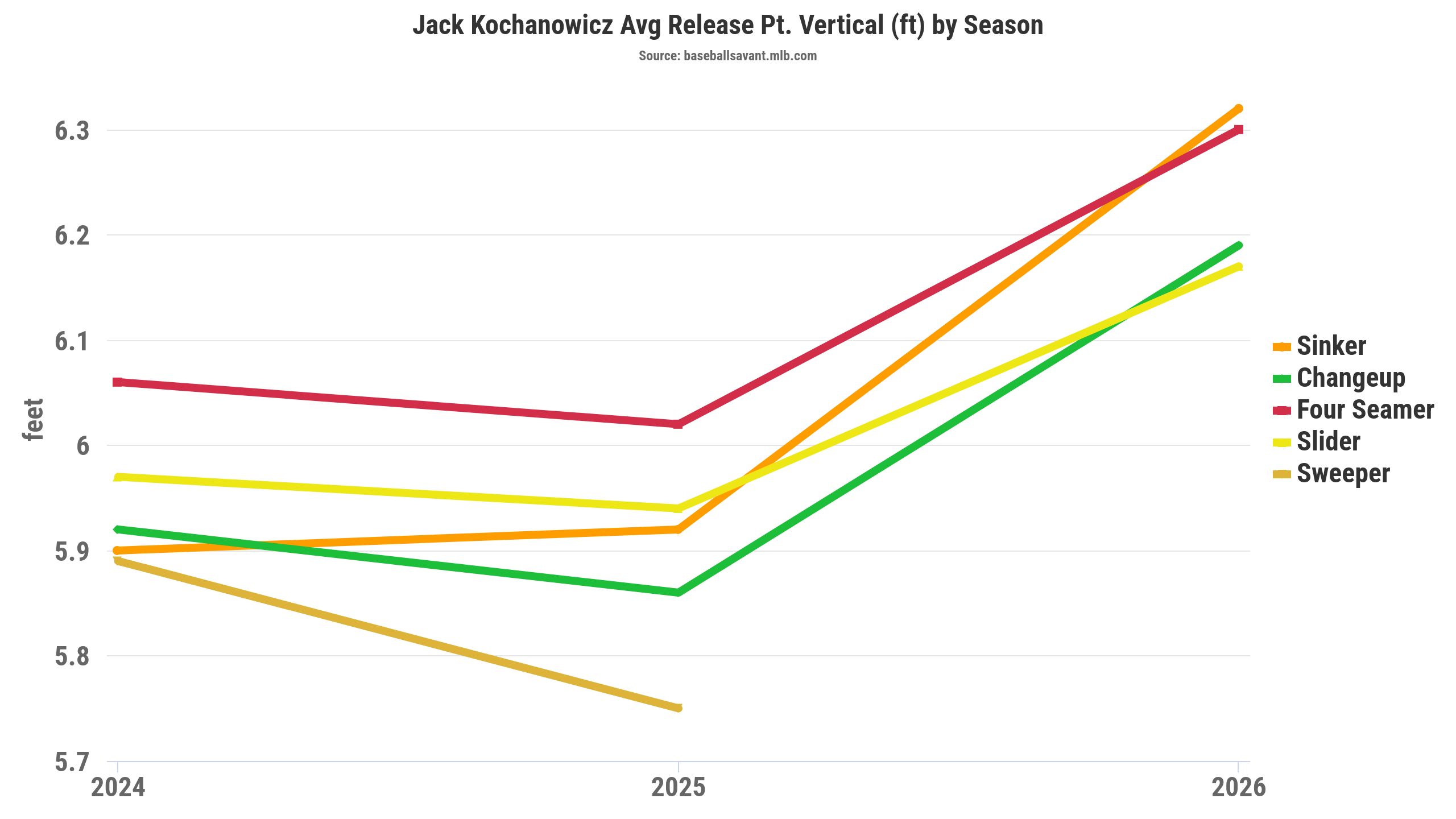
Kochanowicz raised his arm angle to 36 degrees (2026) from 30 degrees (2025). He raised his vertical release point by over four inches while bringing in his horizontal release point by over five inches in 2026. That turns his arm slot into something more over the top than low and farther from his midline.
With the newer arm angle, Kochanowicz's pitch movement profiles changed, specifically via the slider and changeup. Kochanowicz's changeup gained an additional inch or more via its downward and horizontal movement toward his arm side.
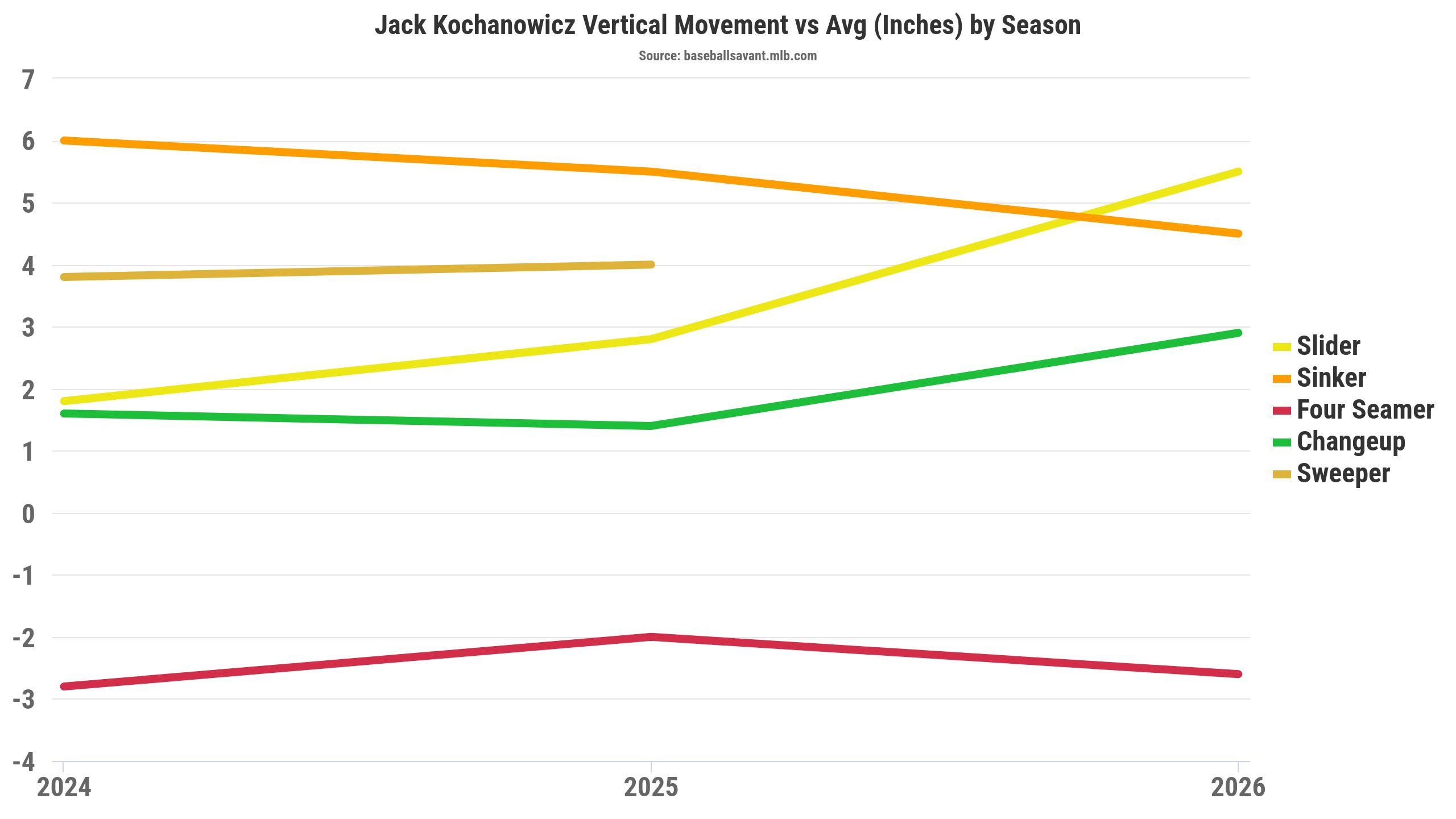
Meanwhile, Kochanowicz throws a gyro-like slider that gained four inches of downward movement and nearly two inches of arm-side fade. Theoretically, both pitches should generate more whiffs and weak contact. That said, we probably could speculate on Kochanowicz's command and pitch location.
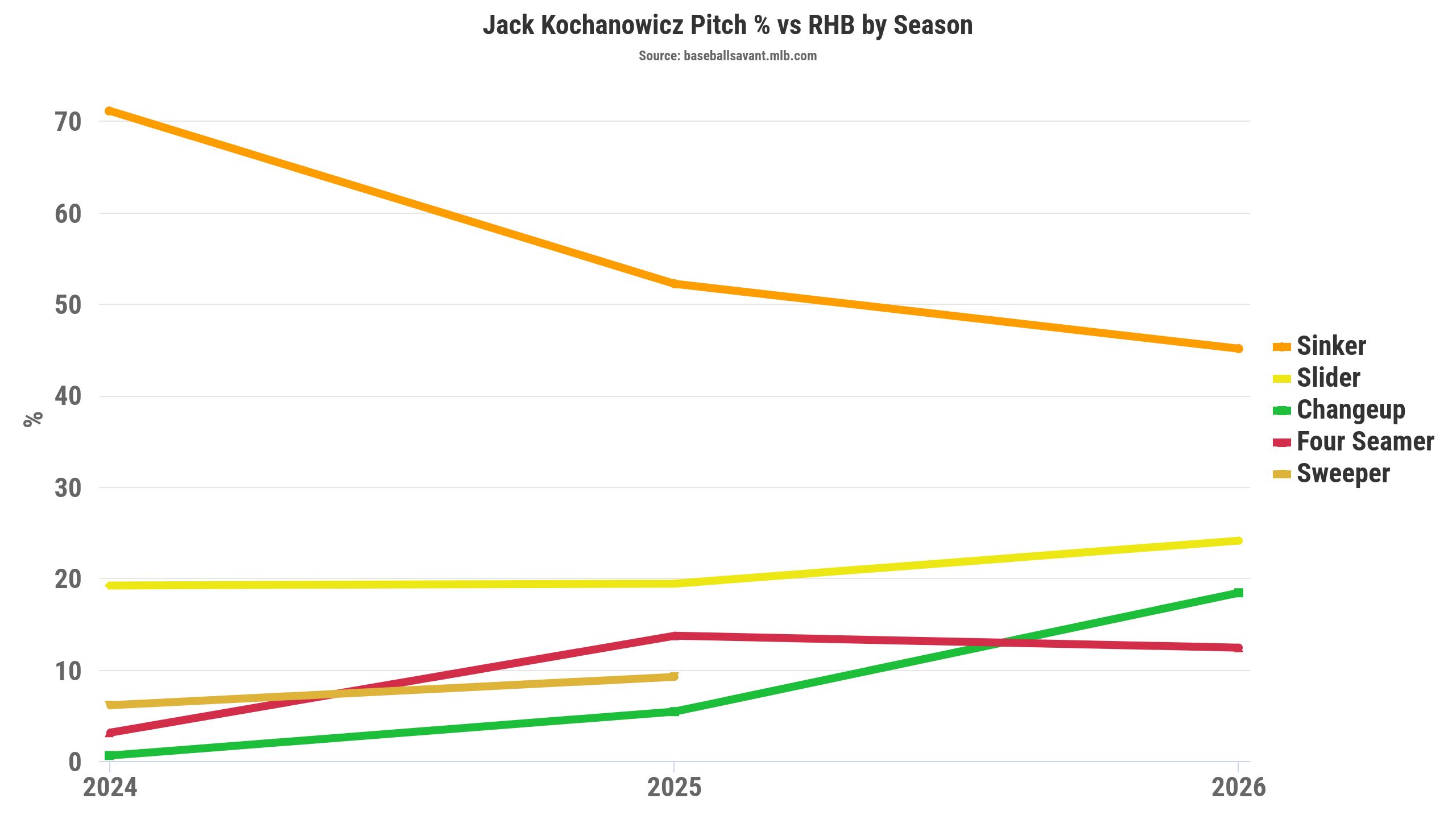
The locations for Kochanowicz's changeup and slider have been relatively stable over the past two seasons. However, we've seen a significant adjustment for his pitch mix in 2026 with more sliders (24.1%) and changeups (18.4%) against right-handed hitters. For context, Kochanowicz threw sliders 19.4% and changeups at 5.4% in 2025 against righties.
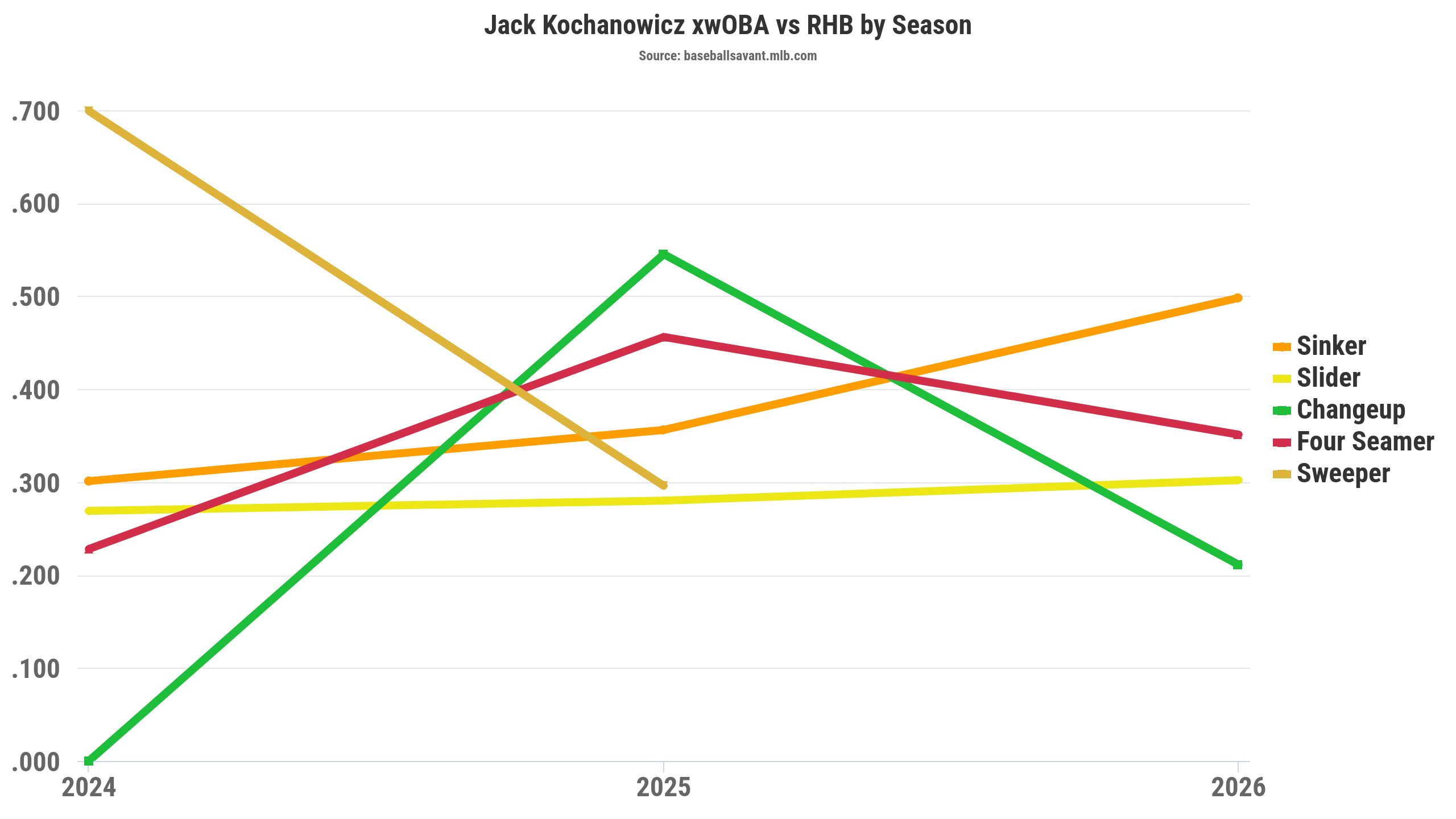
Though Kochanowicz's slider has been performing well against righties (.069 wOBA), the .238 xwOBA in 2026 has been better than the 2025 numbers (.353 wOBA, .280 xwOBA). His slider results align with the new movement profile.
Meanwhile, Kochanowicz's changeup was significantly better in 2026 (.241 wOBA, .211 xwOBA) than in 2025 (.672 wOBA, .545 xwOBA). Why has Kochanowicz's changeup been performing better? It's partly because he threw the changeup 3 inches lower in the zone.
Theoretically, Kochanowicz's changeup thrown lower in the zone could lead to more whiffs and weak contact, which we've seen early in 2026.
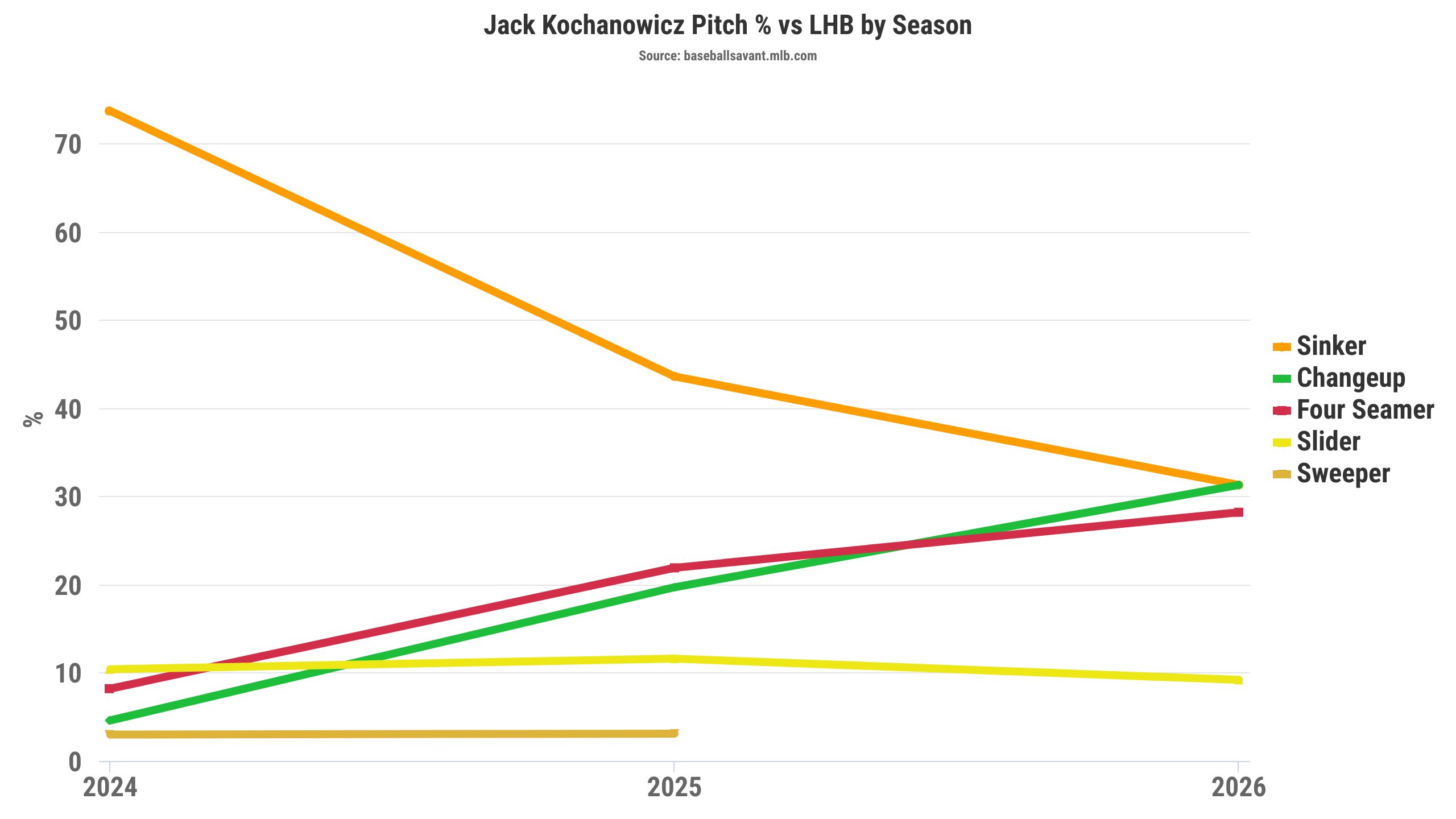
Kochanowicz threw a career-high in changeups (31.3%) against left-handed hitters in 2026. That's a nearly 12 percentage point increase in 2026, which coincided with fewer sinkers (31.3%) and more four-seamers (28.2%). That's notable because Kochanowicz threw his sinker 43.6% of the time in 2026, and the four-seam had a 21.9% pitch percentage in 2025.
The sinker is Kochanowicz's best pitch from a wOBA standpoint (.186 wOBA, .248 xwOBA) against left-handed hitters. Meanwhile, Kochanowicz's four-seam (.304 wOBA, .321 xwOBA) and changeup (.309 wOBA, .319 xwOBA) have been solid against lefties in 2026 after some bumps in 2025.
Throughout Kochanowicz's career, he has been profiled as a pitcher who relies more on command (102 Location+) than stuff (96 Stuff+). However, Kochanowicz possesses a slider, sinker, and changeup, with a near-elite vertical movement profile.
We're interested, but it might take time for Kochanowicz's whiffs to align with the command and movement profiles. He looks like a solid streamer for now.
Colin Rea, SP, Chicago Cubs
15% Rostered
Rea has been pitching better over the past few outings. Most of Rea's advanced metrics look similar to his career averages, evidenced by his 12.8% K-BB%, 35.4% ball rate, and 8.5% swinging-strike rate. Unfortunately, Rea had a brutal outing against the Dodgers over the weekend, allowing six earned runs and four walks, with four strikeouts in 3.1 innings.
All those metrics have been within a few percentage points of Rea's career average. Rea's slider (14.8%), cutter (13.9%), and splitter (12.2%) lead his arsenal from a swinging-strike standpoint. However, both Rea's swinging-strike rates via the slider and splitter have been near or below the league norms.
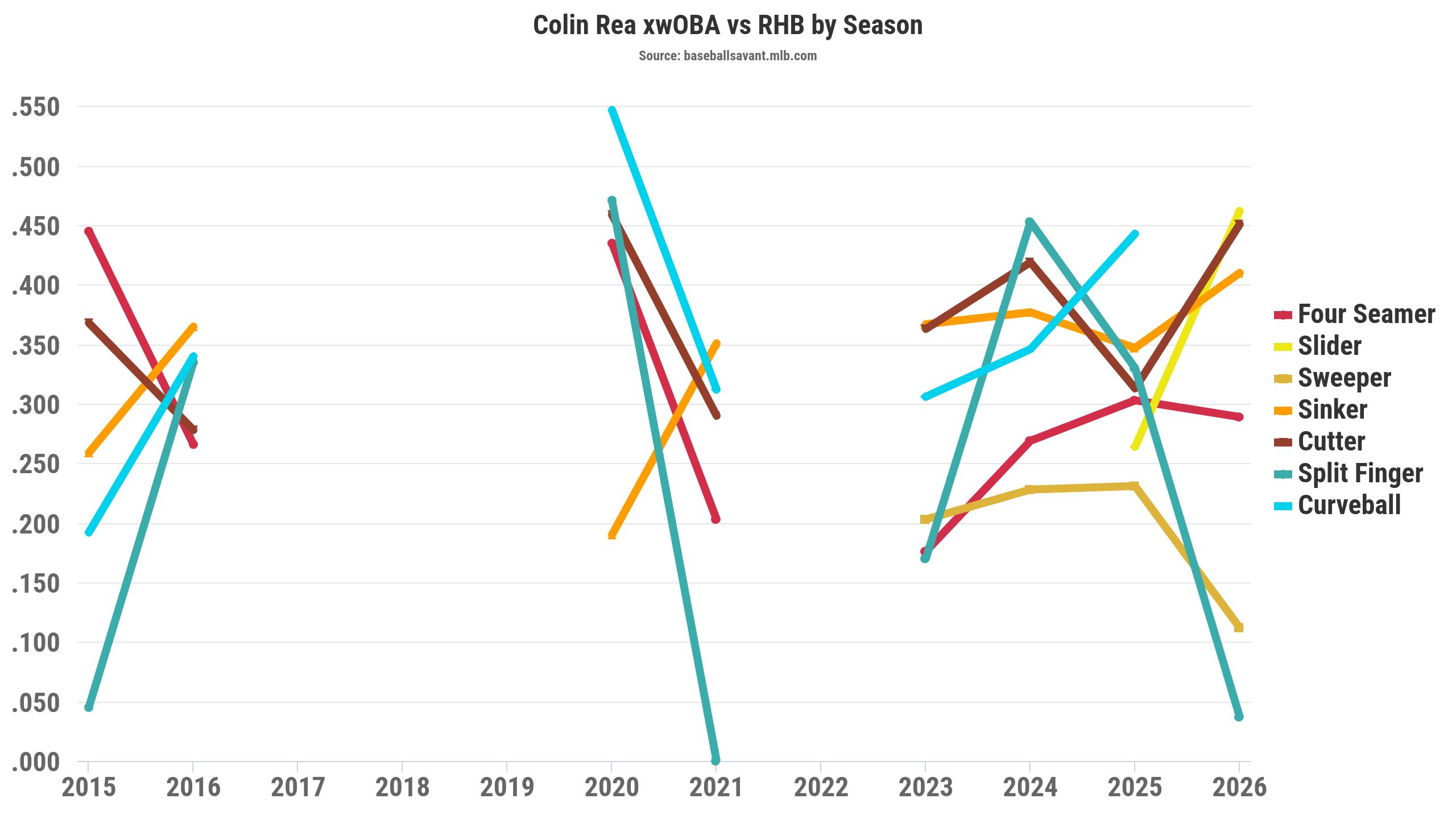
Rea uses a consistent pitch mix against right-handed hitters, throwing his sweeper, slider, and sinker between 18-20% of the time to pair with his four-seamer (36.4%). His four-seam (.258 wOBA, .289 xwOBA), sweeper (.000 wOBA, .112 xwOBA), and sinker (.124 wOBA, .410 xwOBA) have been his three best pitches against righties in 2026 and recent seasons.
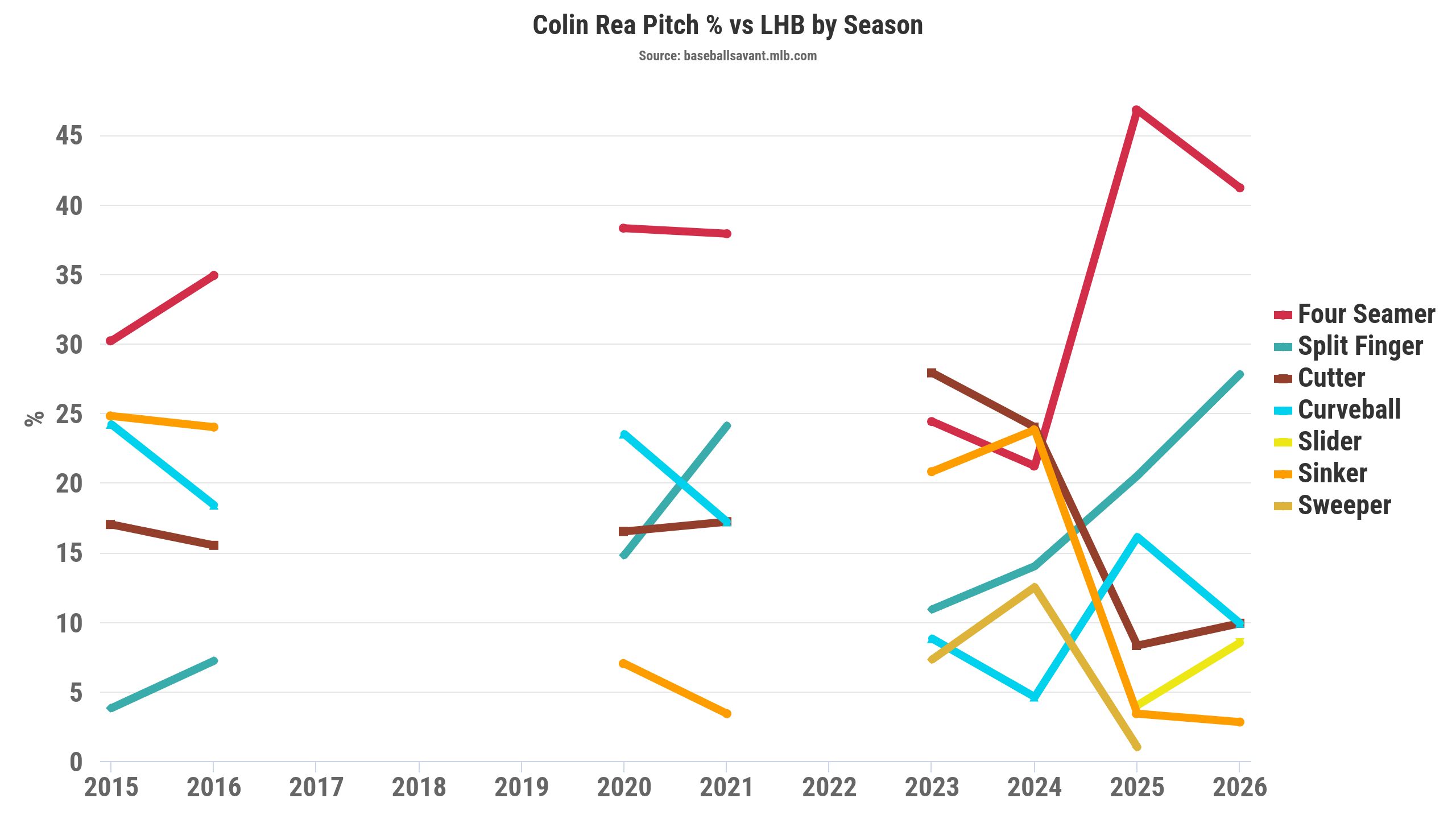
Over the past two seasons, we've seen Rea rely more upon his splitter against lefties in 2026 (27.8%) and 2025 (20.5%). That coincided with slightly fewer four-seamers and curveballs in 2026 toward left-handed hitters.
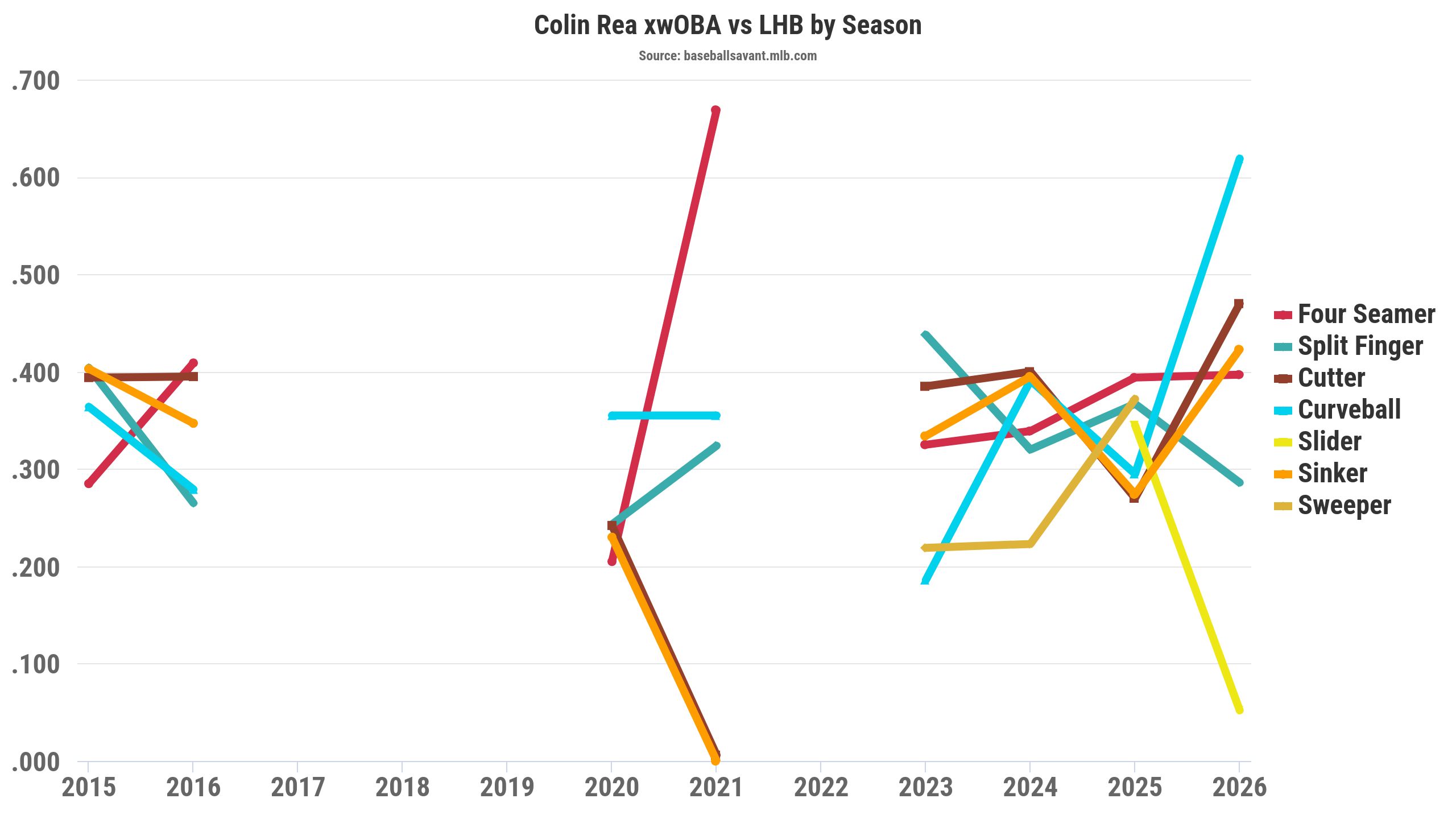
Interestingly, Rea's curveball was his best offering against lefties in 2025 (.265 wOBA, .295 xwOBA) among his pitches thrown 10% of the time or more. However, left-handed hitters have been crushing the curveball (.970 wOBA, .619 xwOBA) in 2026.
Rea has been throwing the curveball over four inches more toward his glove side while consistently remaining low and below the zone. It seems like left-handed hitters have been sitting on the curveball thrown in the zone since he lowered the zone rate to 50% (2026) from 55.5% (2025).
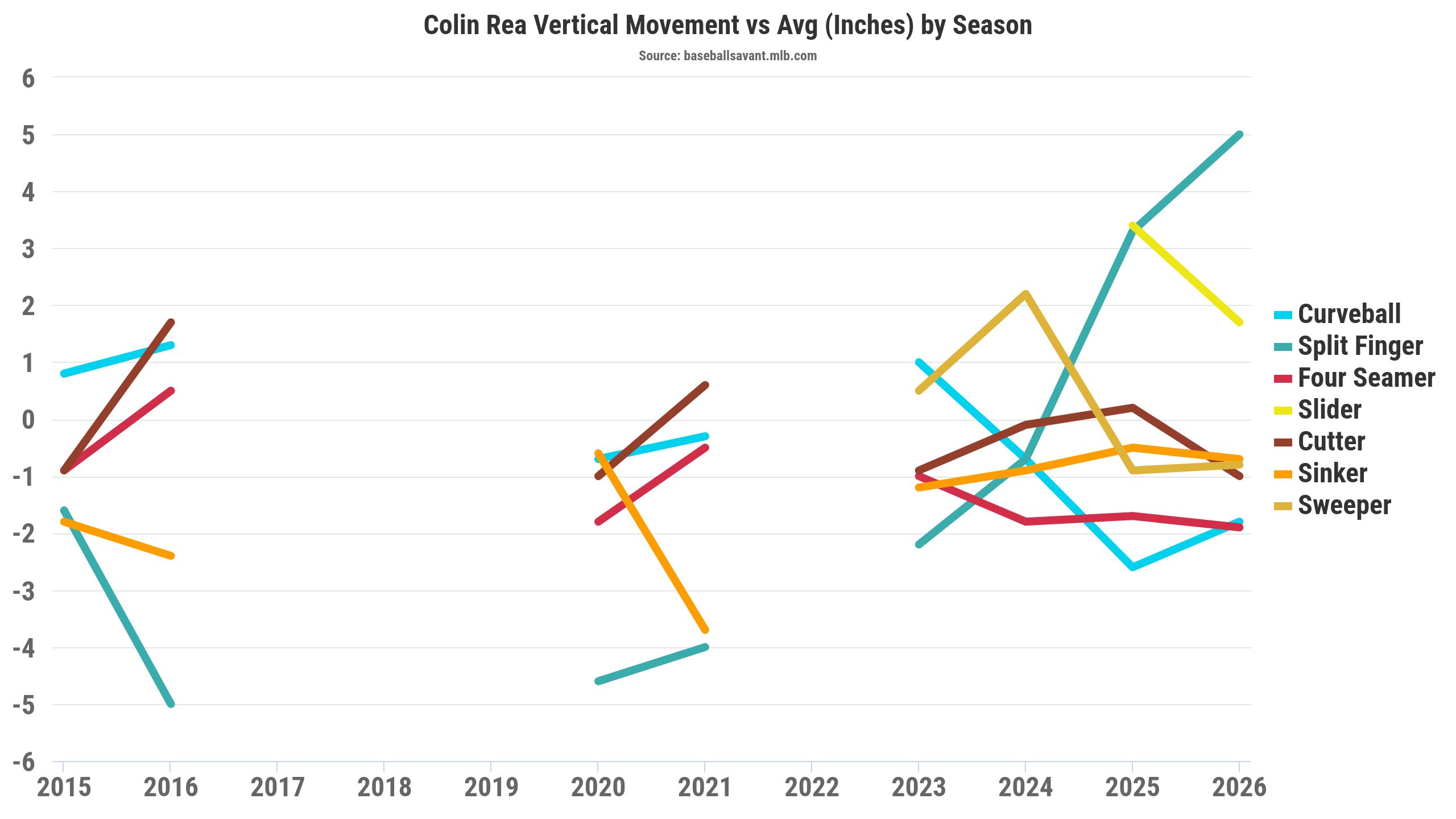
With better results against lefties for Rea's splitter in 2026 (.197 wOBA, .261 xwOBA) compared to 2025 (.372 wOBA, .364 xwOBA), we might speculate on movement or location changes. Rea's splitter added two inches of downward movement, with the curveball nearly adding two inches of drop in 2026.
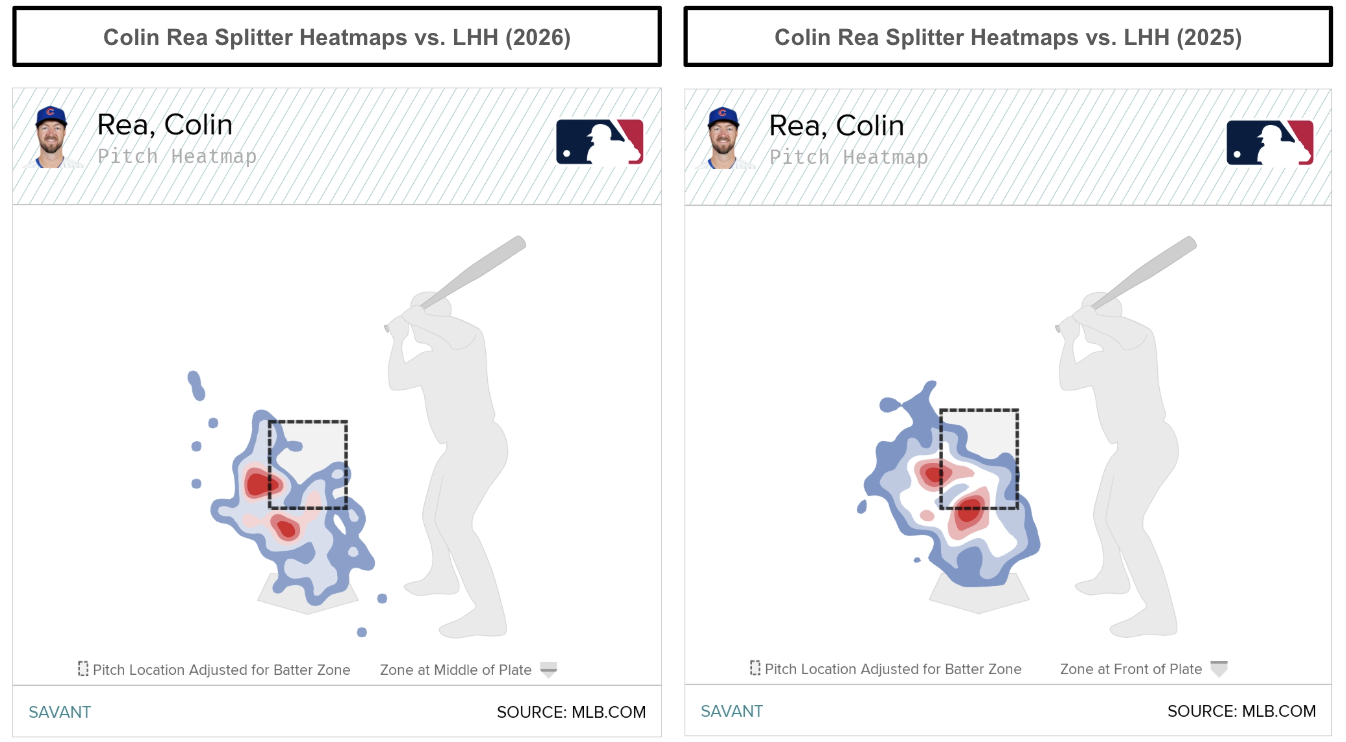
Rea threw his splitter lower in the zone by over three inches in 2026 against left-handed hitters. That aligns with Rea's splitter zone rate in 2026 (30.4%), dropping from 37% in 2025. Whenever Rea left the splitter in the zone in 2025, hitters were crushing it.
That's evident in Rea's splitters, allowing a .425 wOBA (.421 xwOBA) in 2025 and a .226 wOBA (.280 xwOBA) in 2026 when thrown in the zone. It looks like the splitter command might be better in 2026. Interestingly, Rea's splitter had a 101 Location+ in 2026, up from a 96 Location+ in his career.
Historically, Rea relied more on his command than his stuff. He'll need to be precise with his command, which can lead to him outperforming the underlying metrics and ERA estimators. There will be the occasional rough outing against good offenses.
More Fantasy Baseball Advice
Download Our Free News & Alerts Mobile App
Like what you see? Download our updated fantasy baseball app for iPhone and Android with 24x7 player news, injury alerts, sleepers, prospects & more. All free!