



 RADIO
RADIO









Corbin's deep dive into starting pitcher fantasy baseball breakouts, waiver wire adds, for Week 2 of 2026. Are these unlikely aces potential leagues winners?
Welcome to the second edition of our Unlikely Aces series in 2026. We're into the second full week of the 2026 fantasy baseball season. It's fun to stream starting pitchers and find success. However, sometimes streaming pitchers can destroy the ratios. We should have a process for any waiver wire move, start/sit decision, or player examination.
Some pitchers possess high-end skills but don't perform well. There are instances where the data and research indicate this pitcher shouldn't perform well, but the outcomes look good. After a quality outcome, fantasy managers need to decide whether it's sustainable. Throughout the season, we'll highlight starting pitchers who have been performing well and examine whether we should buy, sell, or hold.
Are these unlikely aces for real, or is it safe to leave them out on the waiver wire, with negative regression surely coming? Let's take a deeper look!
Featured Promo: Save 50% off the regular price with discount code SUMMER, for a limited time. Exclusive access to our Team Sync platform, DFS cheat sheets, Lineup Optimizers, betting/prop picks, and exclusive content from Nick Mariano and Eric Cross! GAIN ACCESS NOW
Gavin Williams, SP, Cleveland Guardians
91% Rostered
As one of my starting pitchers to fade, Gavin Williams threw seven scoreless innings with 10 strikeouts against the Dodgers. Williams continued to scale back the four-seam usage while increasing the sweeper, curveball, and cutter percentages. In the small early sample, Williams has increased his cutter usage to 28.4% against left-handed hitters, more than 14 percentage points above his 2025 usage.
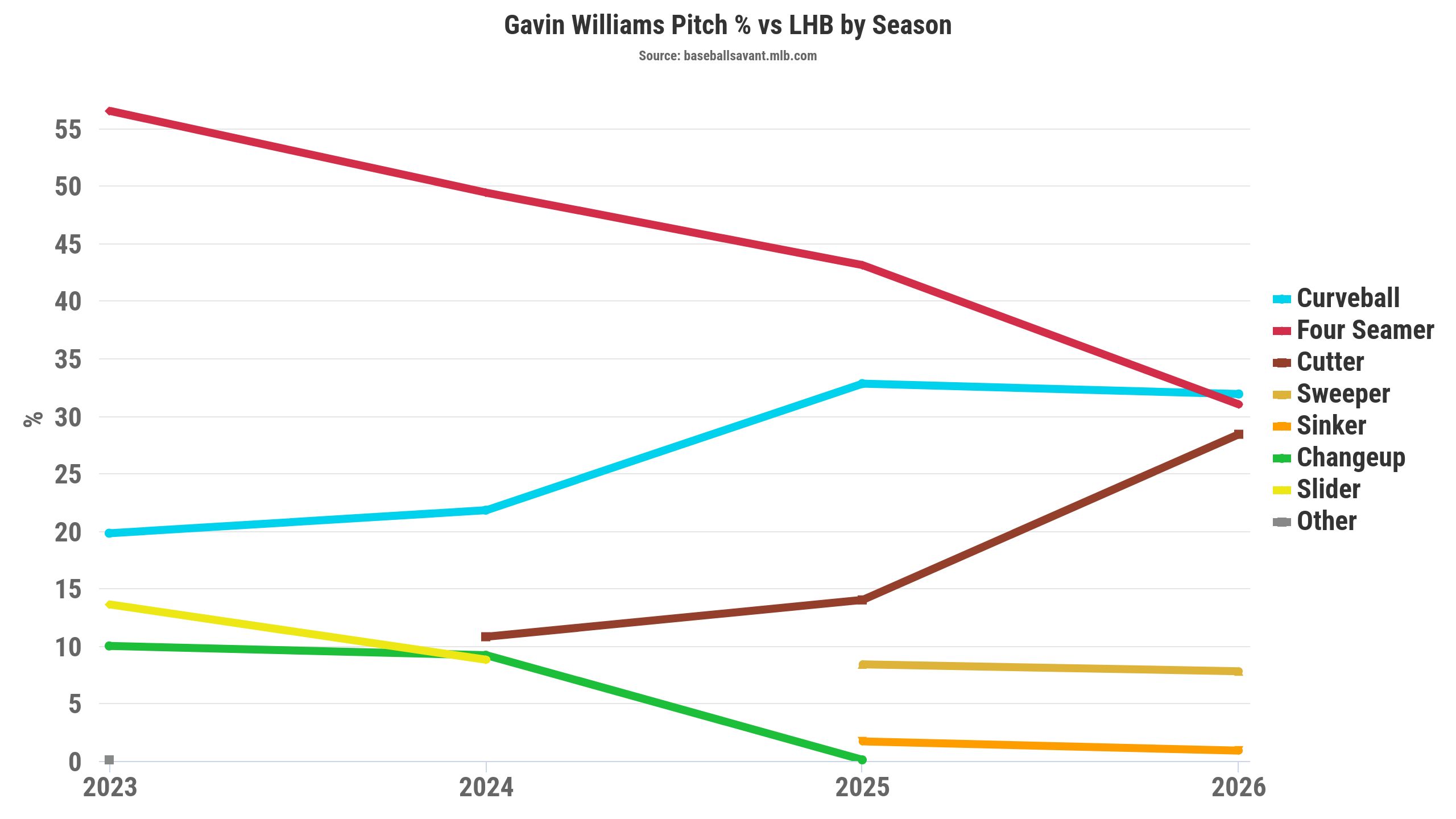
He traded more cutters for fewer four-seamers against left-handed hitters. Interestingly, Williams ditched the cutter toward right-handed hitters in the early 2026 sample.
The curveball has historically been his best pitch against left-handed hitters, with a .146 wOBA (.220 xwOBA) in 2025 and .000 wOBA (.024 xwOBA) in 2026. If Williams' cutter can be a second effective offering to lefties, that increases our optimism.
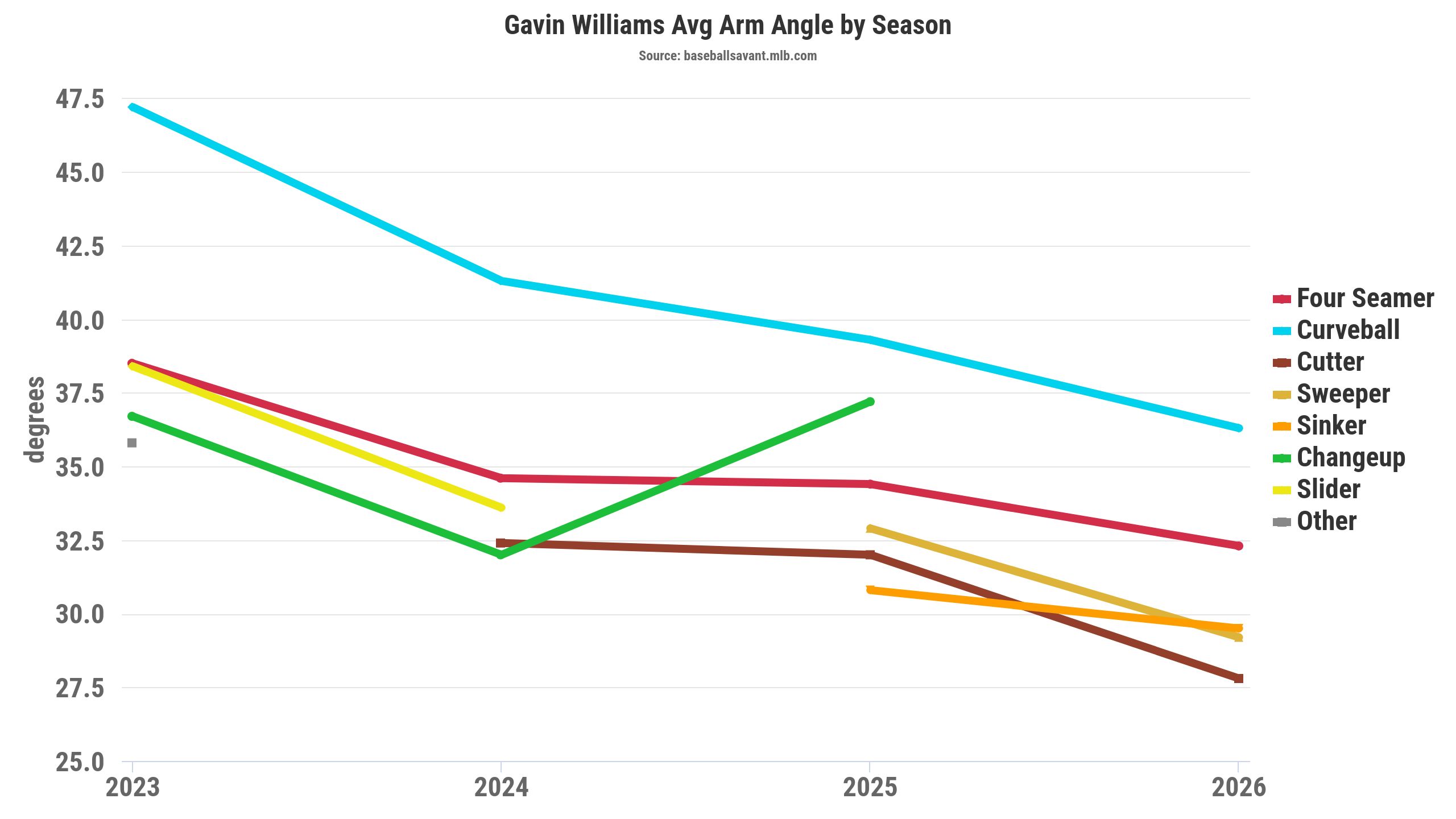
Meanwhile, Williams threw plenty more sinkers (29.3%) in 2026 compared to 2025 (12%) against righties. His sinker added two inches of arm-side movement while throwing from a lower arm angle (31 degrees).
Williams lowered his arm angle by three degrees in 2026 compared to recent seasons. Interestingly, he maintained his horizontal release point, but dropped his vertical release point by almost two inches.
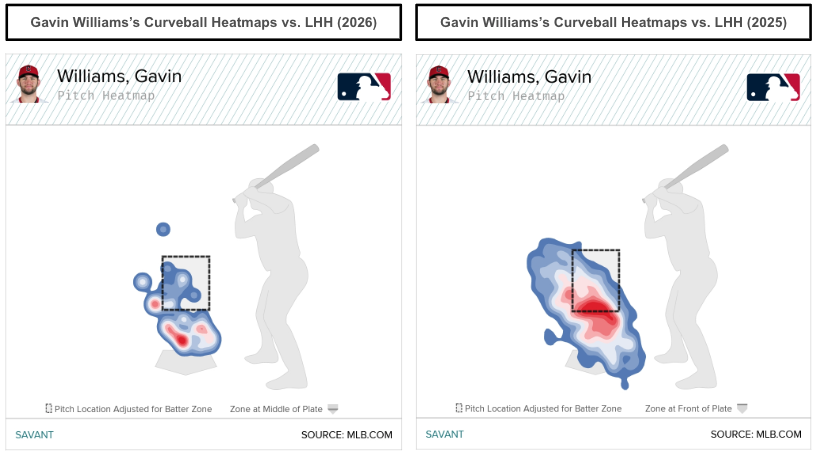
Control remains an issue with a 40% ball rate in 2026 and 37% throughout his career. The same goes for his command, posting a 93 Location+ in 2026 and a 98 Location+ in 2025. Specifically, Williams' curveball had a career-best 112 Location+ in the early 2026 sample, which has been thrown one inch lower and elicited a 25.6% swinging-strike rate.
We're highlighting his curveball because he throws it most often against left-handed hitters, around 31-33% of the time.
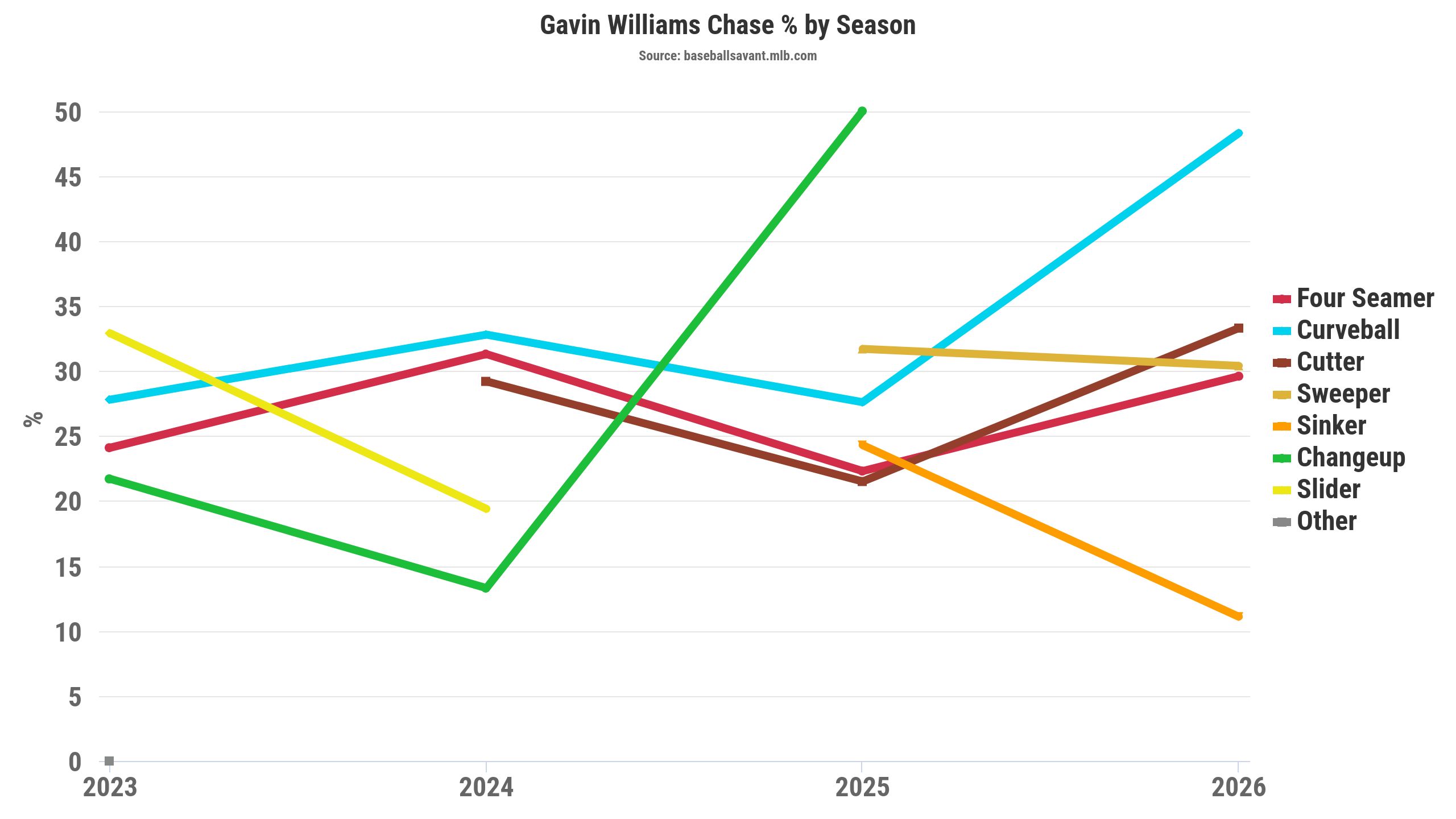
That's further evident by Williams throwing his curveball in the zone 25.6% of the time in 2026, a 10 percentage point drop from 2025 (35.9%). Opposing hitters have been chasing the curveball outside the zone 48.3% of the time in 2026, up 20 points from 2025 (27.6%). Those numbers should regress, or he could continue to fool hitters who chase and whiff against the curveball low in the zone.
Maybe we should've given Williams more credit for evolving in the second half of the 2025 season from a pitch mix standpoint. However, there's still a good chance that Williams will be a stuff-over-command type pitcher who generates whiffs while leading us on a bumpy ride.
Reid Detmers, SP, Los Angeles Angels
30% Rostered
Reid Detmers fit the Kris Bubic breakout mold from last season, which is why Detmers was a target in 2026. Through two starts, Detmers maintained his control (33% ball rate) with a high-end swinging-strike rate (14.5%) in 2026. The fastball velocity is down 2 mph in 2026, but that's understandable after shifting from reliever to starter again this season.
Even with Detmers' lower four-seam velocity, it maintained the high-end induced vertical break (18.4 inches) while adding 1.5 inches of arm-side run. Theoretically, Detmers' four-seamer should help to generate whiffs in the upper third of the zone and induce weak contact with that type of pitch movement profile.
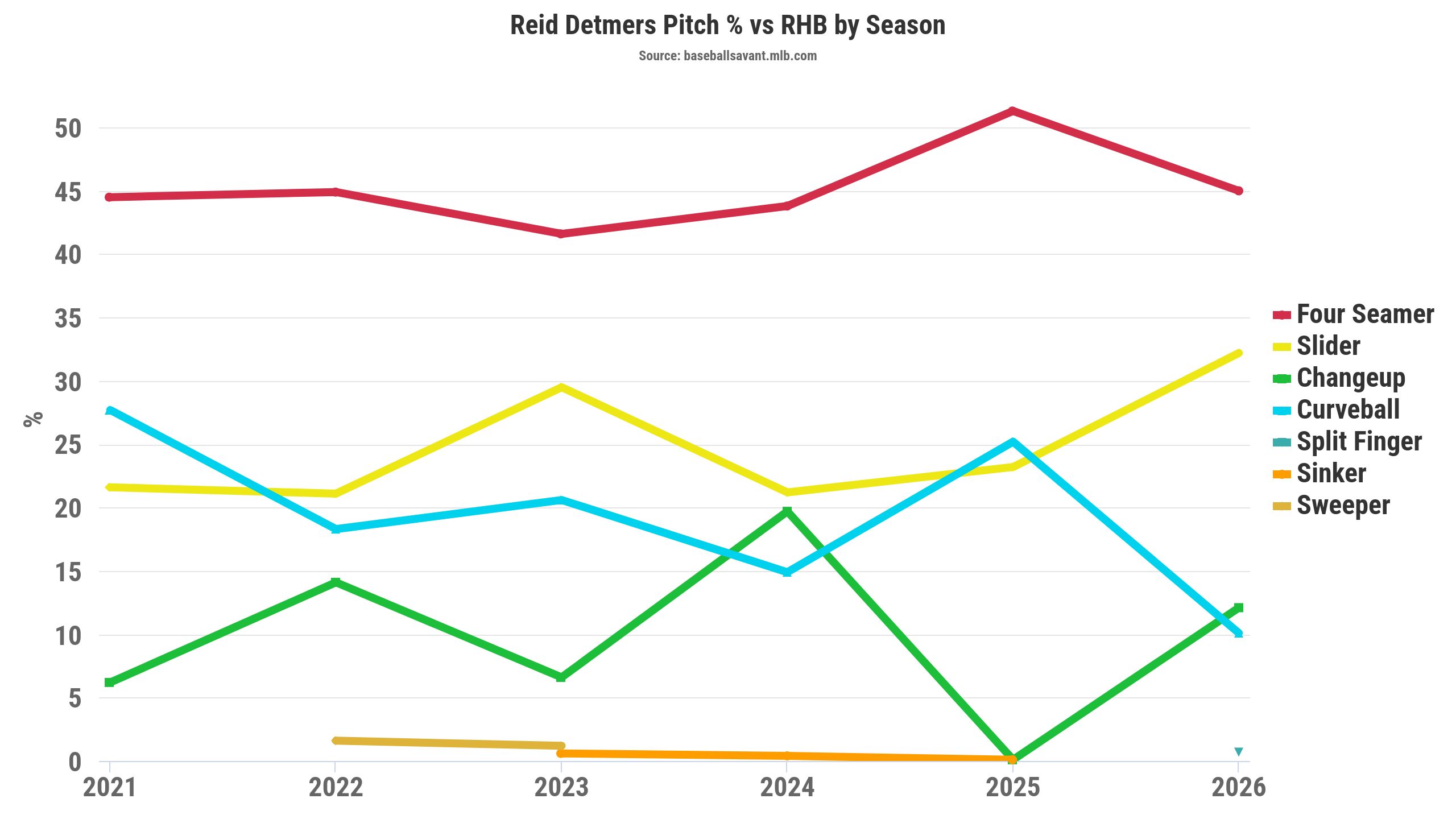
Detmers started throwing more sliders to right-handed hitters (32.2%), up from 23.2% in 2025. The results have been positive in the early 2026 sample (.183 wOBA, .061 xwOBA) via the slider against righties.
His other pitch mix change against right-handed hitters in 2026 involves throwing more changeups (12.1%) than in 2025. However, Detmers threw changeups 19.7% of the time in 2024 and 6.6% in 2023 against right-handed hitters.
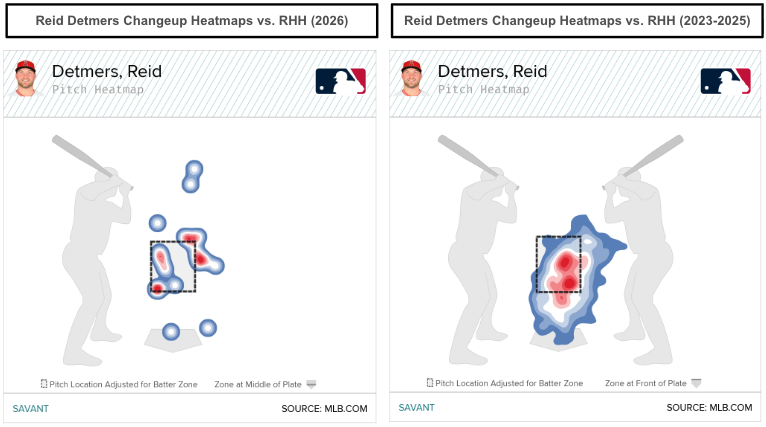
The results haven't been great against Detmers' changeup (.534 wOBA, .419 xwOBA), so we could probably guess the poor outcomes may be related to command. Detmers is throwing a slower changeup in 2026, around 4 mph lower than in recent seasons.
Interestingly, the changeup movement profile is within 1-2 inches in vertical and horizontal movement, but slower. That said, Detmers could be messing with the changeup grip and experimenting with locations.
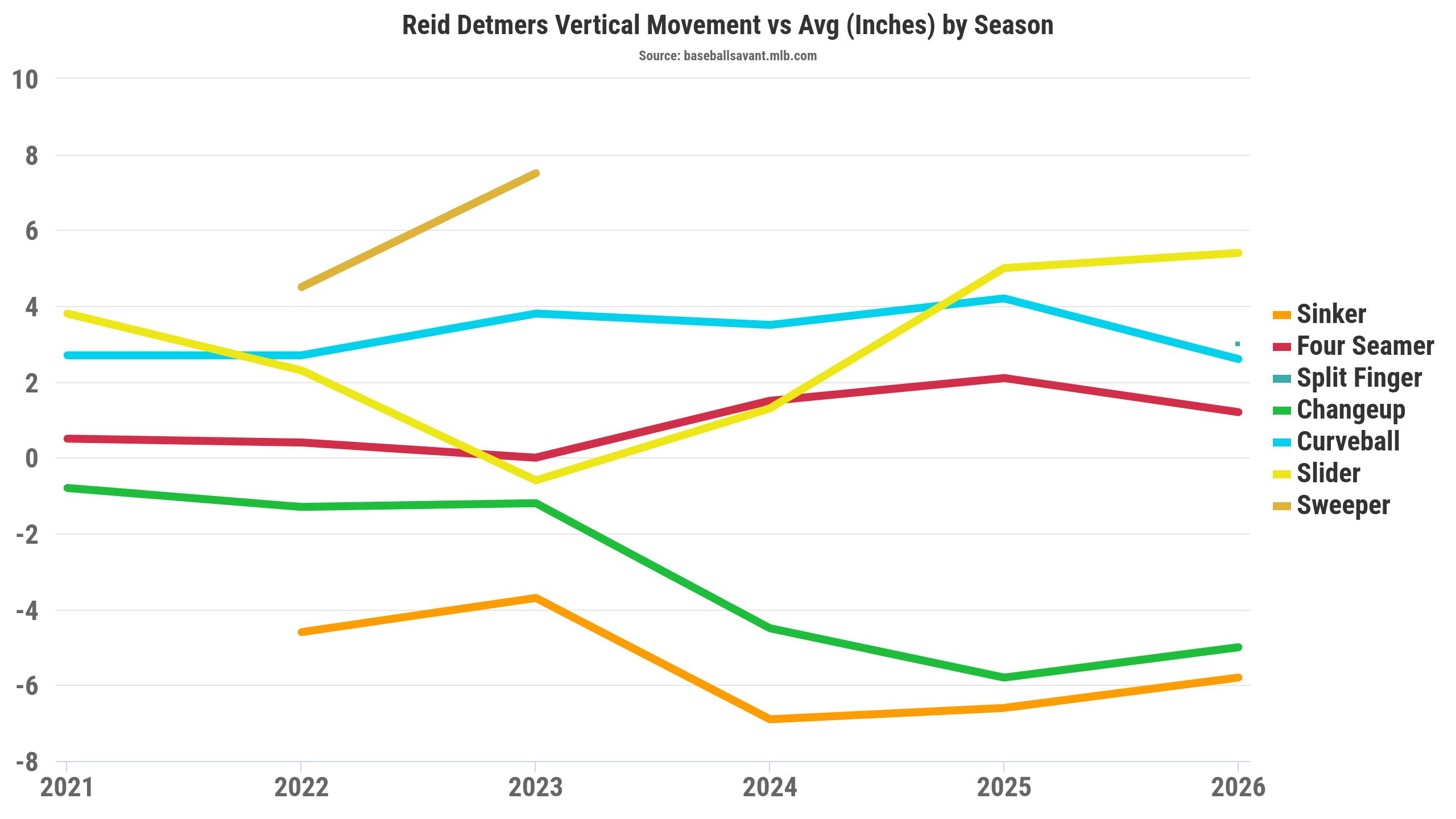
Let's go from his worst pitch to the best, with the slider. Detmers' slider added 4-5 inches of downward movement in 2026 with a similar velocity. That coincides with Detmers' slider, which added 100-200 RPM in spin rate. The slider's movement shift can partly be explained by Detmers moving his horizontal release point over 2 inches farther away from his midline.
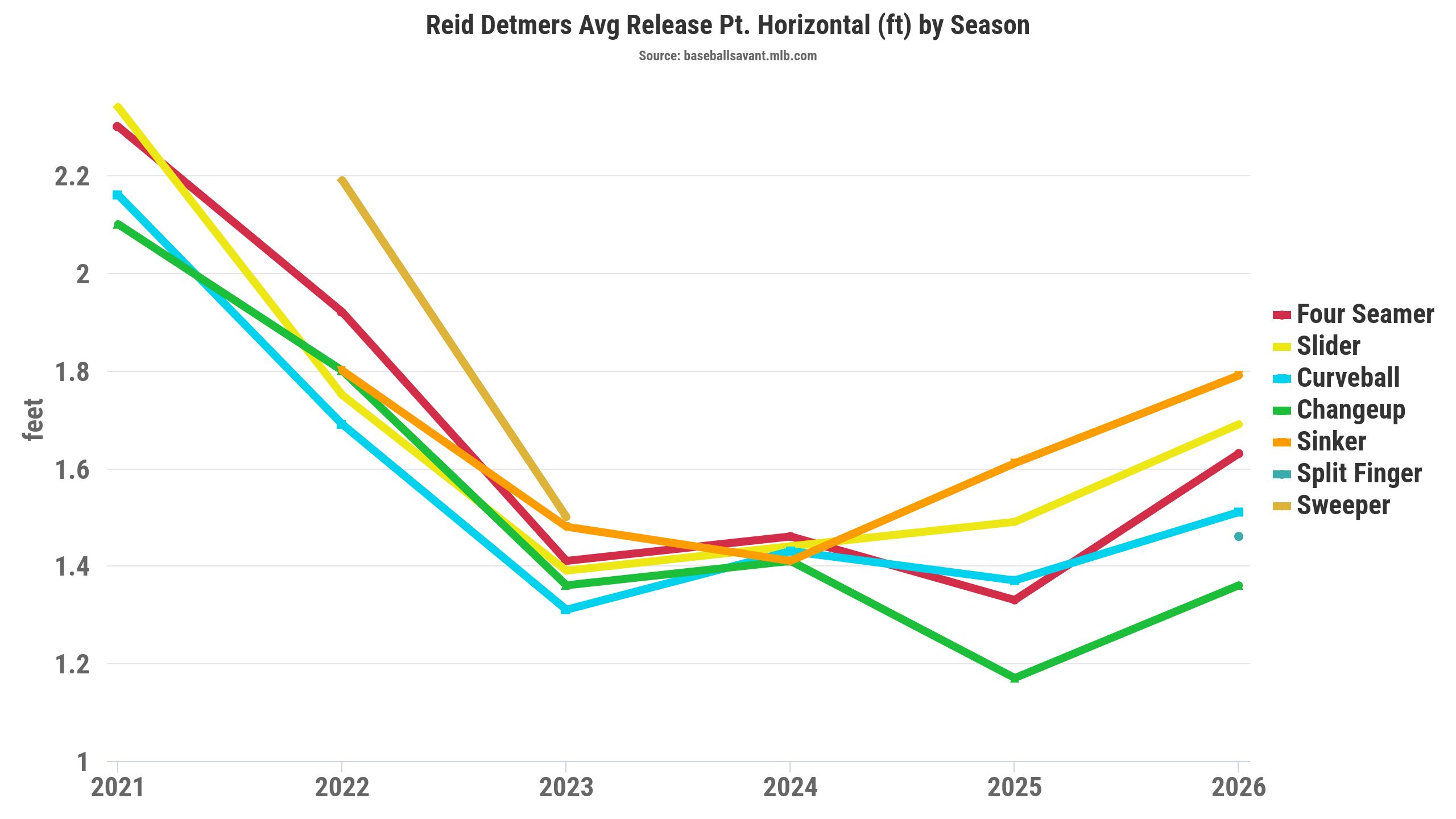
Detmers' slider has been thrown low and away from lefties (21.1% swinging-strike rate, .225 wOBA). Furthermore, the slider looks better against right-handed hitters. That's evident in the slider's 16.7% swinging-strike rate and .183 wOBA (.061 xwOBA) in 2026. Currently, Detmers has three non-fastballs with a 15-16% swinging-strike rate, including the curveball, changeup, and slider.
Assuming Detmers will continue to evolve, we could be witnessing his breakout season, especially with Mike Maddux being a sneaky pitching coach hire in the offseason. There's still the injury concern of elbow inflammation to end the season, so the volume might not be there over a full season. It's probably confirmation bias, but I'm buying into Detmers early in 2026.
Joe Boyle, SP, Tampa Bay Rays
10% Rostered
After two solid outings, Joe Boyle might be out of the Rays' starting rotation, especially with Ryan Pepiot expected to come off the injured list next week. The concern with Boyle has been the control. However, Boyle's ball rate improved to 33% in 2026 across 11 innings, compared to a career 40% ball rate. Besides improved control, Boyle's 14.5% swinging-strike rate was a career-best.
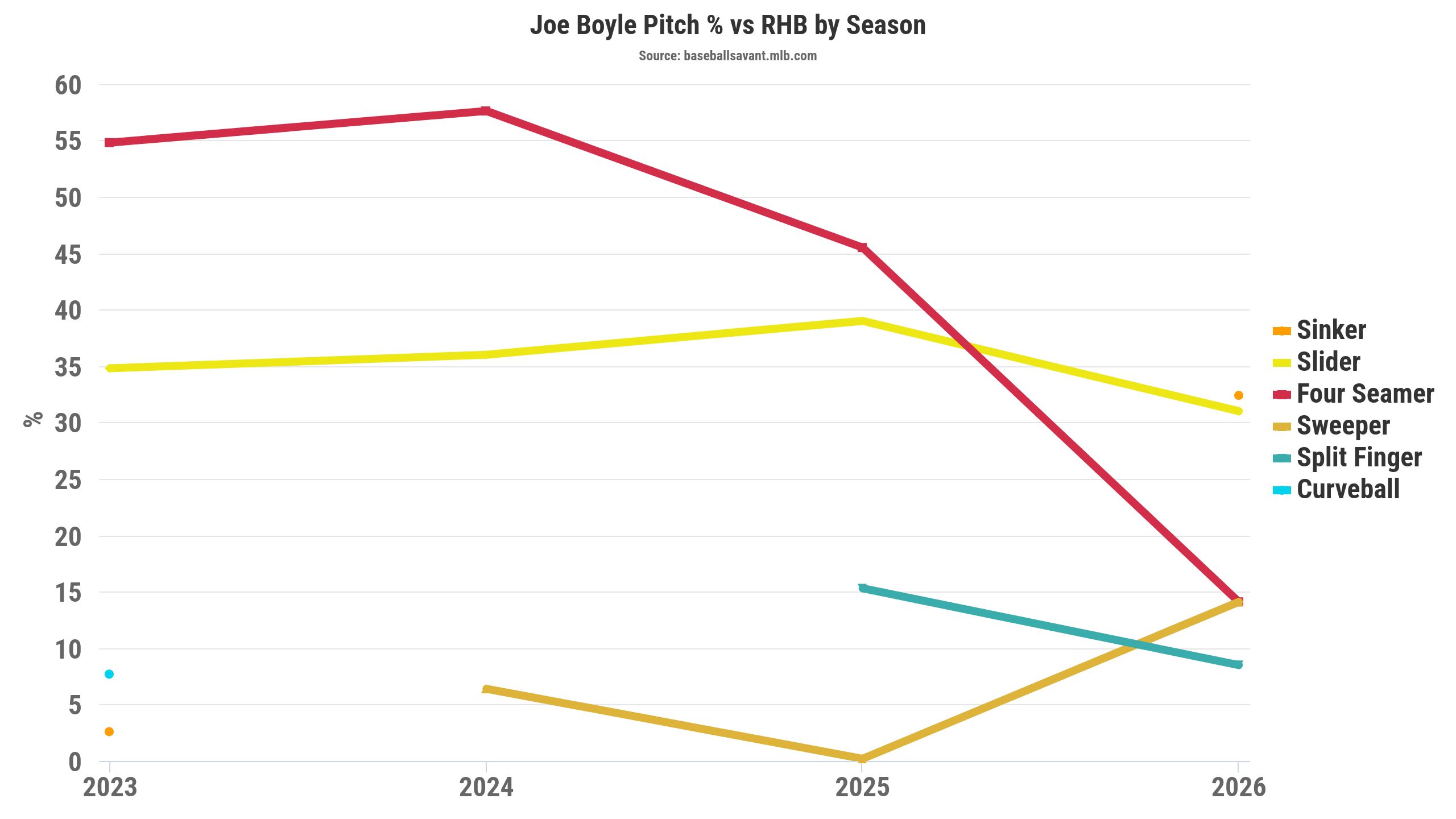
After primarily throwing sliders, four-seamers, and splitters, Boyle introduced a brand new sinker. Boyle threw the sinker 32.4% of the time to right-handed hitters, giving him four pitches to use against righties instead of three. The sinker drops 23.4 inches (1.8 inches more than the average), with the intention to locate the sinker on the inside part of the plate for right-handed hitters.
Sinkers typically help to generate groundballs, but that hasn't been the case in the early 2026 sample, with a 25% ground-ball rate. Furthermore, Boyle's sinker has been hit hard, with a .482 xwOBA (.180 wOBA), so the outcomes have been fluky. Command is an issue for Boyle, but the sinker's 105 Location+ leads his arsenal, so that's a pitch to monitor.
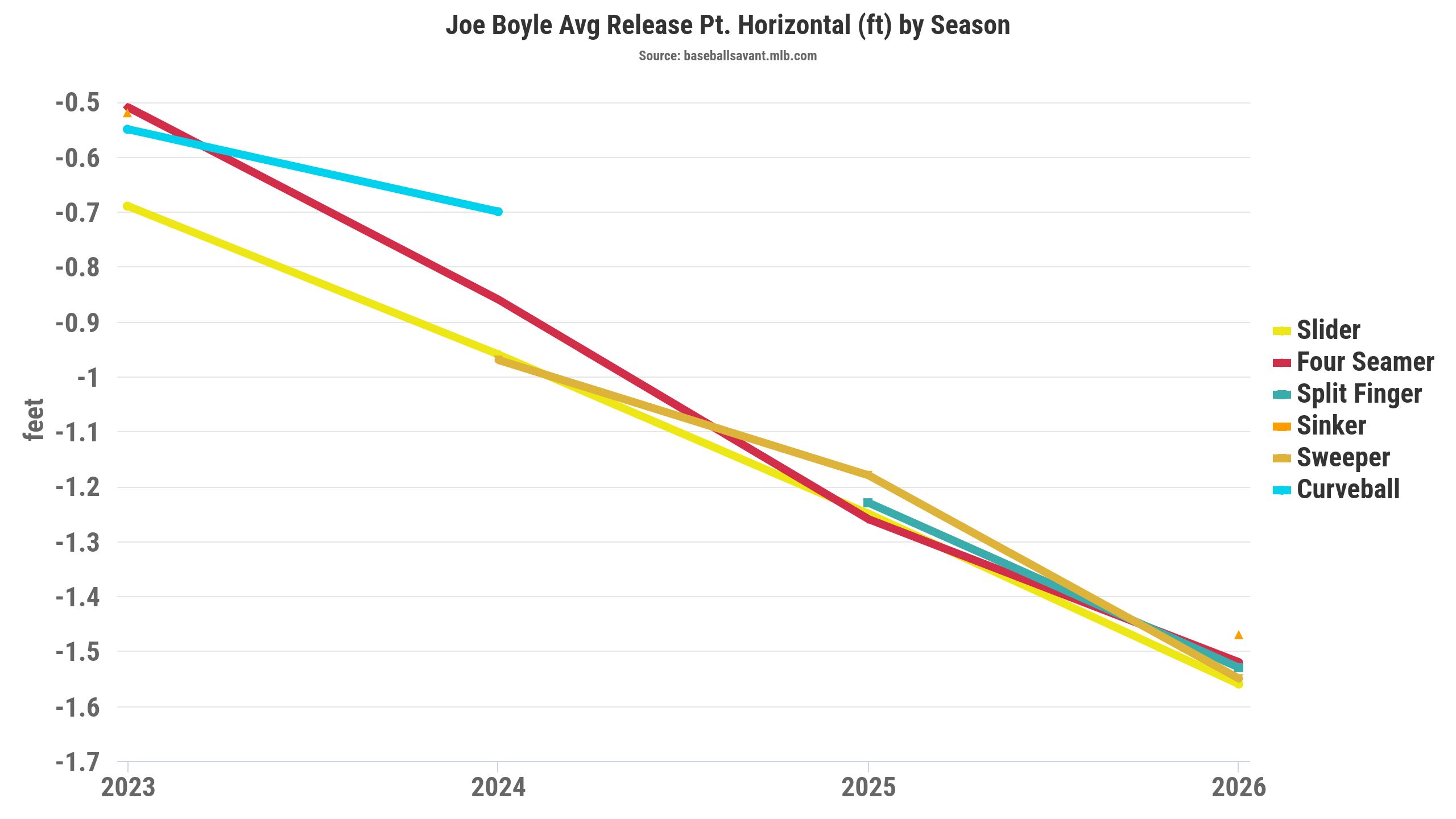
Boyle has been throwing from a lower arm angle (27 degrees), down from 32 degrees in 2025. That can be explained by Boyle's vertical release point dropping by three inches, with the horizontal release shifting over three inches farther from his midline.
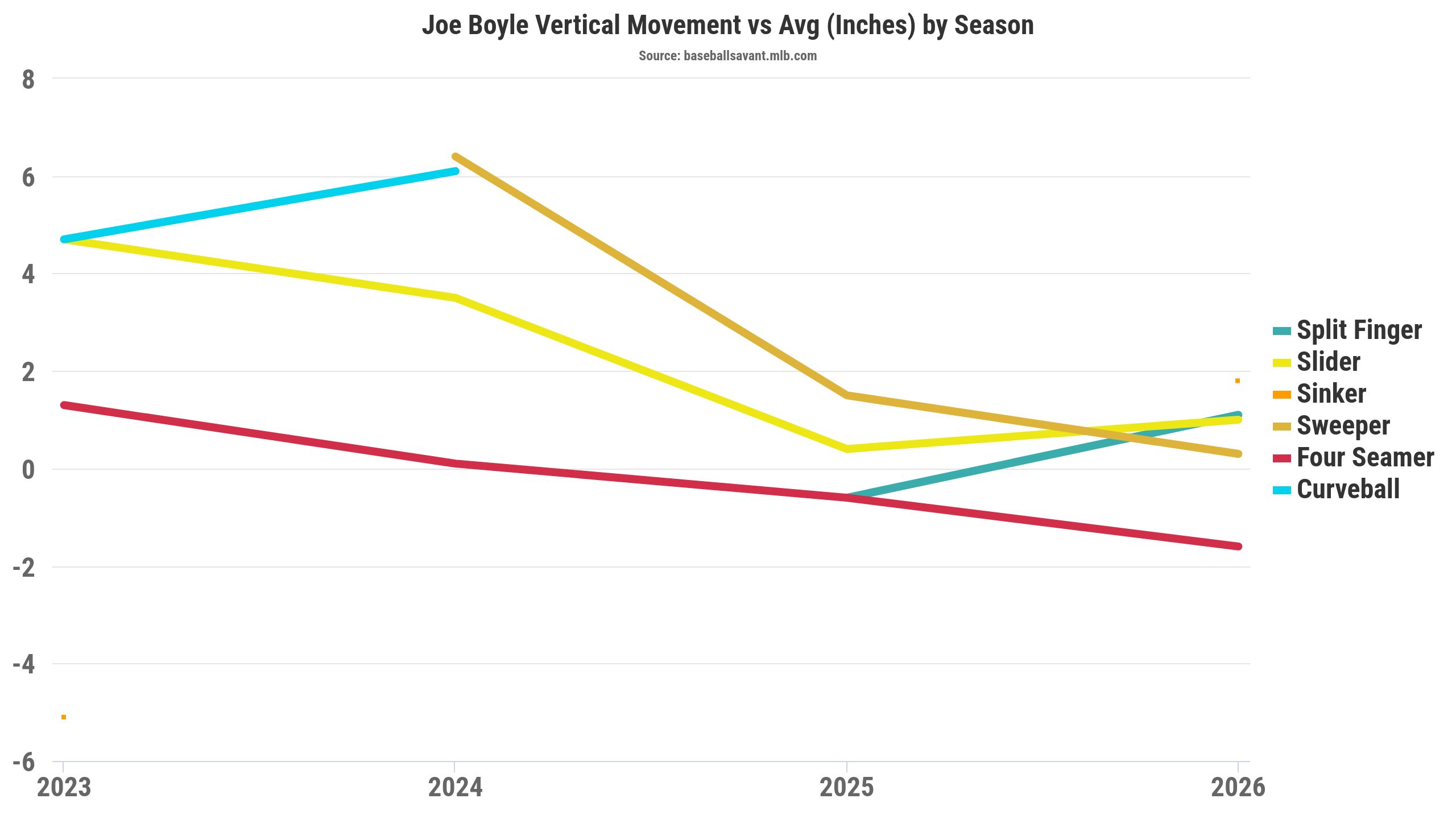
We highlight the release changes because Boyle's splitter dropped two inches more and added nearly 1.5 inches of arm-side fade. Boyle's gained nearly four inches of downward movement in 2026, potentially leading to more whiffs. Those above-average movement profiles make the slider and splitter two of his best pitches.
We could argue that Boyle deserves a spot in the starting rotation over Steven Matz and Nick Martinez, but sometimes logical coaching doesn't exist. Hold Boyle if he shifts to the bullpen in most formats because he added a sinker, shifted his arm angle, and showed better movement profiles.
Jose Soriano, SP, Los Angeles Angels
72% Rostered
Detmers and Jose Soriano have put the Angels starting pitchers on the map with their early success. Soriano has been lucky with a .140 BABIP and 100% strand rate, but we like the additional whiffs with a 15.5% swinging-strike rate.
It might be unsustainable for Soriano to maintain the higher swinging-strike rate, especially considering his sinker elicited a 15.7% swinging-strike rate early in 2026.
Meanwhile, Soriano's knuckle curve (21.5%) and splitter (20%) led the arsenal from a swinging-strike standpoint. There has been a slight usage change against right-handed hitters, where Soriano threw the knuckle curve (32.3%), sinker (31.6%), and four-seamer (20.3%) as his primary three pitches in 2026.
For context, Soriano threw sinkers (50.8%) and knuckle curves (31.2%) over 80% of the time in 2025 against righties.
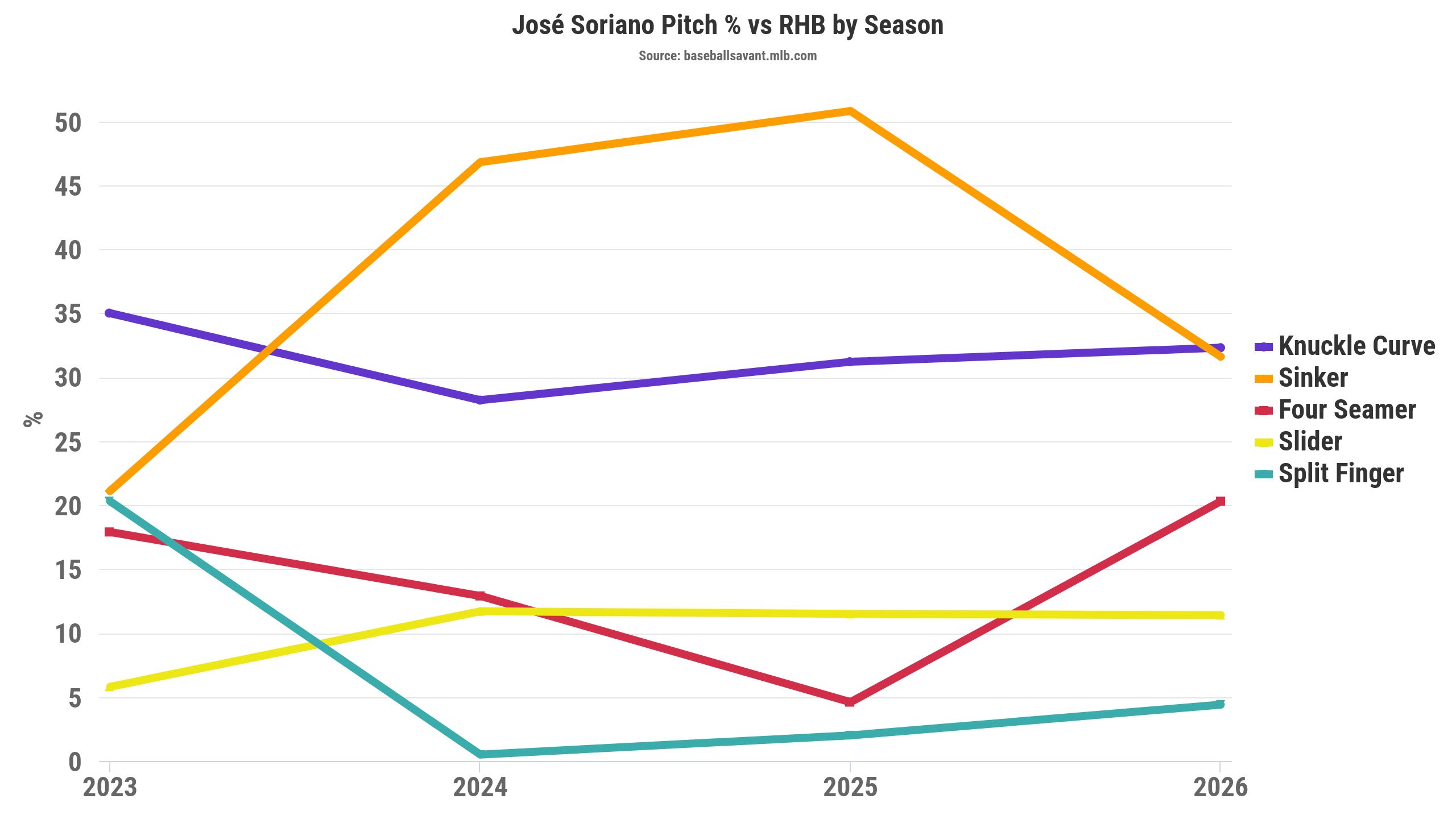
That's notable because we haven't seen that type of pitch balance across three pitches for Soriano against right-handed hitters. Soriano's knuckle curve lost over three inches of downward movement in 2026.
That coincides with Soriano's knuckle curve being chased outside the zone (43.1%) more often compared to the career average (32.4%). There's a chance Soriano's curveball locations have been optimal so far.
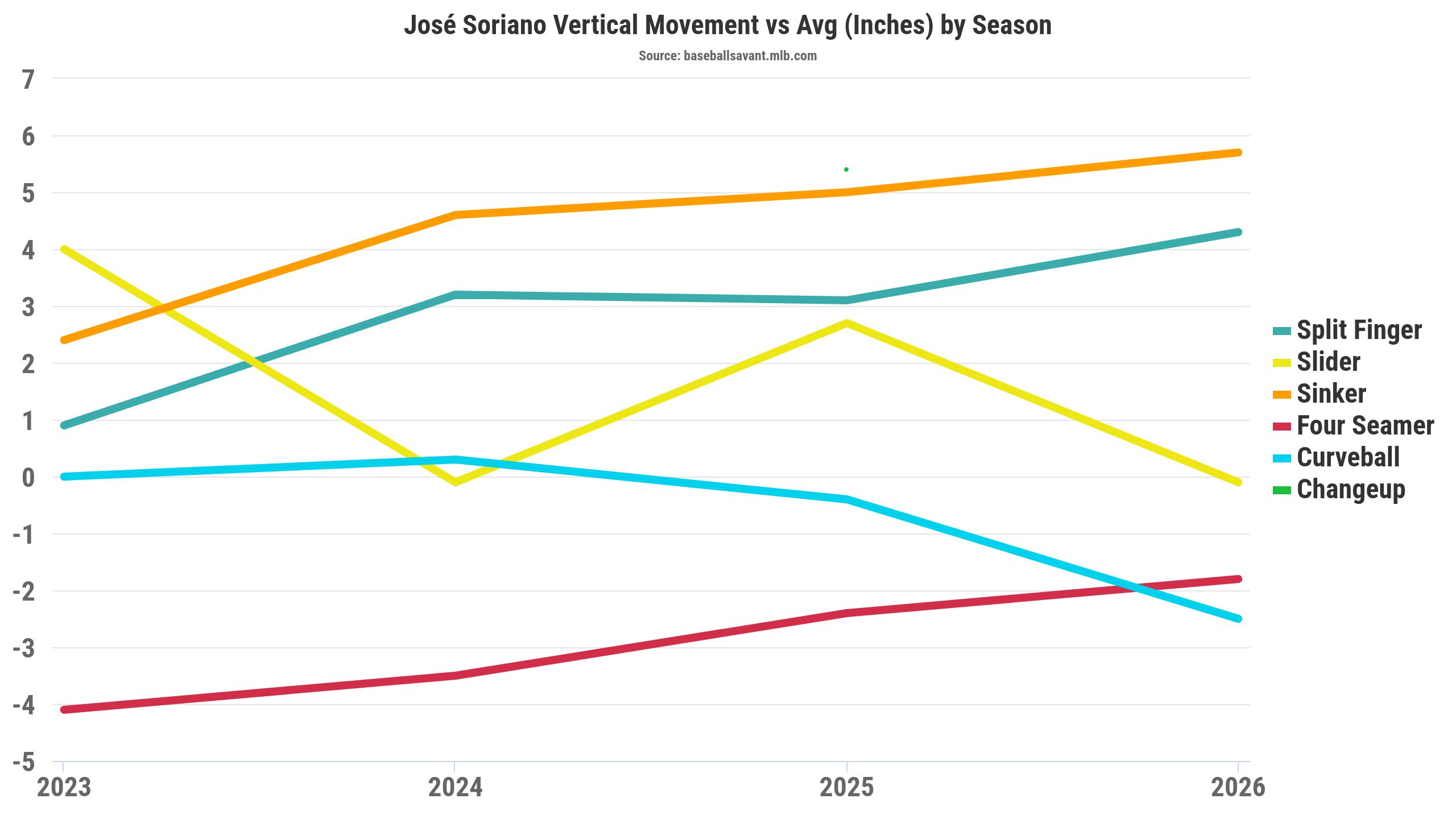
Like the pitch mix to righties, Soriano mixed up his usage to lefties by specifically throwing more splitters (19.2%) in the early 2026 sample, up around 4-5 percentage points compared to previous seasons.
Opposite of Soriano's curveball, his splitter gained around three inches of downward movement in 2026. The splitter's spin rate hasn't shifted much (+50 RPM), so maybe Soriano's splitter downward movement regresses, or there's a grip change.
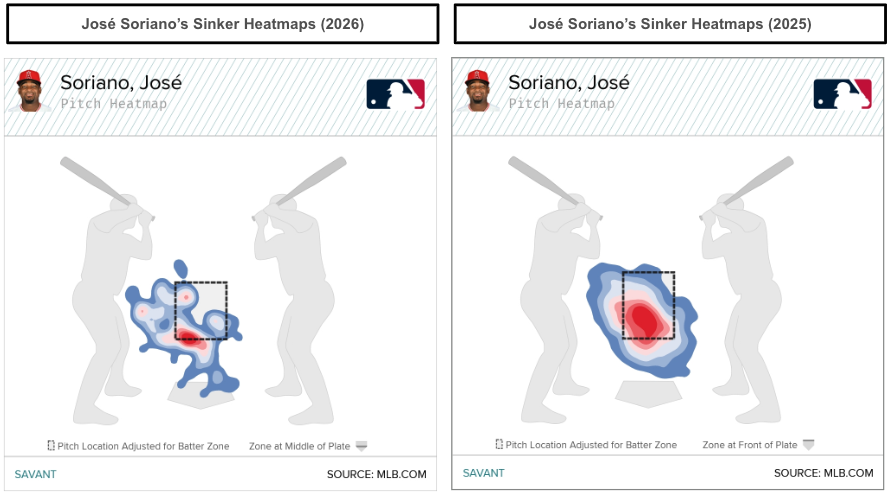
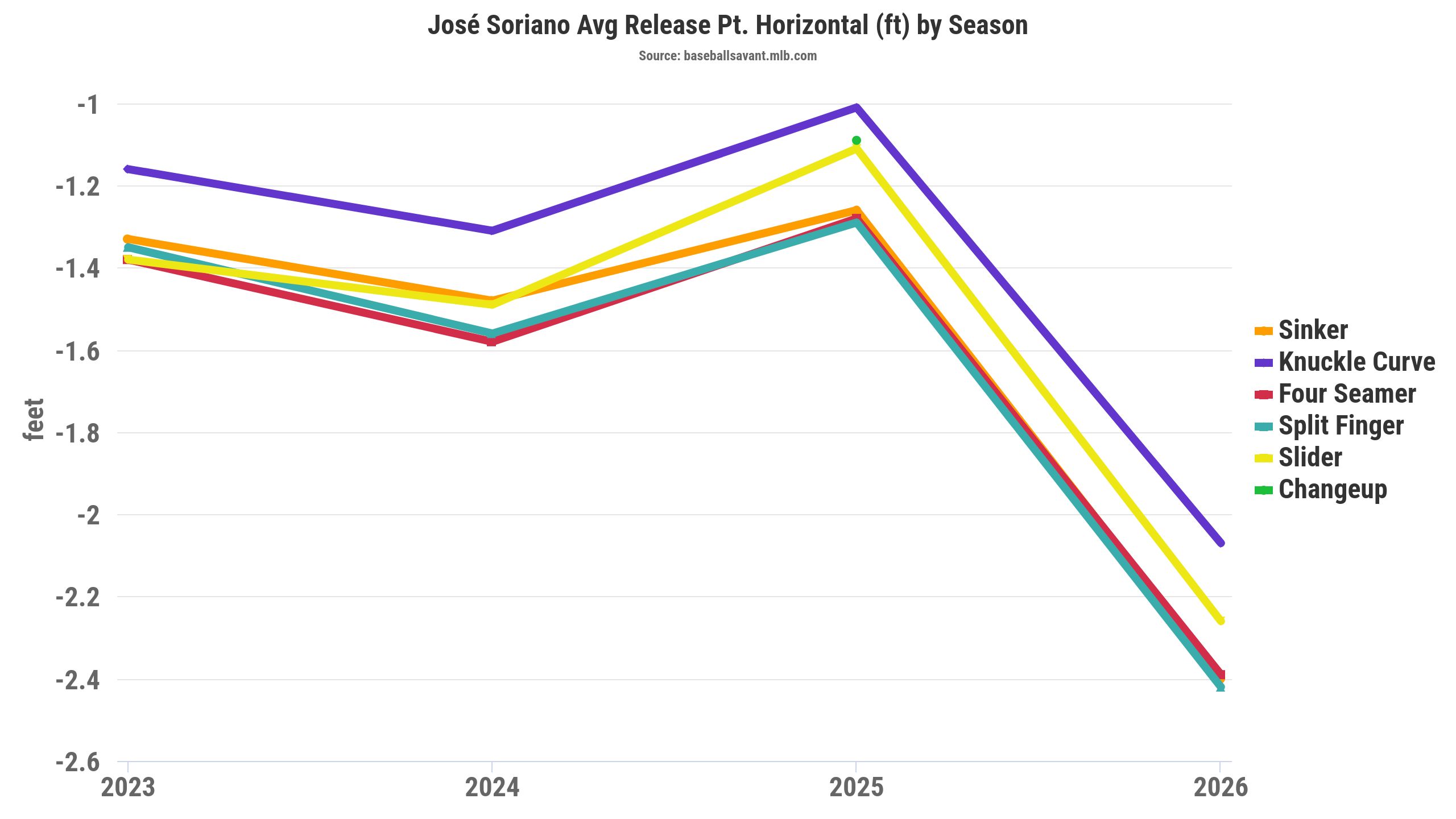
It's probably a minor adjustment, but we've noticed Soriano has been locating sinkers farther outside to left-handed hitters, which coincides with his horizontal release point shifting over 14 inches farther away from his midline. That's similar to Soriano's arm angle change when throwing sinkers toward right-handed hitters, shifting 13 inches away from his midline in 2026.
He continues to locate the splitter (low and away to lefties) and knuckle curve (low and away to righties) in opposite directions. However, Soriano tends to command the knuckle curve (105 Location+) more than the splitter (83 Location+) throughout his career.
Notably, Soriano's sinker Location+ (120) and knuckle curve Location+ (126) increased significantly in 2026, so maybe the new arm angle is an intentional one.
Soriano's career 3.39 xERA and 1.28 WHIP might be fair expectations, especially with his ground-ball-heavy profile (61%). If Soriano can sustain a high-end swinging-strike rate, we could have a new level for him in 2026. He looks like he is breaking out this season.
More Fantasy Baseball Advice
Download Our Free News & Alerts Mobile App
Like what you see? Download our updated fantasy baseball app for iPhone and Android with 24x7 player news, injury alerts, sleepers, prospects & more. All free!