



 RADIO
RADIO









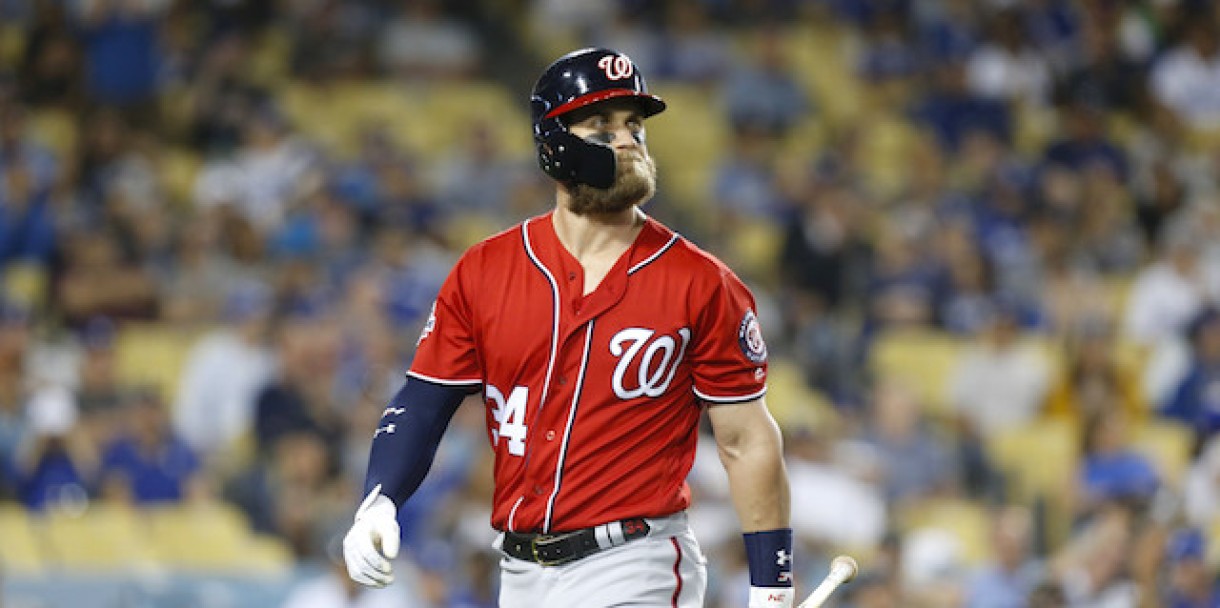
Elliott Baas looks at Washington Nationals outfielder Bryce Harper's problems when facing defensive shifts and how he can adjust to put together a strong second half of 2018.
Going into the break one of the hottest topics in baseball was the struggles of Bryce Harper. From a real baseball perspective Harper has still been above average at the plate with a 119 wRC+ and .351 wOBA, but he hasn’t been the first-round caliber player that we expected going into the season. This is the second down year in three years for Harper, who was slightly worse in 2016 with a 112 wRC+ and .343 wOBA. While he has been good from a real baseball perspective, a .214 AVG has been an albatross on what was supposed to be a monster year going into free agency.
Popular theories surrounding Harper’s extended slump have ranged from contract year yips, to lack of hustle, to the villainous shift eating up would-be hits. Harper’s agent Scott Boras even publicly criticized the shift as “discriminatory” towards left-handed batters and called it bad for the game.
Unless you are Bryce Harper or Bryce Harper’s therapist there is no way to accurately account for the mental impact the contract year has on him. Besides, it seems unethical for a therapist to own one of his or her clients in fantasy baseball. Lack of hustle is, again, something we cannot account for in player evaluation. Unless Bryce Harper’s failure to run out groundballs has cost him 34 infield hits that doesn’t explain the batting average drop either. The only thing we can potentially hope to quantify is the impact of the shift.
Featured Promo: Save 50% off the regular price with discount code SUMMER, for a limited time. Exclusive access to our Team Sync platform, DFS cheat sheets, Lineup Optimizers, betting/prop picks, and exclusive content from Nick Mariano and Eric Cross! GAIN ACCESS NOW
Holy Shift!
This season Bryce Harper has faced a defensive shift in 59.6% of his plate appearances, ranking 38th in baseball among 591 batters that have had at least 25 PA this season. If we up the threshold to 250 PA Harper ranks 20th among 195 hitters. This is a much higher percentage of shifts than Harper has ever seen before, and the next highest rate was 27.7% in 2016. Even though he is seeing a lot of shifts Harper hasn’t been victimized as much as some other hitters. Chris Davis has been shifted against the most, as defenses have shifted 91.2% of the time while Chris Davis is at the plate. Davis already has plenty working against him, but the amount of shifts he sees may have exacerbated his already deteriorating skills. While Scott Boras’ complaints to media about the shift looks like sour grapes he may have a point about the shift unfairly affecting left-handed batters. The most shifted against right-handed batter is Edwin Encarnacion, who has faced the shift 51% of the time, 48th most in the majors. Every player above him is either left-handed or a switch-hitter, and altogether only 16 of the top 100 batters in percentage of shifts faced are pure right-handers.
So how does facing this many shifts affect Harper? Based on the information Statcast gives us, it doesn’t. Harper has a .349 wOBA with a shift, and a .357 wOBA without a shift. A negligible difference in the grand scheme of things. Using wOBA as a measure is a little misleading because it accounts for home runs, walks, and strikeouts. These are called the three true outcomes for a reason, and a shift is irrelevant on them. Since Statcast doesn’t get in depth on a batter’s statistics against the shift versus no shift the next best measure would be to judge Harper’s statistics on pulled balls this season versus years past.
To begin with, Harper is pulling the ball 44.6% of the time, the second highest rate of his career behind only his 2015 MVP season. For his career Harper is hitting .368 with a 1.135 OPS and .295 BABIP on pulled balls-in-play (BIP). This season Harper is hitting .291 with a .223 BABIP on pulled BIP. Harper is down 72 points in BABIP compared to his career averages. Problem solved, right? Not quite. While we can glean some valuable information from this exercise, this is an imperfect measurement for a few reasons.
One, pulled BIP are just that, balls-in-play. They don’t account for strikeouts or walks, two things that certainly influence overall performance but are unaffected by the shift. Second, just because a BIP is pulled doesn’t mean Harper was shifted against. Defenses are still lining up traditionally 40.4% of the time against him. Third, the shift doesn’t only affect pulled BIP, it affects all BIP. We think of a shift as loading up every defender on the left side of the infield, but remember that somebody is usually standing right over second base. The shift is designed to defend against where the batter is most likely to hit the ball, which does not only encompass the pull-side.
There is one other measure we can use to try and glean information about Harper’s struggles, and that is performance on batted ball type. Flyballs can largely be disregarded, because they are not as affected by the shift compared to line drives and groundballs. Flyballs are usually home runs or easy outs and the shift won’t have as big of an impact on them. Whether groundballs are hits or outs depends heavily on defensive positioning, and this season Harper is hitting just .165 on groundballs (batting average and BABIP on groundballs will always be equal) compared to his career .255 AVG on grounders. A 90 point drop off and 71 points below the league average of .236. That dip in production still pales in comparison to his drop in line drive performance this season.
This season Harper is hitting .522 with a .500 BABIP on line drives, and that is a big drop off compared to his career .692 AVG and .678 BABIP. It’s also way below the league’s average on line drives, which is a .683 AVG and .675 BABIP. Line drives are by far the most likely batted ball type to fall in for a hit, yet Harper can't buy a hit, even for $400 million. He is currently tied with four other players (Ryan Braun, Russell Martin, Eric Sogard, Delino DeShields) for the lowest BABIP on line drives. Ryan Braun is the only other player of the five that could be described as a good hitter getting unlucky, as the others mostly make weak contact easily playable for defenders. One way to visualize the difference in Harper’s outcomes is by comparing his spray charts (source: fangraphs.com) from seasons past. Here are his spray charts from the past four seasons in chronological order.


The increase in pull rate is glaring by comparing these charts. As mentioned previously, Harper is pulling the ball more this season at 44.6%. The only other year he pulled the ball over 40% of the time was his 2015 MVP season, where Harper posted 9.3 WAR and a .461 wOBA. In 2015 Harper was shifted against 18.3% of the time, and that number has more than tripled this season. The way Harper was hitting the ball that season has been remarkably similar to this season. Here is a blind side-by-side comparison to demonstrate their similarity.
| Statistic | Season A | Season B |
| Hard Hit % | 41% | 41% |
| Avg. Exit Velocity | 90.3 MPH | 91 MPH |
| Barrel % | 14% | 13% |
| Line Drive % | 21% | 22% |
| Flyball % | 40% | 39% |
| HR/FB % | 25% | 27% |
| xwOBA | .393 | .409 |
| xSLG | .544 | .535 |
Season A is 2018 and Season B is 2015. Most of the differences are negligible, but it’s hard to distinguish between Harper’s 2015 MVP season and his down 2018 season based on batted ball profile. This table is selective and a little misleading, however. There is one key difference that wasn’t included, which is Harper’s startling decline in contact rate. In 2015 Harper had a 75.4% contact rate, which was slightly below average but not concerning given his production. This season Harper has a dismal 69.1% contact rate, the ninth worst among qualified hitters. It’s true that contact rate has gone down over the last three years, but Harper’s drop has excelled league-wide contact rate deflation. The league-wide contact rate was 78.8% in 2015 and it is currently 77% this season, a 1.8% drop. Harper has experienced a 6% drop compared to 2015 and his career average 75.2% contact rate. He can’t blame the shift if the ball isn’t in play.
When Breaking Balls Break You
Bryce Harper’s sharp decline in contact rate cannot be excused by an increase in shifts, because if there is one thing the shift shouldn’t affect it’s the ability to put the ball in play. Harper has seen a decrease in production across the board, but the most alarming trend is his utter inability to hit breaking balls and off-speed pitches. This season Harper is batting .141 with a 42.7% whiff rate and .090 ISO against breaking balls. He's been slightly better against off-speed pitches, but he is still hitting .177 with a 39.7% whiff rate and .194 ISO. This is a massive drop off against both pitch categories, but since Harper has been worse against breaking balls and experienced a bigger decline compared to seasons past breaking balls will be the focus.
Pitch sequencing hasn’t changed against Harper, so it’s not as if pitchers are throwing breaking balls more often or earlier in the count. He has seen breaking balls 24.3% of the time this season compared to 25.5% for his career (excluding the knuckleball and slow curve, which Harper has not seen this season and has scarcely seen during his career). What about pitch location? Surely pitchers are attacking him differently, right? Here is a heat map comparison (source: brooksbaseball.net) of breaking ball location for prior to 2018 (left) and this season (right).


And here is whiff rate based on location.


Inside pitches are getting him more, outside pitches are getting him more, low pitches are getting him more, even pitches in the zone are getting him more. Harper has a career-high 14% SwStr rate this season and his Z-contact rate is down to 79% and his O-contact rate is down to 52.2% this season, both career lows.
Harper’s production has also declined against fastballs this season, but in 2017 he vastly overperformed on fastballs. He hit .360 with a with a .298 ISO on heaters in 2017, and this season he is hitting .257 but does have a .342 ISO. Harper’s batting average may have dropped over 100 points but his xBA only dropped from .312 to .286 and his xSLG is higher this season going from .592 to .644. Regression from his .356 BABIP and .319 AVG in 2017 was inevitable, and since much of that overperformance came on fastballs his dip in production against heaters is not as concerning as Harper’s inability to hit curveballs.
So, what does this all mean then? Is Harper hopelessly shafted by the shift? Although the batted ball comparisons in this article aren’t definitive, there is a clear drop-off in performance on BIP this season compared to his career and compared to league average. He is making high-quality contact that is most likely getting absorbed by shifted defenders. To combat this Harper should make a conscious effort to hit the ball the other way. He goes up the middle 29.4% of the time and the other way 26.1%, both significant drop-offs compared to last season. Not only is he being shifted against more, but he is hitting into it more too.
The contact rate issues are more alarming because they represent a stark drop in skill. The shift is something out of Harper’s control, but his ability to make contact should not be affected by it. Perhaps he is pressing in a contract year, but to reiterate an earlier point, only Bryce Harper and his therapist could know whether that is affecting him. A .226 BABIP is undoubtedly unlucky, and Harper should experience better outcomes going forward. The effect of the shift and the drop in contact rate limit the extent of his recovery. The power numbers and walk rate should be good enough to keep him afloat, but be won’t be able to hit close to .300 like this, and might struggle to hit above .250 in the second half unless things change dramatically.