RADIO
RADIO






Andy's starting pitcher fantasy baseball busts to avoid in 2026 fantasy baseball drafts. These overvalued starting pitchers are his fantasy baseball avoids.
Navigating the early rounds can be the difference between setting yourself up for success and creating a major hole to dig out of. While leagues are not won (or lost) in the opening rounds, avoiding landmines can be the difference between finishing within the top three or the bottom half of your roto league.
In this piece, we will spotlight five pitchers who are going inside the top 115 picks in NFBC drafts and are potential landmines at their current price. While these pitchers are not "must-fades", they would have to have seen many things go right to live up to their current cost.
Who are five pitchers you should think twice before selecting on draft day? Let's dive in!
Featured Promo: Save 50% off the regular price with discount code CHAMP, for a limited time. Exclusive access to our Team Sync platform, DFS cheat sheets, Lineup Optimizers, betting/prop picks, and exclusive content from Nick Mariano and Eric Cross! GAIN ACCESS NOW
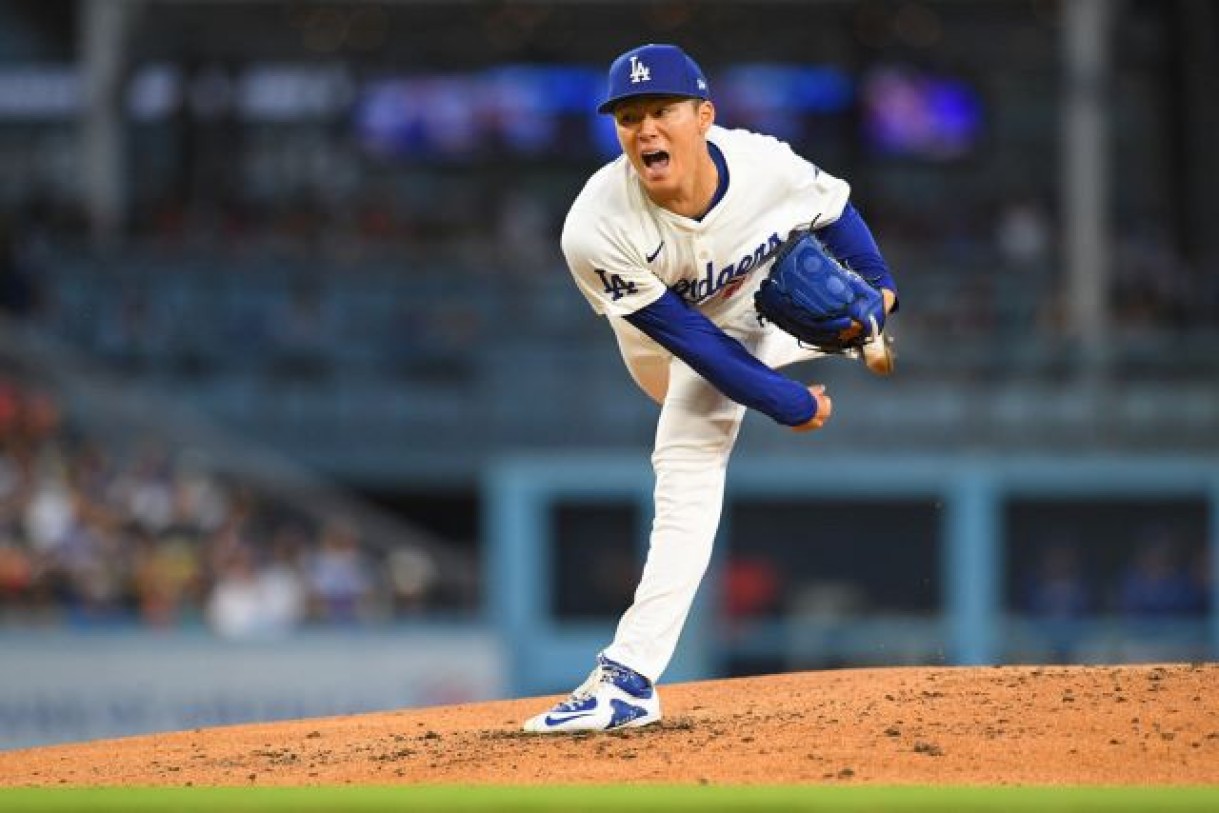
Yoshinobu Yamamoto, Los Angeles Dodgers
ADP - 26.4 (SP4)
The consensus SP4 in drafts is World Series hero Yoshinobu Yamamoto. With the top three (Tarik Skubal, Paul Skenes, and Garrett Crochet all going within the top 11 picks), Yamamoto sits on an island as the SP with a 26.4 ADP, as the SP5 (Cristopher Sanchez) is not going until pick 32.0.
After a somewhat underwhelming debut season that was hindered by a slow start and injuries, Yamamoto enjoyed a breakout campaign in 2025. Last season, the right-hander posted a 2.49 ERA with a stellar 0.99 WHIP. Across 173 2/3 innings, Yamamoto struck out 201 hitters but struggled with his command, allowing walks at a rather high 8.6% rate. However, his 92nd percentile .199 xBA kept his WHIP low.
During his debut season, Yamamoto was limited to only 90 innings of work and held a 3.00 ERA with a 1.11 WHIP.
Yamamoto relies on his four-seamer (35.2% usage), which generated a .290 xwOBA with a 19.2% whiff rate. He was able to rack up strikeouts with his No. 2 pitch, his split-finger (25.5% usage), which generated a remarkable 42.1% whiff rate and a .180 xwOBA.
However, while the talent is not in question, the concern for Yamamoto is his workload. After logging only 90 innings as a rookie, being immediately bumped to a massive workload of 173 2/3 innings is quite alarming for a pitcher. He does not have a long track record of being a consistent workhorse, which makes his SP4 price tag hard to swallow.
Additionally, the Dodgers are expected to deploy a six-man rotation in 2026, which will cap Yamamoto's ceiling. With Shohei Ohtani back to his full pitching workload, Tyler Glasnow back in action, and Roki Sasaki slated to return to the rotation, Yamamoto will only see one start a week (assuming no other pitcher is injured).
While Glasnow and Blake Snell will likely spend time on the IL (and Snell may even miss the opening weeks of the season), Yamamoto is also not a safe bet to maintain perfect health, given his inconsistent rookie season.
The talent is elite, but the projected workload will not allow him to enjoy an SP4-caliber season. ATC projects Yamamoto to log 158 innings of work with a 3.27 ERA, 1.12 WHIP, and 170 punchouts. Wait another round and grab an SP1 with a much safer workload, like Hunter Brown or Max Fried.
I will not draft Yoshinobu Yamamoto at cost (ADP 24.8 @TheReal_NFC)
Going as the SP4 with real workload concerns
Best-case: ~170 IP (ATC projects 158)
In a six-man rotationI’ll gladly wait 15 picks and take Logan Gilbert as my SP1 pic.twitter.com/iVTHhBec2l
— Andy Smith (@A_Smith_FS) January 27, 2026
Jacob deGrom, Texas Rangers
ADP - 52.8 (SP11)
After logging just 105 1/3 total innings from 2022 through 2024, Jacob deGrom turned back the clock in 2025, as he tossed 172 2/3 innings. He held a 2.97 ERA with a stellar 0.92 WHIP. He struck out hitters at a high 27.2% rate (83rd percentile) and maintained strong command, allowing walks at a 5.5% rate (89th percentile).
However, sitting just outside the top 50 managers will need to pay a high price tag for a pitcher who finally eclipsed the 170-innings mark for the first time since 2019.
Even though he remained healthy and tuned in an impressive bounce-back season, his production was a stark decline from his dominant early-career totals. While his strikeout rate remained above average, it was his lowest mark since the 2016 season. Additionally, his 5.5% walk rate was his highest since the 2020 season.
Under the hood, deGrom generated a 9.2% barrel rate with a 41.9% hard-hit rate, both of which were within the 37th percentile among qualified pitchers. He generated a base .259 wOBA with an alarming .369 xwOBACON, suggesting the 36-year-old could be in store for some serious regression in 2026.
His No. 2 pitch, his slider, generated a .273 xwOBA, which was a massive jump from the typical .180 xwOBA it generated during his prime seasons. While this mark is still low, his primary whiff pitch is not as elite as it once was, suggesting that deGrom is nearing the end of his dominant run.
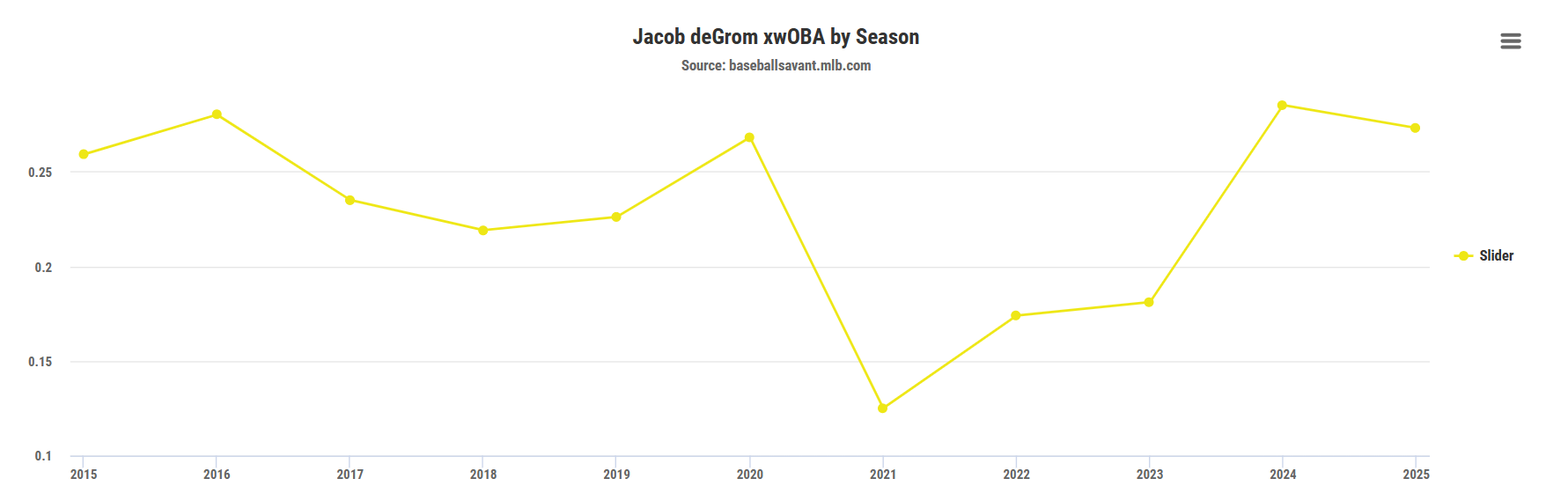
Additionally, the slider generated a whiff rate of 39.0%, a massive decline from the 50.1% whiff rate averaged from 2020 through 2023.
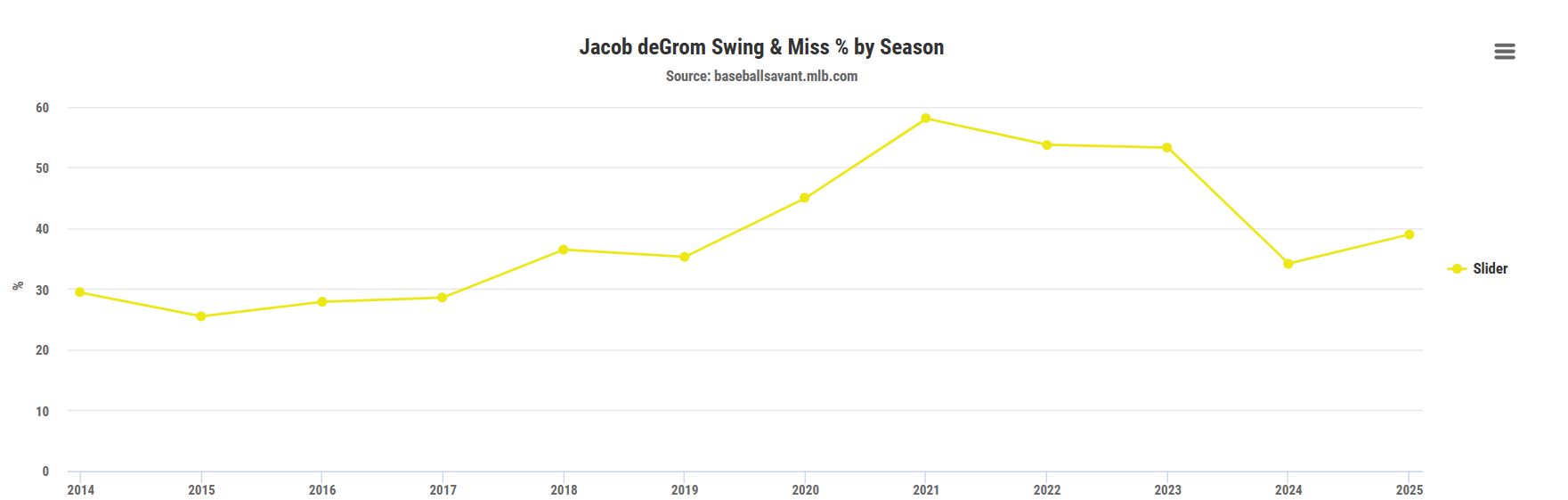
With his declining strikeout profile and high injury risk, deGrom is a massive landmine going off the board at SP11. Managers can target a pitcher with a much higher floor, a few picks later, like the previously noted Fried, or target an elite strikeout option in Cole Ragans.
Freddy Peralta, New York Mets
ADP - 67.5 (SP15)
Freddy Peralta was one of the top names on the trade market this winter and was dealt to the Mets in January. In return, the Mets sent two of their top prospects, Brandon Sproat and Jett Williams. After leading the Milwaukee rotation for the past few seasons, Peralta is now expected to serve as the ace in Queens.
Peralta turned in a career season in 2025, which caused his ADP to skyrocket into the opening rounds. With the Brewers, the right-hander logged 176 2/3 innings to the tune of a 2.70 ERA and a 1.08 WHIP. He picked up an eye-catching 17 victories, pitching for the top team in the NL Central.
His 2.70 ERA was a career best and a stark drop from the 3.73 ERA he averaged over the previous three seasons. His 1.08 WHIP was right in line with the 1.14 WHIP he held from 2022 through 2024.
A look under the hood suggests Peralta will likely return to his mid-3.00s ERA in 2026. He generated a 3.43 xERA, a slight improvement from the 3.83 xERA he generated back in 2024. However, his .353 xwOBACON was very similar to his 2024 .378 xwOBACON, suggesting his profile has not improved much, contrary to his base statistics.
He made a slight tweak to his pitch repertoire, which may have helped drive the breakout season, as evidenced by the lower slider usage rate (21.6% - 9.4%), and instead, opted to raise his changeup usage (17.5% - 21.2%) and curveball usage (7.1% - 15.8%).
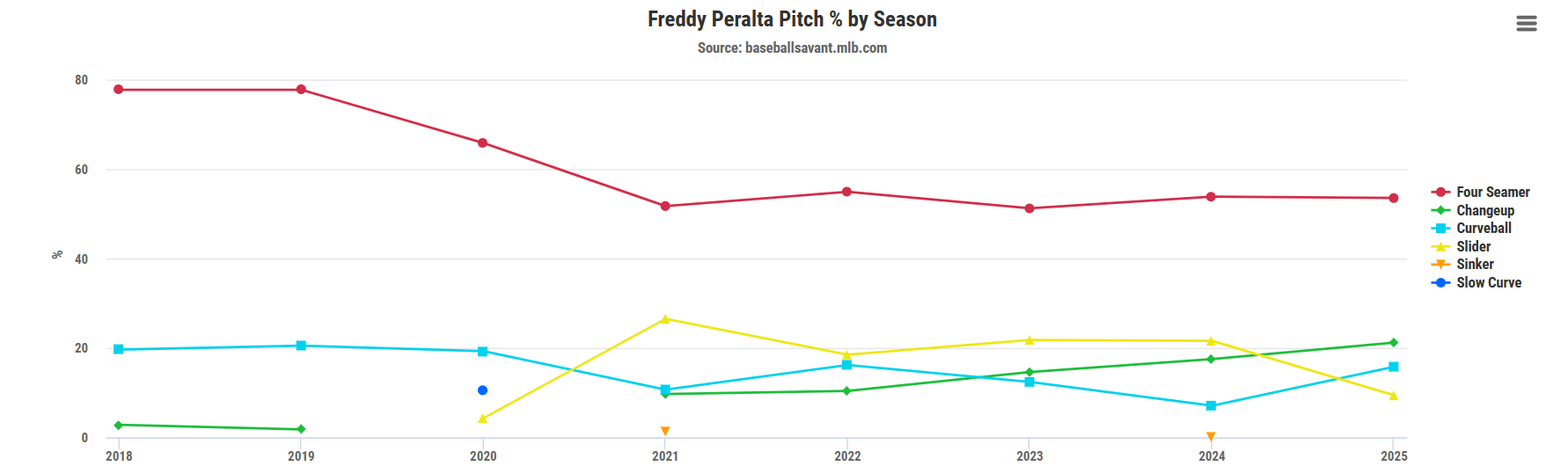
The increased deployment of his curveball was a useful change, as this pitch boasted an elite .182 xwOBA with a 34.5% whiff rate this past season.
While Peralta should remain a viable high-end SP3/mid-end SP2 in 2026, he is being drafted as a borderline low-end SP1. Given the expected regression in ERA, Peralta does not appear to have high-end SP2 production in his outcome.
ATC projects the newly-acquired Met to post a 3.76 ERA with a 1.18 WHIP in 2026, making him a bust at his current price tag.
Spencer Strider, Atlanta Braves
ADP - 112.5 (SP27)
Spencer Strider had a slight delay in the 2025 season after undergoing an internal brace procedure the year prior. After posting a 3.86 ERA, 1.09 WHIP, with a 281:58 K:BB back in 2023 (across 186 2/3 innings), Strider was a prime "draft-and-stash" candidate as he would prove SP1 upside as soon as he returns to the bump.
While he returned early in April, Strider was a major disappointment in his first year back post-injury. Through 125 1/3 innings, Strider struggled, posting a hefty 4.45 ERA with a 1.40 WHIP. He tallied only 131 punchouts at a low 24.3% rate, a stark drop from the 36.8% and 38.3% rates he posted in 2023 and 2022.
Additionally, Strider's walk rate jumped to 9.5%, an increase from the 8.0% he averaged in 2022 and 2023.
In his prime, Strider was a three-pitch pitcher (four-seamer, slider, changeup) with a high four-seamer and a slider accounting for nearly 90% of his usage. In 2023, his four-seamer boasted a .319 xwOBA while his slider racked up whiffs at an eye-catching 55.7% rate. However, in 2025, his pitches show massive regression,
This past season, Strider once again leaned on his four-seamer and slider (making up 86.5% of his pitch usage) while his newer curveball and changeup were mixed in. However, his four-seamer posted a .392 xwOBA, the highest of his career (over a full season) with a low 15.3% whiff rate. His slider posted a much-lower 48.6% whiff rate as well.
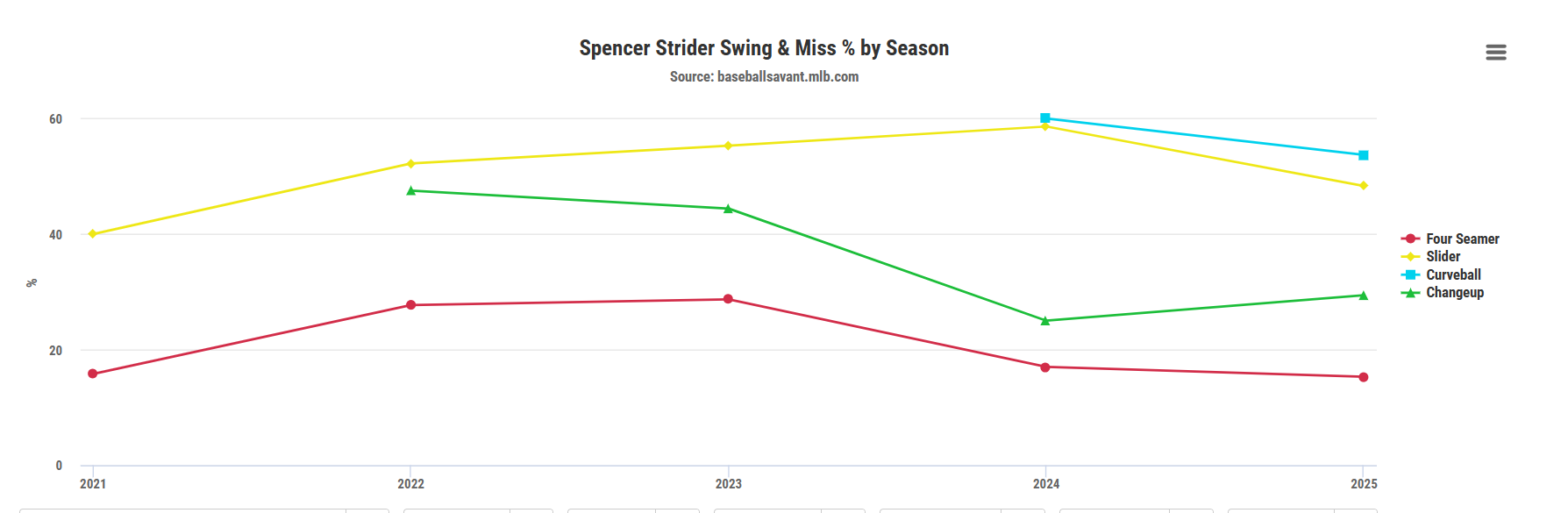
Additionally, his slider was not as dominant, posting a .281 xwOBA, compared to the .205 xwOBA it held back in 2023.
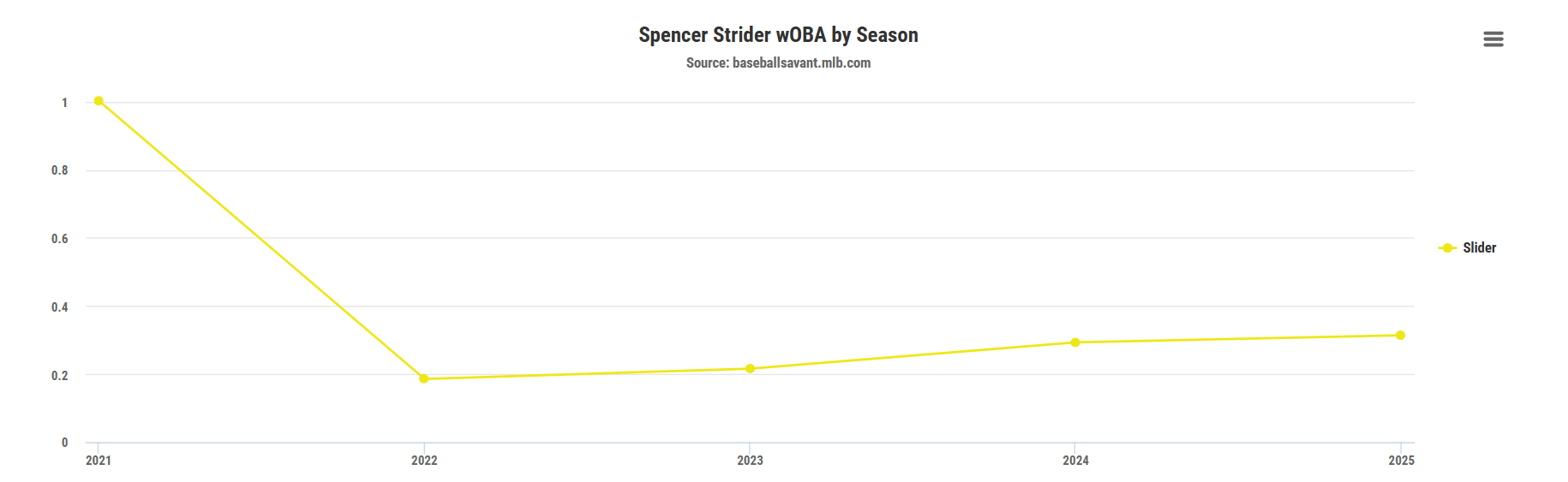
Overall, he generated a 4.93 xERA (14th percentile) with a .253 xBA (26th percentile).
While Strider could round back into form with a healthy offseason, managers will have to pay up for it. The underlying metrics are not overly promising, and especially not worthy of a selection just outside the top 100 picks.
Nolan McLean, New York Mets
ADP - 103.1 (SP26)
Rounding things out will be a rookie who has gotten a little too much preseason hype in early drafts. Nolan McLean made his MLB debut in mid-August and was a late-season league winner as he logged 48 innings to the tune of a 2.06 ERA and a 1.04 WHIP. During this brief debut, McLean struck out 57 batters while walking hitters at a modest 8.5% rate.
Earlier in the season, he logged 113 2/3 innings across Double-A and Triple-A and posted a 2.45 ERA with a 1.13 WHIP. During this stretch, he racked up 127 strikeouts with 50 free passes. Overall, he posted a 27.2% K% in the upper levels, but that jumped to 30.3% in the big leagues. While early drafters see this as a breakout indicator, savvy managers should pump the brakes, as this may not be sustainable.
During his first taste of action in Queens, McLean posted a hefty 21.2% CStr% (called-strike rate), which was the highest of his career in a given stint where he logged at least 40 innings with a club. He also generated swinging strikes at a low 10.9%, which was a drop from the 14.3% rate he posted at Double-A and the 11.4% he posted at Triple-A earlier that season.
Overall, his CSW% (Called+swing-strike rate) at the majors was 32.2%, higher than the 29.2% he generated in the minor leagues, suggesting he is due for regression in the strikeout department.
McLean relies on a kitchen-sink approach, deploying four pitches at least 13.0% of the time and mixing in two other pitches at last 8.0% of the time. His top pitches, his sinker and sweeper, were thrown 53.6% of the time. The sinker generated a low 18.7% whiff rate while his sweeper (his primary "whiff" pitch) posted a modest 20.3% whiff rate.
While his No. 3 pitch, his curveball, was effective in generating swings and misses, his sweeper will need to be more consistent for him to sustain these strikeout totals over his first full season.
His batted-ball profile also suggests regression could affect his ratios. McLean generated a high 43.4% hard-hit rate with a modest 8.0% barrel rate. Additionally, his 3.53 xERA further suggests that his first full season in the big leagues could come with a few bumps in the road.
ATC projects McLean to tally just 145 strikeouts across 147 innings of work. Managers should instead pivot to another budding star, Chase Burns, who possesses immense upside, especially when looking for strikeouts, but is going nearly 20 picks later in the current ADP.
More Fantasy Baseball Advice
Download Our Free News & Alerts Mobile App
Like what you see? Download our updated fantasy baseball app for iPhone and Android with 24x7 player news, injury alerts, sleepers, prospects & more. All free!