



 RADIO
RADIO









Rick's high-upside catcher breakout candidates, sneaky 2026 later-round draft values to outperform their ADPs. Draft the next fantasy baseball breakouts including Samuel Basallo, Carter Jensen, Harry Ford, more
Catchers are the bane of every fantasy manager's existence. They rarely produce like other position players and require far more off days. Many formats also need two, doubling the pain and suffering associated with the position.
The number of catchers you need dictates how you should approach the position. Managers in one-catcher formats can afford to wait for whatever cheap option falls into their lap, monitoring the waiver wire for upgrades. Two-catcher formats generally require draft-day selections since the wire will be barren.
Fortunately, there will be catcher breakouts in 2026. Below, we profile five catchers with an ADP of 150+ who have fantasy upside without an exorbitant price tag.
Featured Promo: Save 50% off the regular price with discount code CHAMP, for a limited time. Exclusive access to our Team Sync platform, DFS cheat sheets, Lineup Optimizers, betting/prop picks, and exclusive content from Nick Mariano and Eric Cross! GAIN ACCESS NOW
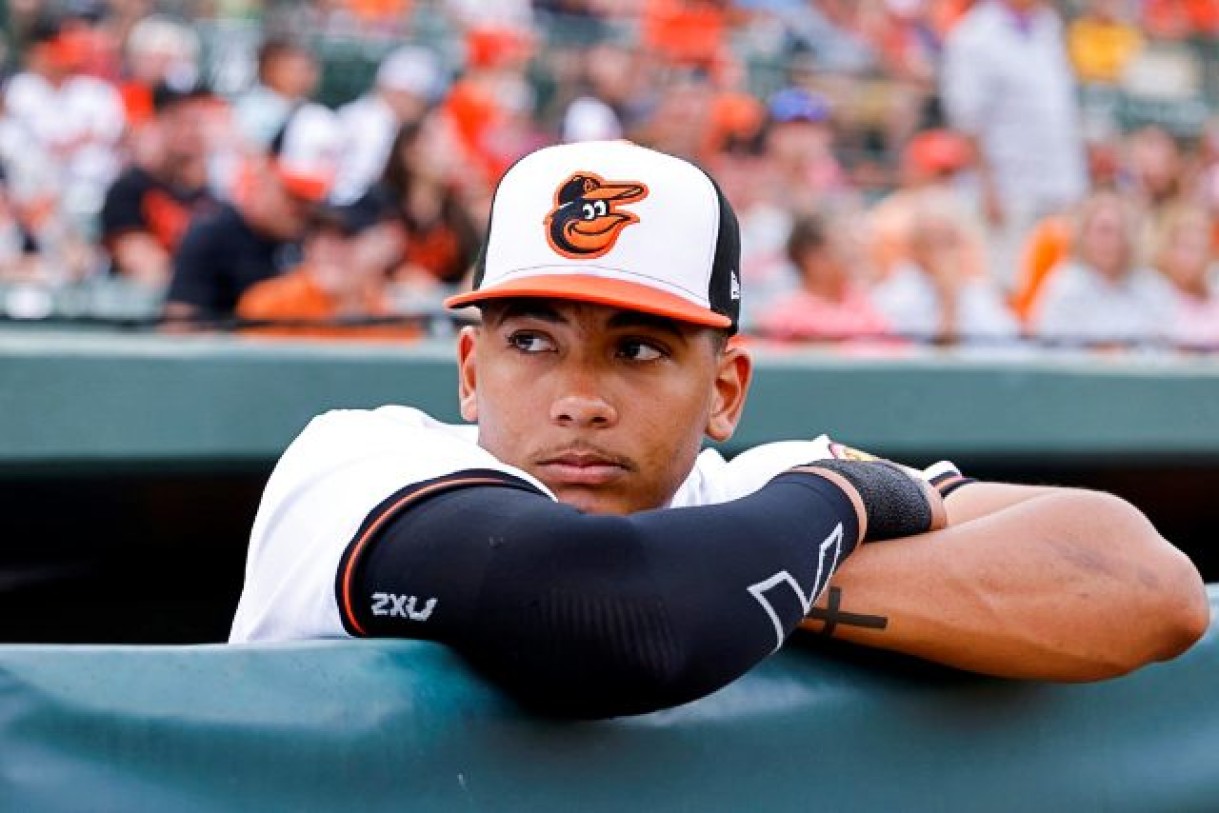
Samuel Basallo, Baltimore Orioles
ADP: 169.09
Basallo joined the parade of Baltimore prospects struggling when first called up in 2025, slashing just .165/.229/.330 with four homers across 118 plate appearances (PAs). His .187 batting average on balls in play (BABIP) had a lot to do with it, but his 25.4 K% and 5.1 BB% didn't do him any favors either.
Basallo doesn't have a huge MLB sample, and he demonstrated real growth in the minors last season. In 2024, he hit .289/.355/.465 with 16 homers in 446 PAs at Double-A. His plate discipline was solid with a 9.2 BB% against a 19.1 K%, but he struggled to get to his power with a 31 FB% and 33% in-field fly-ball rate (IFFB%).
Basallo wasn't hitting enough flies, and a third of the flies he hit were classified as useless pop-ups. His 16.5% HR/FB wasn't bad, but fantasy managers needed to see more flies to care about him.
That's exactly what he did at Triple-A last season. He slashed .270/.377/589 with 23 homers in 321 PAs, recording significant improvements in his FB% (40%) and his IFFB% (12.8%). Basallo also saw his HR/FB spike to 29.5%, but that was at least partially due to Triple-A's hitter-friendly environment. The changes to his batted-ball profile represent skill improvements.
Many players see their plate discipline deteriorate as they add loft, but Basallo's 13.7 BB% and 23.7 K% were arguably better than his Double-A rates the prior season. His 32.6% chase rate and 13 SwStr% were decent as well, with the latter a slight improvement over his 2024 rate of 13.4%.
Basallo's improvements on flies followed him to Baltimore, as he posted a 40.5 FB% with a microscopic 3.1 IFFB% in his short MLB sample.
He chased way too many pitches with a 40.8% chase rate, but that was probably just a 20-year-old being a little overzealous in his first taste of The Show. He had a much more disciplined approach on the farm, which should help him reduce his 14% SwStr%.
Perhaps most importantly for our purposes, Basallo looks like he'll be a non-catching catcher who carries "C" eligibility without actually catching. Adley Rutschman is Baltimore's unquestioned starter behind the dish, with Basallo expected to split 1B/DH duties with Pete Alonso. That could allow Basallo to rack up more PAs than other catchers and produce more fantasy value.
Starting your backup catcher at another position can get awkward if injury strikes, and Basallo will have to hit for the Orioles to force him into the lineup. Still, there is breakout potential here.
Carter Jensen, Kansas City Royals
ADP: 202.01
Jensen hit .300/.391/.550 with three homers in 69 PAs last year, and his Statcast page would be blood red if he had enough PAs to qualify:
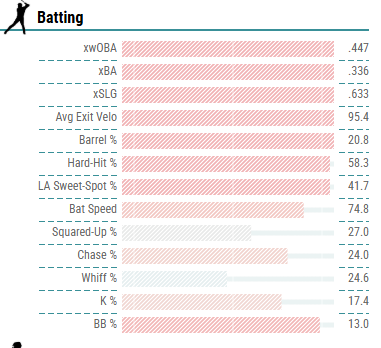
Yes, it's a small sample, but you can't fake contact quality over any sample size.
Jensen's 2025 looks even better under the hood. His 13 BB% nearly equaled his 17.4 K%, and both were supported by his 28.1% chase rate and 10.9% SwStr%. A relatively low 33 FB% also supported his .333 BABIP, so regression shouldn't be as severe as it might be for others.
Jensen's offense is supported by his MiLB history, too. He hit .233/.300/.480 with eight homers in 170 PAs at Double-A in 2024. His 55.6 FB% was too high and led to a .267 BABIP, and his plate discipline needed work with an 8.8 BB%, 26.5 K%, and 12.5 SwStr%. Still, the power was a good start for a catcher.
Jensen improved dramatically last year, hitting .290/.377/.501 with 20 homers and 10 steals over 492 PAs split between Double-A and Triple-A. His 10.7 SwStr% was an improvement of nearly two full ticks, helping his BB% increase to 12.2 while his K% decreased to 24.8. His 36.8 FB% also became more realistic, and Jensen may have overcorrected on that front.
Jensen's BABIP surged to .361 while his HR/FB rose from 13.3% in 2024 to 19.6% last season, setting the stage for his highly successful debut as a Royal.
The biggest knock on Jensen is probably his playing time, but the Royals should figure out how to get the 22-year-old on the field. Salvador Perez is 36 and shouldn't be the iron man he once was. Jensen also has first experience when Vinnie Pasquantino needs a day off and is otherwise projected to see DH time. Kauffman Stadium is also moving the fences in, potentially boosting Jensen's HR total.
In short, Jensen should play enough to impact fantasy teams, and even 80 percent of last year's production will represent a breakout in 2026.
Harry Ford, Washington Nationals
ADP: 515.95
Ford made his MLB debut last season, but we won't learn anything from his eight PAs as a Mariner. We can learn from his MiLB work, which shows Ford as the rare catcher-eligible player who can make a meaningful contribution in stolen bases.
Check out how aggressive he's been on the farm:
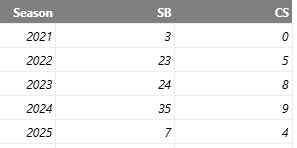
What other catcher offers 20 SB upside, much less 30? Last year's SB numbers were disappointing, but Washington is aggressive on the bases and doesn't mind caught stealings (tied for second in MLB at 48 last season), so Ford should get every opportunity to run.
You can't steal first base, but Ford has hit in the minors. He hit .249/.377/.367 with seven homers in 523 PAs at Double-A in 2024, demonstrating an advanced plate approach (14.1 BB%, 22 K%, 10.5 SwStr%) and a footspeed-aided .323 BABIP. He lacked power despite a 41.3 FB% due to a 5.5% HR/FB, but he still graduated to Triple-A in 2025.
Ford was even better last year, slashing .283/.408/.460 with 16 homers in 458 PAs. His 16.5% chase rate and 8.6 SwStr% suggest total mastery of the level and support his 16.2 BB% and 19.2 K%. He also cut his FB% to 30.5, giving him more opportunities to use his legs to beat out base hits. His HR/FB even increased to 18.4%, so he shouldn't be a total zero in HR.
Ford already plays MLB-caliber defense, and his advanced plate discipline should allow him to produce right away. The only obstacle is Keibert Ruiz. While the 22-year-old Ford has the upside the Nationals should be chasing, Ruiz is 27 and unlikely to get much better. Ruiz put up 0.2 WAR over 1,851 PAs and is coming off a scary concussion, so the "competition" should be anything but.
Ford's ADP will skyrocket once the Nationals announce him as the Opening Day starter, so grab this potential breakout candidate in all of your early drafts.
Dalton Rushing, Los Angeles Dodgers
ADP: 524.46
Rushing didn't do much for the Dodgers last season, slashing .204/.258/.324 with four homers in 155 PAs. His plate discipline was ugly with a 6.5 BB% against a 37.5 K%, but Rushing's MiLB resume suggests he should be much better in 2026.
Rushing split the 2024 season between the Double-A and Triple-A levels, slashing a combined .271/.384/.512 with 26 HR in 503 PAs. He rarely swung and missed with a 9.9 SwStr%, and he posted a 20.8% chase rate at Triple-A. The resulting 12.7 BB% and 20.5 K% suggested he was ready for MLB, especially since he also had a 38.9 FB% and 21.3% HR/FB.
Unfortunately, the Dodgers had few openings, and Rushing spent 149 PAs at Triple-A. He torched the ball with a triple-slash line of .314/.436/.512 with five homers. Nearly all of his plate discipline metrics improved (18.8% chase rate, 8.8% SwStr%, 17.4% BB%, 21.5% K%), and he maintained his power stroke.
Rushing kept his eye in The Show, chasing just 19.9% of the pitches he saw out of the strike zone. His 14.5 SwStr% was a little high, but not insurmountable, and his minor league performance suggests he should make more contact this season.
More contact would be a good thing, as Rushing's contact quality metrics were strong last year. His max exit velocity (EV) was 112 mph despite limited playing time, tying him with solid performers Ian Happ and Alejandro Kirk.
Furthermore, Rushing's average EV on flyballs and line drives was 95.1 mph, tying him with five players, including Colson Montgomery and Bryan Reynolds. Rushing's 14% rate of barrels per batted-ball event (Brls/BBE) was the most impressive, tying him with exciting sluggers Junior Caminero, Zach Neto, and Wyatt Langford. Pretty good company, right?
Rushing is the only person on this list who probably needs an injury or trade to get consistent playing time. There was talk of outfield reps early this offseason, but the Kyle Tucker signing probably ends that experiment. Will Smith won't be dislodged as LA's primary catcher, and superstars fill both first base and designated hitter duties.
However, Rushing might also have the best underlying skills on this list. You don't need to draft him, but throw him on your watchlist and pounce if this breakout candidate gets a real chance to show what he can do.
Joe Mack, Miami Marlins
ADP: 563.71
Mack hasn't made his MLB debut yet, and at least some of you are wondering who the heck this guy is. Here's his FanGraphs scouting report as an introduction:
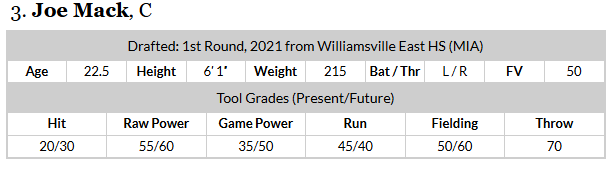
Mack is a 22-year-old former first-round pick with raw pop and plus defense, giving him a solid foundation to carve out a successful big league career. Scouts note that his "grooved, upper-cut swing" gives him "rare all-fields power for a catcher," while there's "still room for muscle on his frame".
That power comes at the price of swing-and-miss, but fantasy managers will live with that for 25 HR from a catcher. Mack hit .241/.322/.456 with 22 HRs in 475 PAs at Double-A in 2024, mitigating his 14.3 SwStr% and 25.7 K% with a 20.6% HR/FB. His 9.7 BB% wasn't bad either, though this profile wants a higher FB% than 35.5.
Mack was promoted to Triple-A last season, slashing .250/.320/.459 with 18 homers in 412 PAs. The plate discipline got worse with a 15.3 SwStr% and 27.9 K%, but he again made up for it with a 20% HR/FB. Mack's 35.6 FB% was virtually unchanged, but he cut his IFFB% in half (from 19.6 to 11.1). That's more flies with a chance of finding the cheap seats.
Mack probably begins 2026 in the minors, so he won't have an immediate fantasy impact. However, Agustin Ramirez isn't really a catcher defensively, and the Fish sacrifice defense whenever he's behind the plate. Liam Hicks is better defensively, but doesn't project to provide much pop on a team that sorely needs it.
Mack has pop, and he's thrown out 33% of potential base thieves over the last two seasons. Look for Mack to take over as Miami's everyday catcher by midsummer, with Ramirez serving as 1B or DH while Hicks remains the backup catcher.
Mack is the riskiest name on this list, but he could produce at a 30-HR pace when he gets his shot. Don't sleep on this breakout candidate when he gets the call.
More Fantasy Baseball Advice
Download Our Free News & Alerts Mobile App
Like what you see? Download our updated fantasy baseball app for iPhone and Android with 24x7 player news, injury alerts, sleepers, prospects & more. All free!