



 RADIO
RADIO






Corbin's deep dive into starting pitcher fantasy baseball breakouts, waiver wire adds for Week 4 of 2026. Are these unlikely aces potential league winners?
Welcome to the fourth edition of our Unlikely Aces series in 2026. Starting pitchers have been dealing with injuries, breaking out, and struggling early in the 2026 fantasy baseball season. It's fun to stream starting pitchers and find success. However, sometimes streaming pitchers can destroy the ratios. We should have a process for any waiver wire move, start/sit decision, or player examination.
Some pitchers possess high-end skills but don't perform well. There are instances where the data and research indicate this pitcher shouldn't perform well, but the outcomes look good. After a quality outcome, fantasy managers need to decide whether it's sustainable. Throughout the season, we'll highlight starting pitchers who have been performing well and examine whether we should buy, sell, or hold.
Are these unlikely aces for real, or is it safe to leave them out on the waiver wire, with negative regression surely coming? Let's take a deeper look!
Featured Promo: Save 50% off the regular price with discount code CHAMP, for a limited time. Exclusive access to our Team Sync platform, DFS cheat sheets, Lineup Optimizers, betting/prop picks, and exclusive content from Nick Mariano and Eric Cross! GAIN ACCESS NOW
Shota Imanaga, SP, Chicago Cubs
92% Rostered
Imanaga has been showing those skills we saw in his rookie season. That's evident in Imanaga's 33% ball rate, 16.7% swinging-strike rate, and a career-best 2.90 xERA. For context, Imanaga's swinging-strike rate fell to 12.5% in 2025. Furthermore, Imanaga's velocity increased by over 1 mph in 2026 compared to 2025.
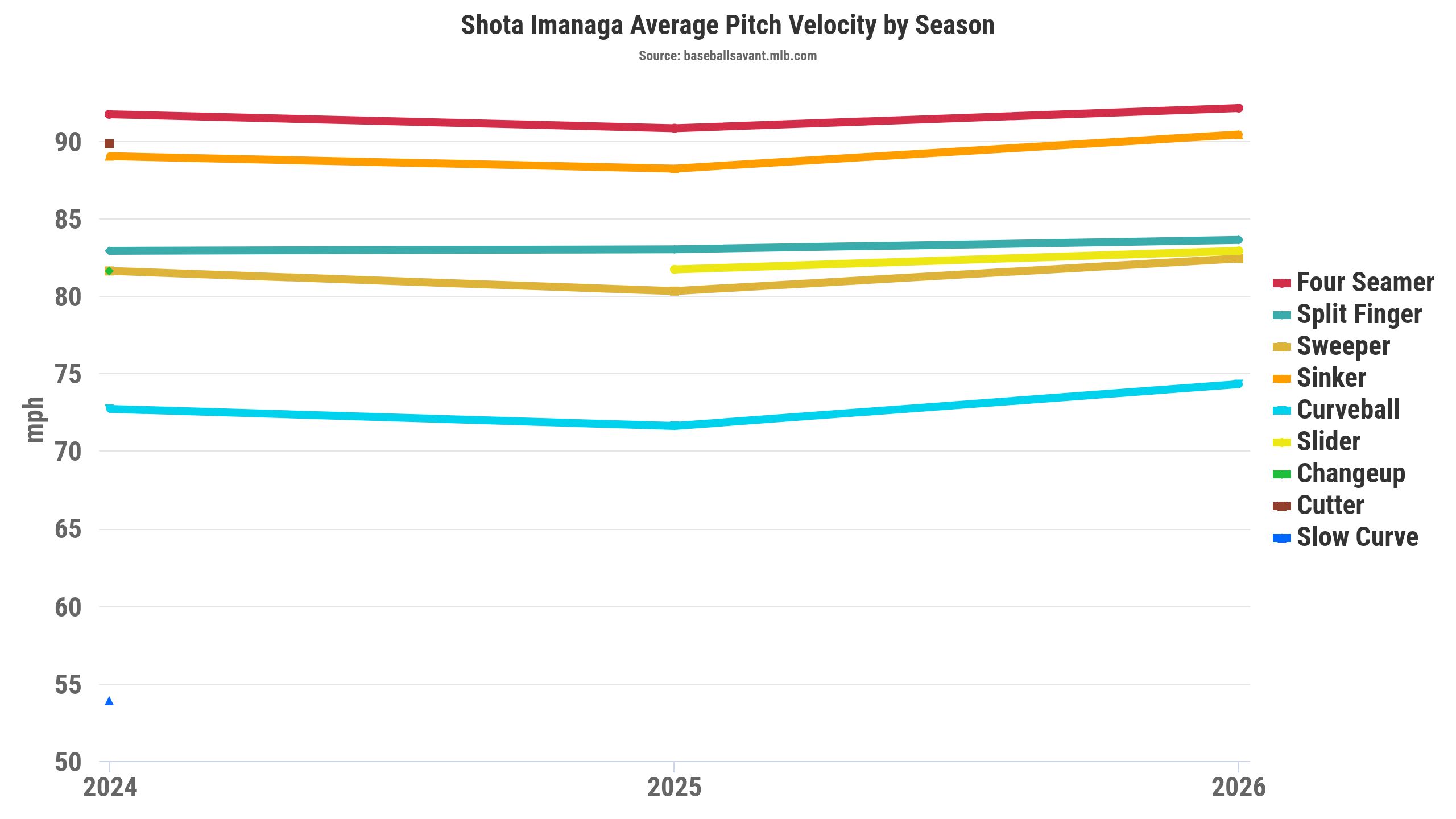
With Imanaga's velocity uptick, his four-seamer added nearly an inch of induced vertical break while maintaining the above-average arm-side fade, making the heater a high-end option. Imanaga's four-seam results against right-handed hitters in 2026 (.221 wOBA, .312 xwOBA) shifted closer to 2024.
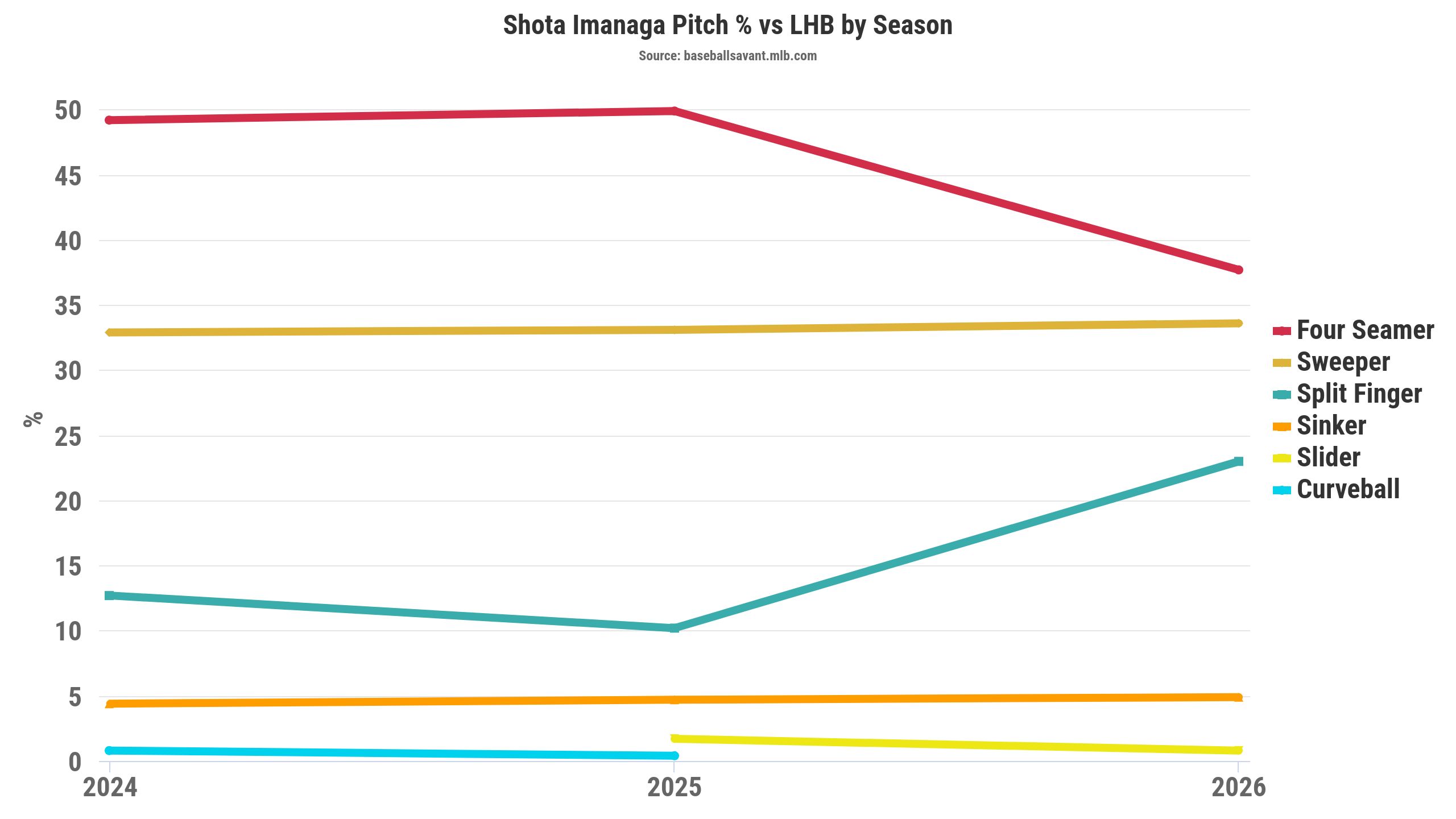
Against right-handed hitters, Imanaga consolidated his pitch mix between four-seamers (45.8%) and splitters (40.6%), accounting for over 86% of his arsenal. However, we've seen Imanaga adjust the pitch mix against lefties in 2026.
That's evident by throwing fewer four-seamers (37.7%), down 12 percentage points compared to the previous two seasons (49%). That coincided with Imanaga throwing more splitters against lefties (23%) in 2026, up from 10.2% in 2025. Imanaga's splitter generated a 25.6% swinging-strike rate in 2026, jumping back to the numbers from 2024.
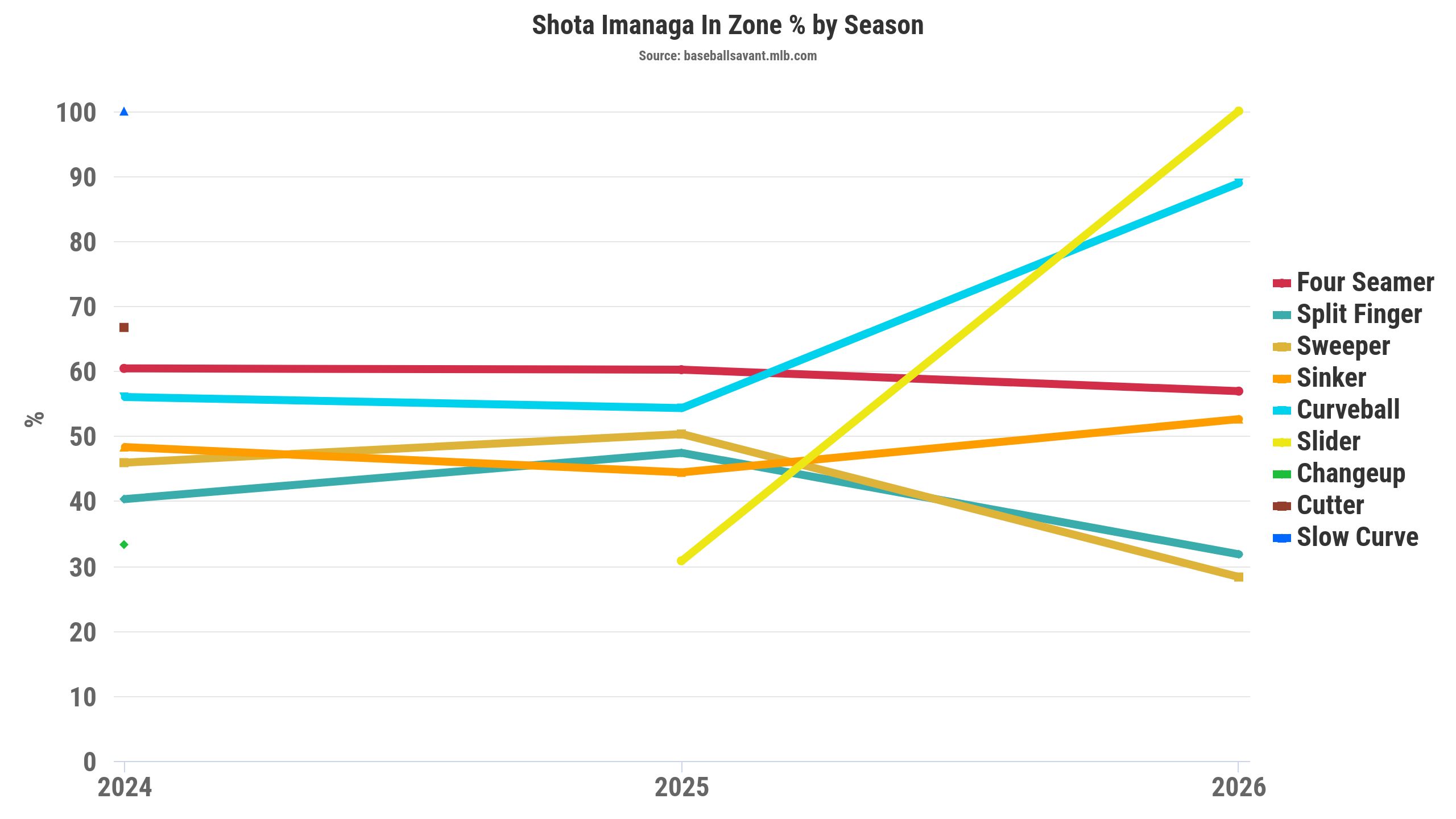
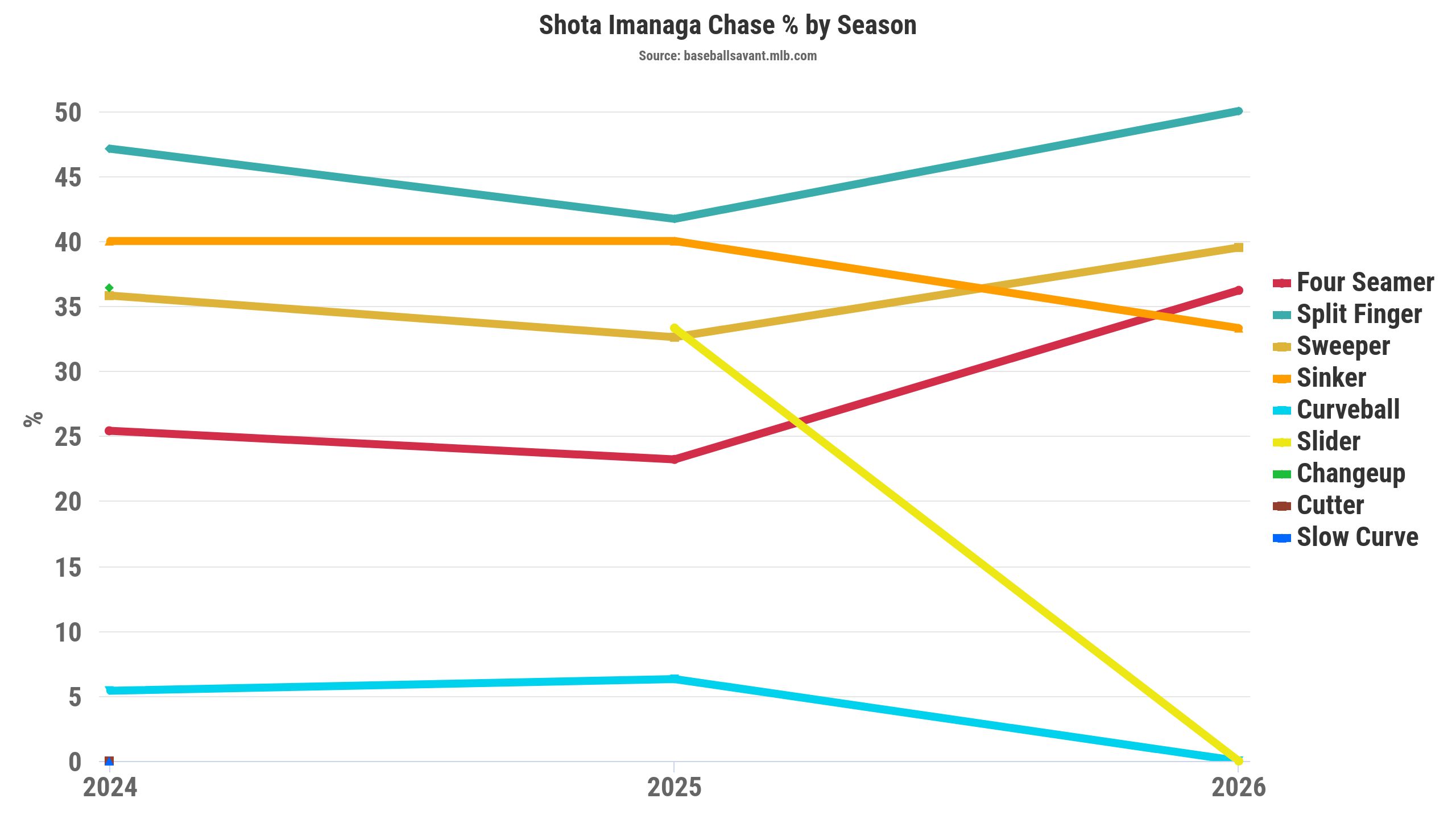
Imanaga has been throwing the splitter and sweeper less often in the zone in 2026, potentially leading to more chases outside the zone. That's evident in Imanaga's splitter having a 32% zone rate and the sweeper at 28.3%. It coincides with hitters chasing the sweeper 39.5% of the time and a 50% chase rate via the splitter, which was a 7-8 point jump from 2025.
We're dealing with a small sample in 2026, so it's understandable to be skeptical. However, we want to highlight that Imanaga is throwing from a higher arm angle again (40 degrees). That said, we noticed Imanaga maintained his vertical release point and brought his horizontal release over eight inches closer to his midline in 2026.
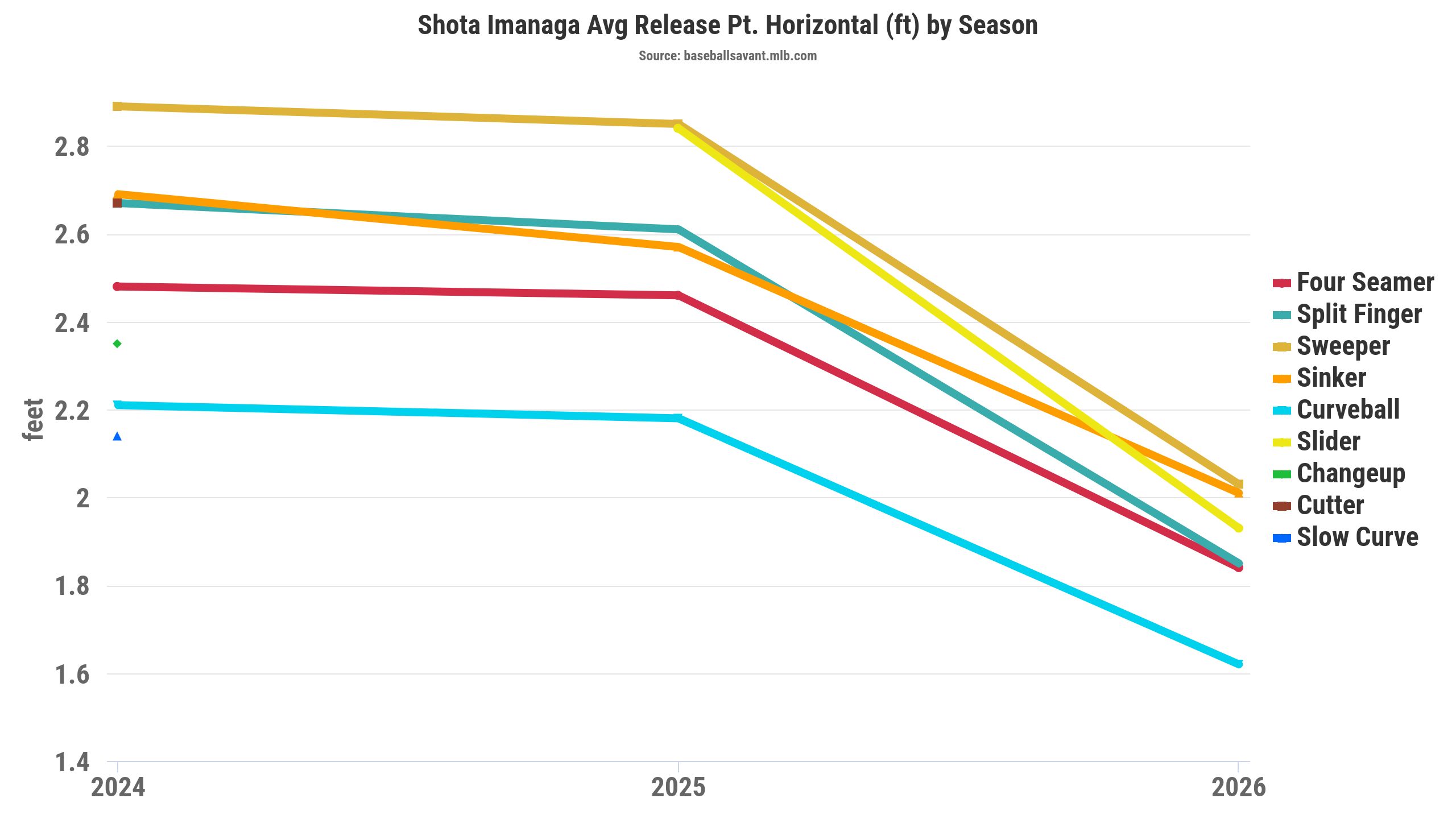
That's been the case across the board for Imanaga's pitches and their horizontal release points. There's a chance that Imanaga's higher arm angle could lead to some deception if it's over eight inches closer to the midline instead of farther away from his body. Or Imanaga might've found a better release point to command his pitches better.
In the early 2026 sample, Imanaga's Location+ via the four-seam (121), splitter (115), and sweeper (145) or curveball on FanGraphs spiked across the board. For context, Imanaga's four-seam has a career 110 Location+, with the splitter at 109 and sweeper at 107, showing significant command improvements.
Imanaga was discounted in drafts, and fantasy managers were rewarded if they bought into a bounce-back season. He has been showing ace-like skills and outcomes early in 2026.
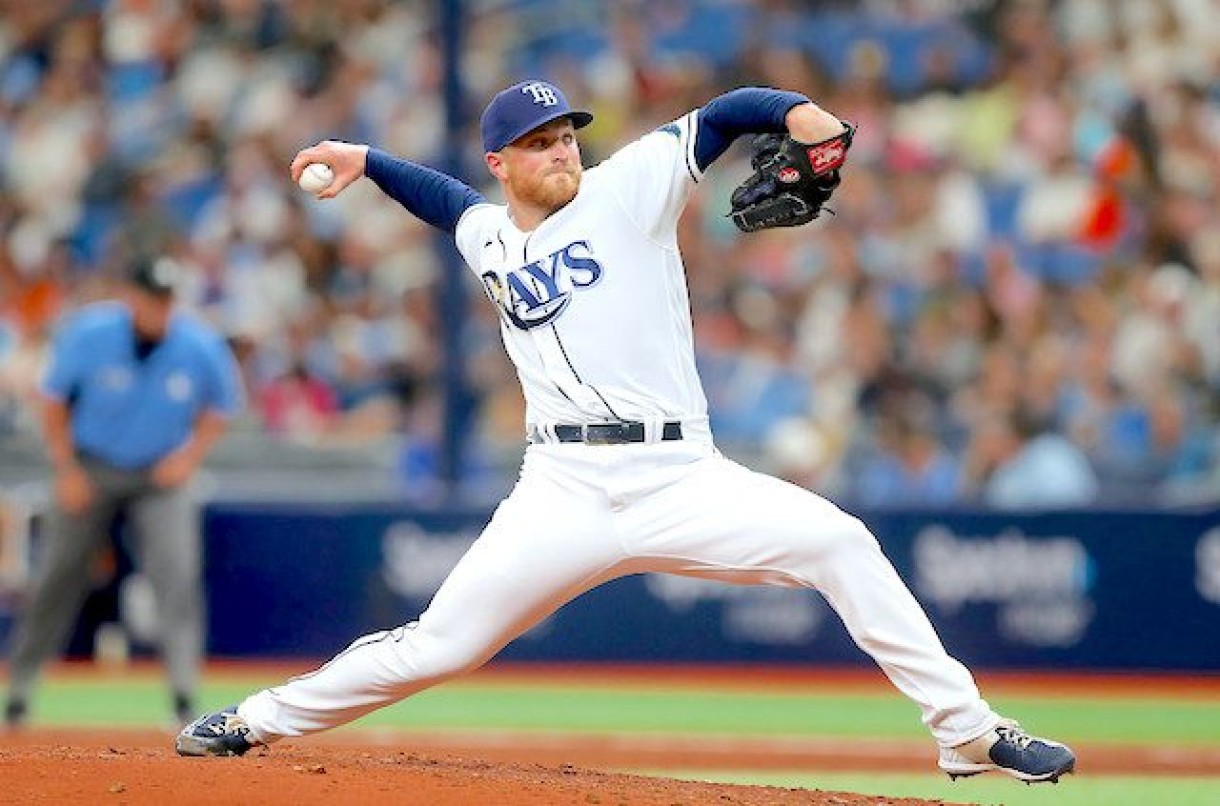
Drew Rasmussen, SP, Tampa Bay Rays
90% Rostered
Throughout Rasmussen's career, he has a 2.89 ERA and 1.05 WHIP across 480 innings. Though Rasmussen pitched as a reliever early in his career, over 62% of his innings came in those peak seasons (2022 and 2025) from an innings standpoint.
Rasmussen has been fortunate early in 2026, given a .128 BABIP and 81.1% strand rate. He typically showed strong control with a 32-34% ball rate, but his swinging-strike rate fell to 9.9% in 2026 after 10.1% in 2025. Overall, Rasmussen profiles as a high-end starting pitcher, especially on a per-inning basis.
Rasmussen's most significant pitch mix change came against left-handed hitters in 2026. That's evident in Rasmussen's cutter being thrown nearly 40% of the time (39.4%) after being at 31.6% (2025) and 26.7% (2024). That coincided with Rasmussen lowering his four-seam usage (31.3%) by 12 percentage points in 2026 against lefties.
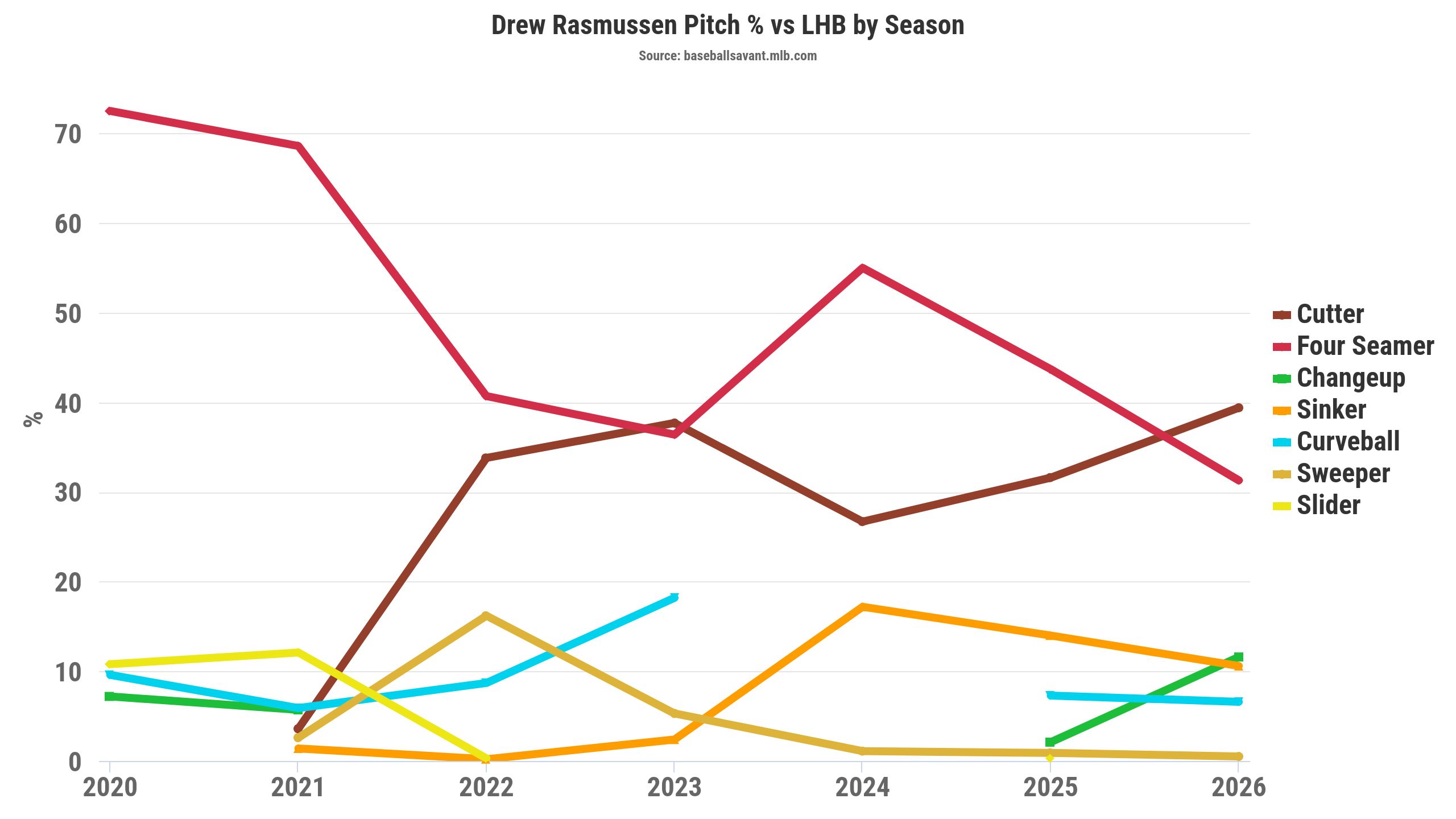
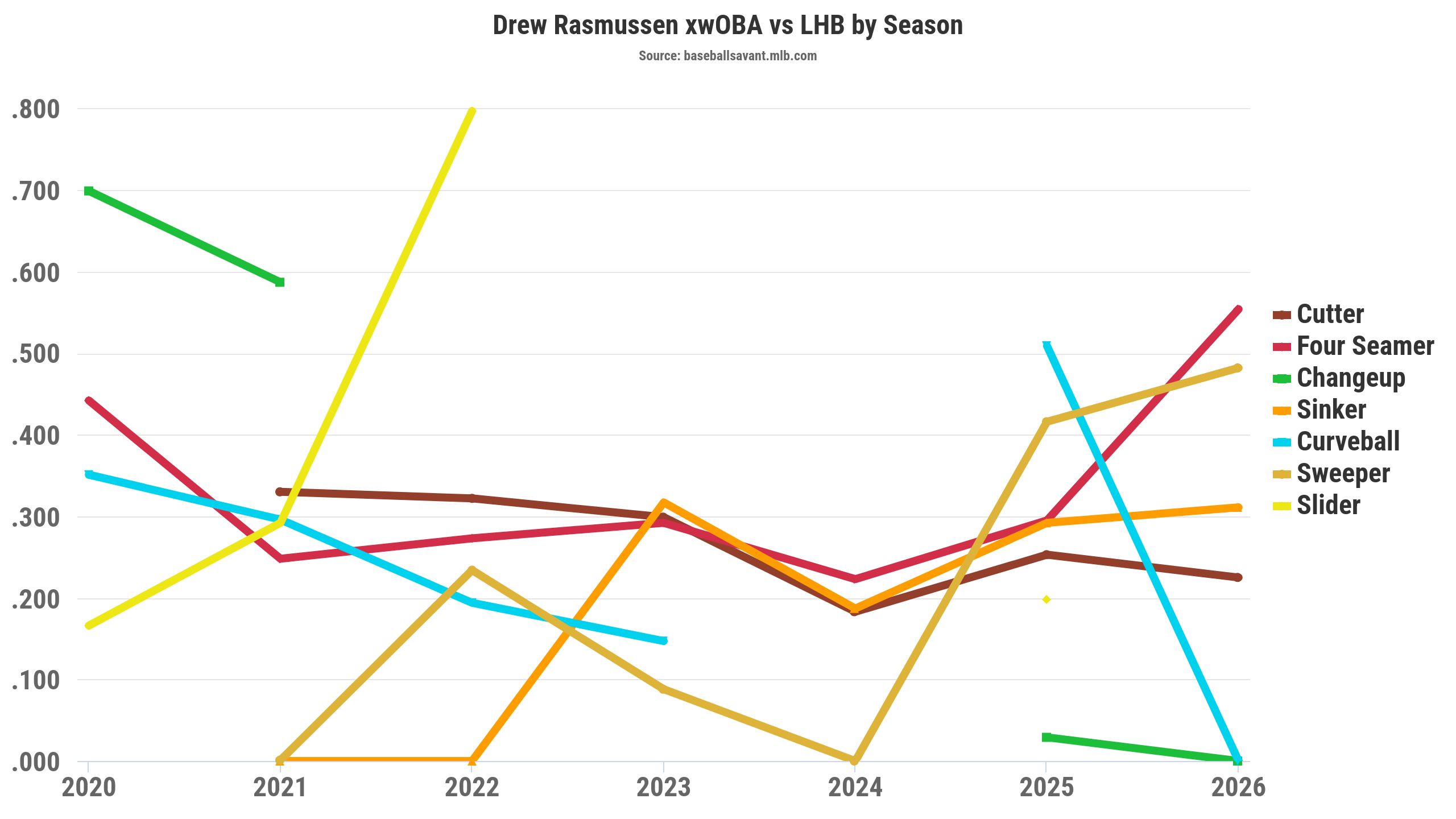
Furthermore, Rasmussen started throwing more changeups (10.8%) to left-handed hitters in 2026. Let's start with the cutter since it was one of his best pitches against left-handed hitters in 2025, allowing a .235 wOBA (.253 xwOBA). It seems like a concerted effort to throw more cutters against lefties, leading to a .198 wOBA (.225 xwOBA) in 2026.
The cutter locations remained consistent, throwing them low and inside to left-handed hitters, generating whiffs and weak contact. Rasmussen's cutter moves like a gyro-like slider that he locates well to left-handed hitters. The location and release point numbers in 2026 look closer to 2024, which is notable after pitching outside of the dome in 2025.
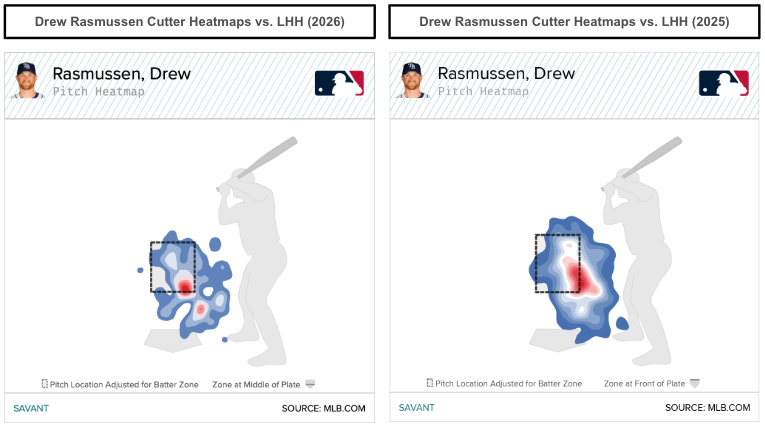
Specifically, against left-handed hitters, Rasmussen threw the cutter at 1.87 feet above the plate in 2026, down from 2.08 feet in 2025 and 1.75 feet in 2024. Furthermore, Rasmussen's cutter horizontal locations gradually shifted one inch closer toward the corner that's low and inside to left-handed hitters.
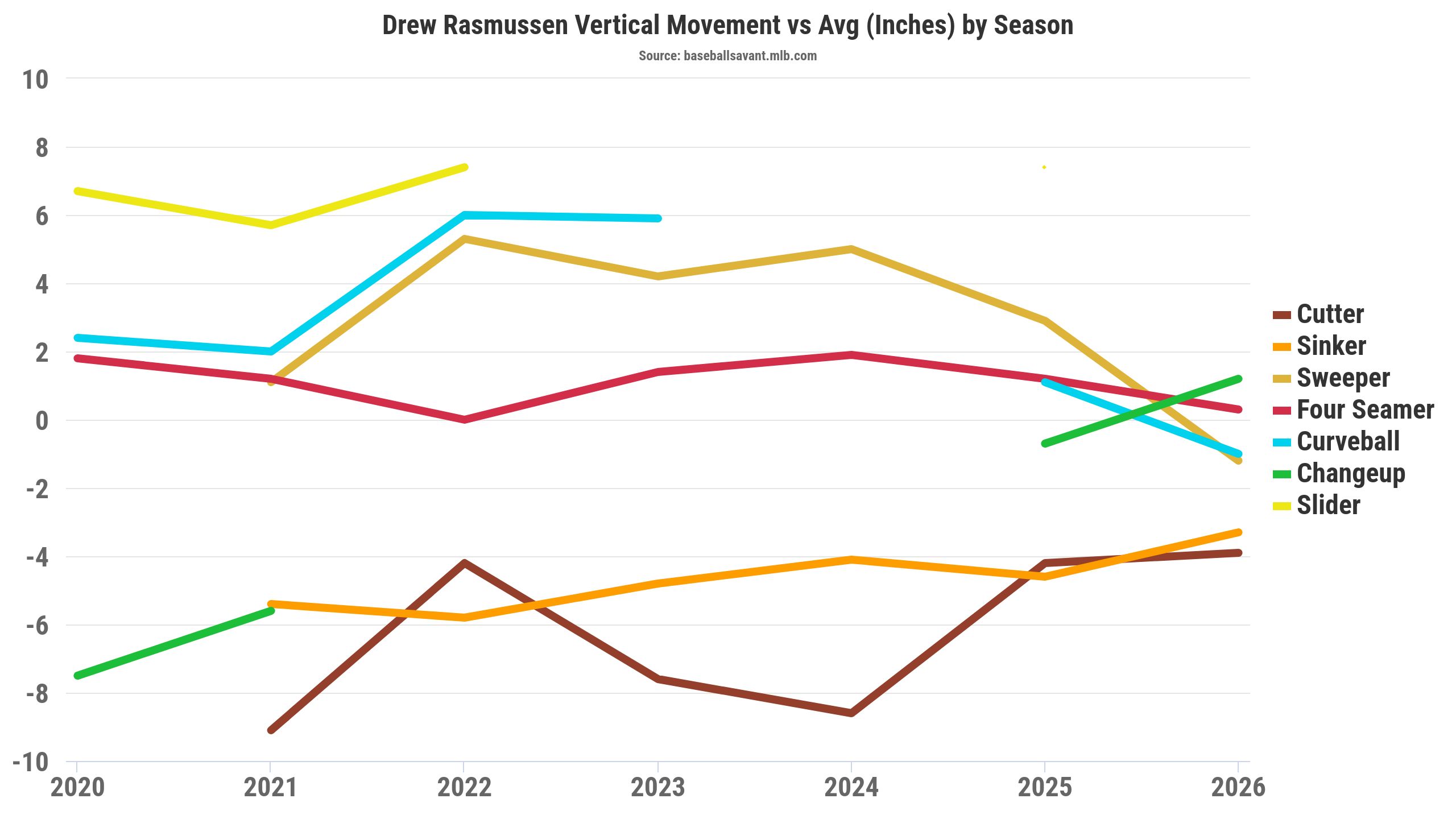
With Rasmussen throwing more changeups, let's review the pitch. Currently, Rasmussen's changeup leads his arsenal with a 26.1% swinging-strike rate in 2026, compared to a career swinging-strike rate at 9.9%. When we compare Rasmussen's changeup movement profile to 2025, it has been dropping two inches, with over one inch of arm-side fade in 2026.
Wildly enough, Rasmussen throws the changeup in the zone 13% of the time in 2026, making it volatile if hitters lay off the off-speed pitch. He peppers the changeup below the zone often, which doesn't generate a high chase rate (25%) against left-handed hitters.
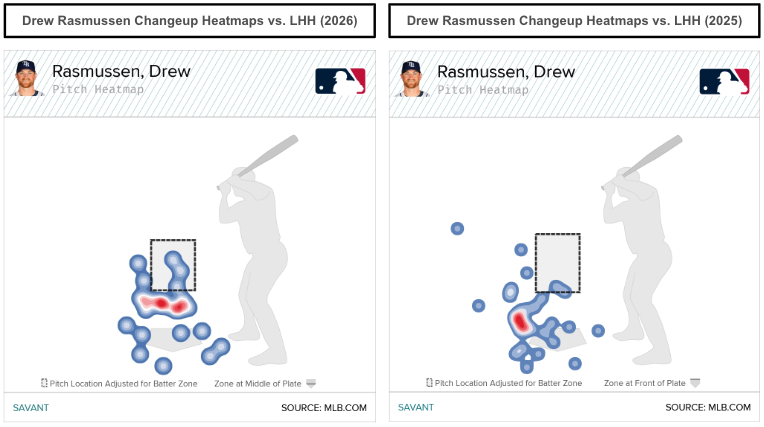
Rasmussen's changeup has a 106 Stuff+ in 2026, down from 117 in 2025. However, Rasmussen's locations were problematic with a 91 Location+ in 2025, improving to a 108 Location+ in 2026. It's such a small sample of 45 changeups thrown, so monitor this pitch mix and movement change.
If the changeup sticks around as a legitimate whiff pitch, we could see Rasmussen's swinging-strike rate increase. Regardless, Rasmussen possesses above-average control, stuff, and command, suggesting a complete profile. Rasmussen might lack volume per start, though he can be efficient.
Mick Abel, SP, Minnesota Twins
24% Rostered
Update: Unfortunately, Abel landed on the injured list with elbow inflammation on Monday. It's a murky timetable, with some missing between two weeks and three months in 2025. It's fine to cut Abel in shallower leagues without an injured list spot. The analysis below was written before Abel landed on the IL.
Abel was discounted in drafts after having a poor debut season in 2025. As a prospect, Abel remained a stuff-over-command type pitcher, which we saw in spurts. Unfortunately, Abel has been destroying WHIP, with a career average of 1.53. The control is average (34% ball rate), but the .341 BABIP hurts us.
That suggests Abel allows too many balls in play, though the Twins defense ranks 29th in Defensive Runs Saved (DRS) and 20th in Outs Above Average (OAA). Wildly enough, Abel's former team, the Phillies, has been worse in both fielding categories. That's not far from DRS (29th) and OAA (20th) in 2025 for the Twins.
Weak defenses can be a downfall for a pitcher. We've seen it with the Nationals and Angels pitchers at times. A prime example was highlighting how MacKenzie Gore joining the Rangers should have helped him from a hit rate (BABIP) and defensive standpoint.
Abel's velocity fell by 1.5 mph in 2026, though his swinging-strike rate increased by over one percentage point. That might be unsustainable if Abel's sinker (16.7%) highlights his arsenal in a swinging-strike rate. However, the four-seam had a slight uptick to 13.7%, with the changeup jumping to 14.3% in 2026 from 9.5% in 2025.
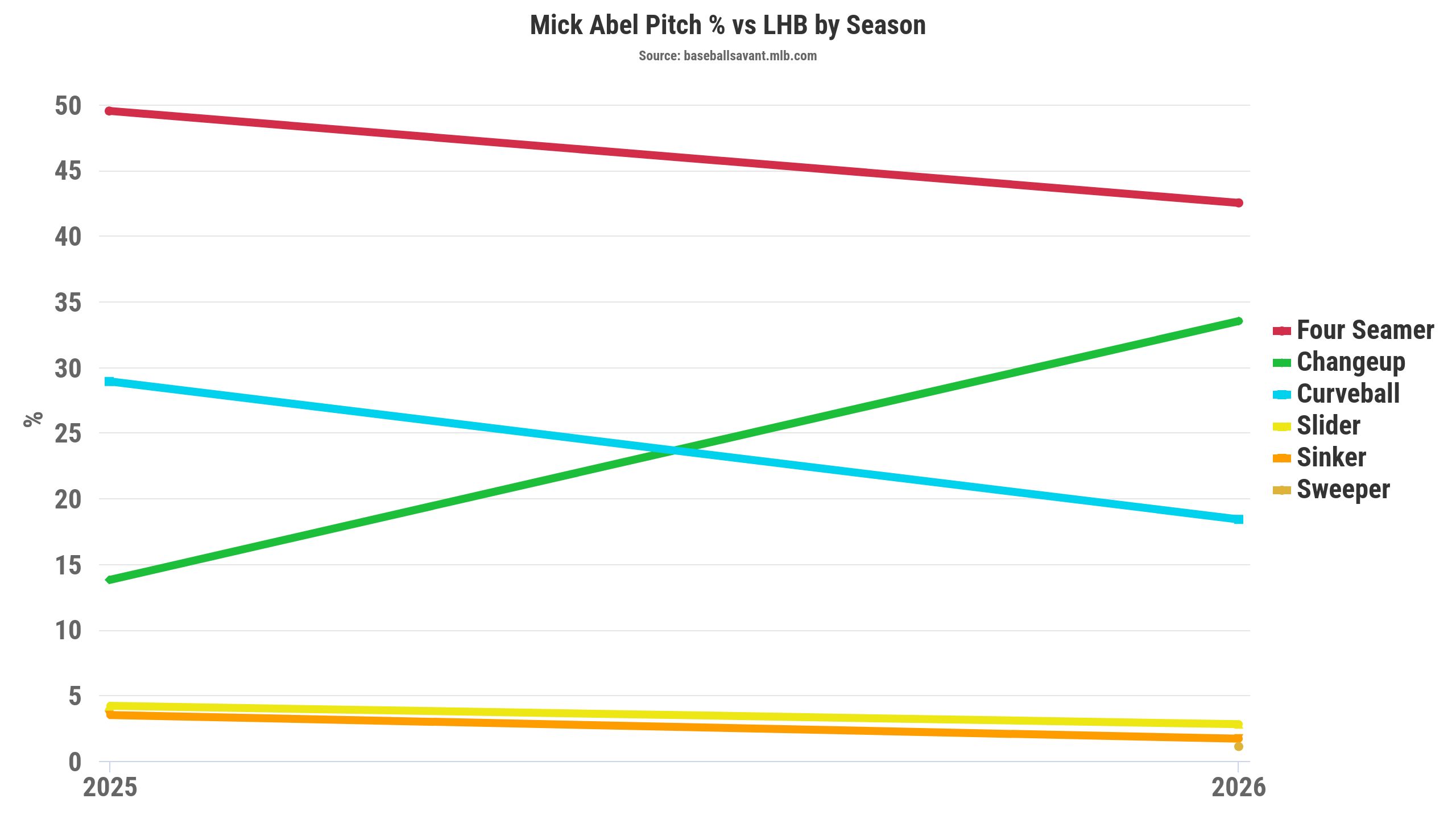
In the early 2026 sample, Abel's curveball took a step backward, going from a 14.6% swinging-strike rate in 2026 to 9.3% in 2025. He cut the curveball usage by five percentage points against right-handed hitters and 10 points against lefties in 2026.
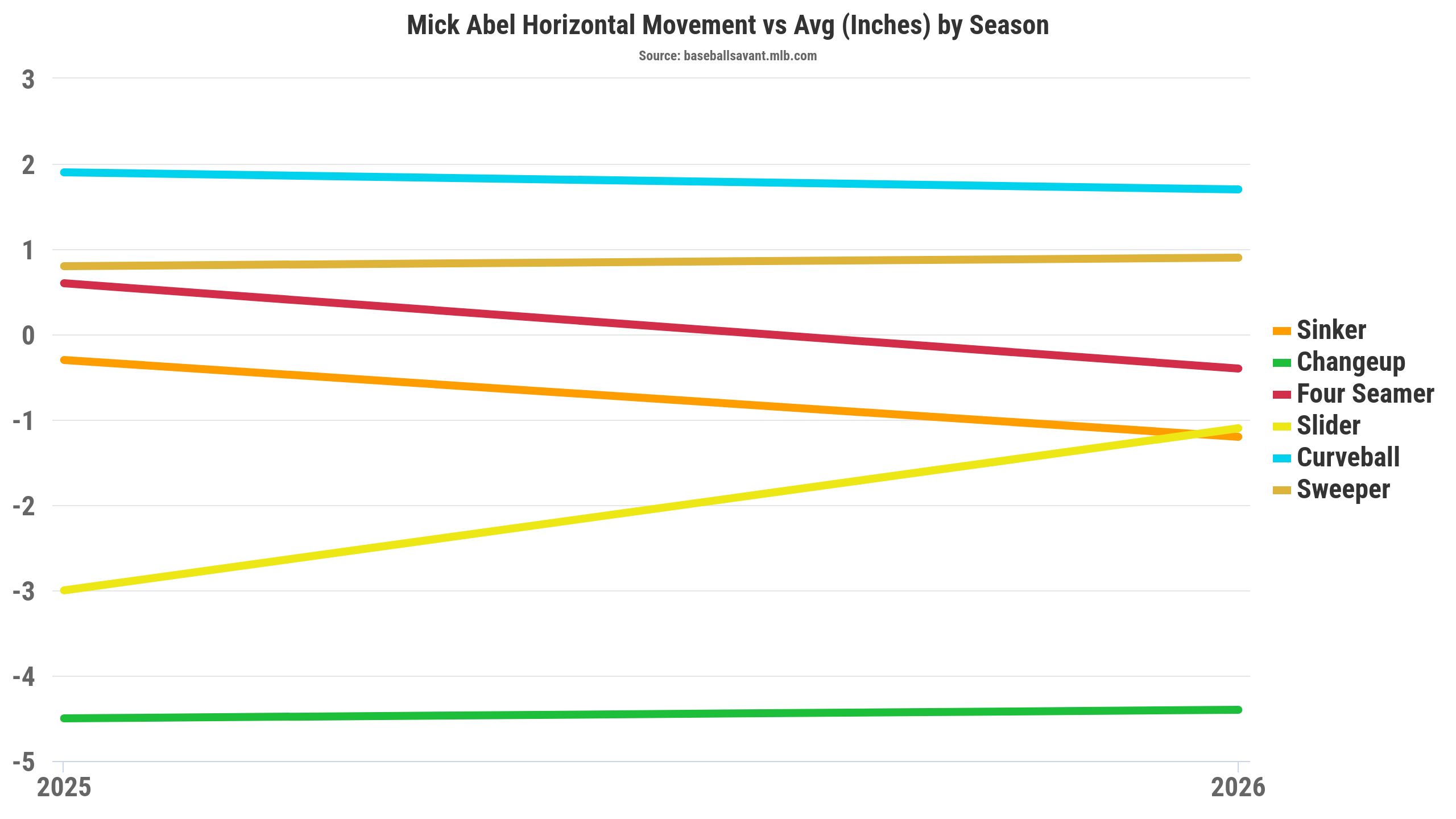
Interestingly, Abel's curveball lost an inch of downward movement and gained over two inches of glove-side sweep. He continues to generate weak contact against righties (.182 wOBA, .213 xwOBA) and lefties (.295 wOBA, .220 xwOBA) in 2026, similar to 2025. Maybe Abel should throw more curveballs.
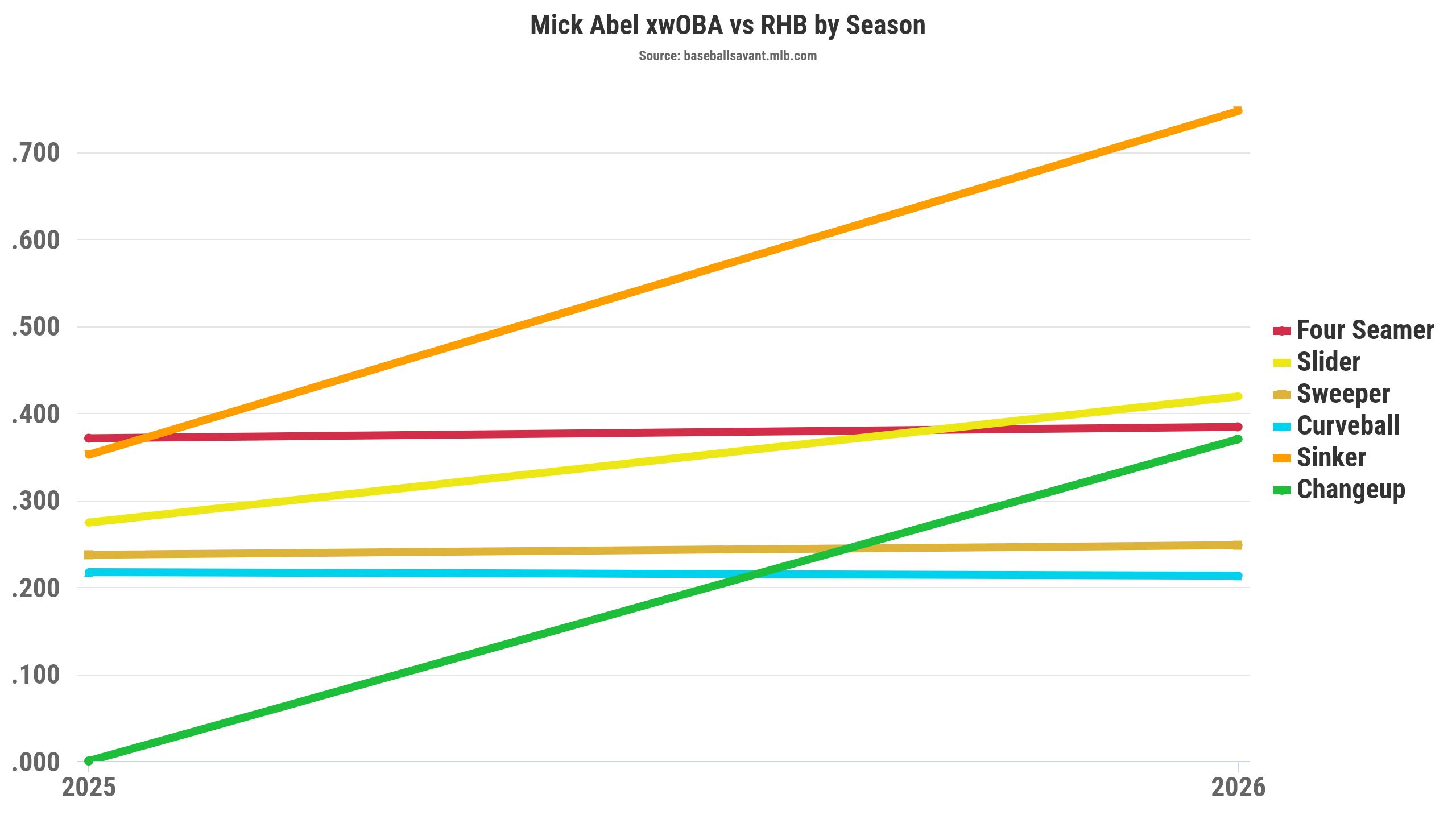
With Abel throwing fewer curveballs against lefties, he increased his changeup usage to 33.5% (2026) from 13.8% (2025). He has been inducing weak contact via the changeup (.232 wOBA, .254 xwOBA) in 2026 compared to 2025 (.368 wOBA, .375 xwOBA). It makes us wonder about the changeup's movement profile.
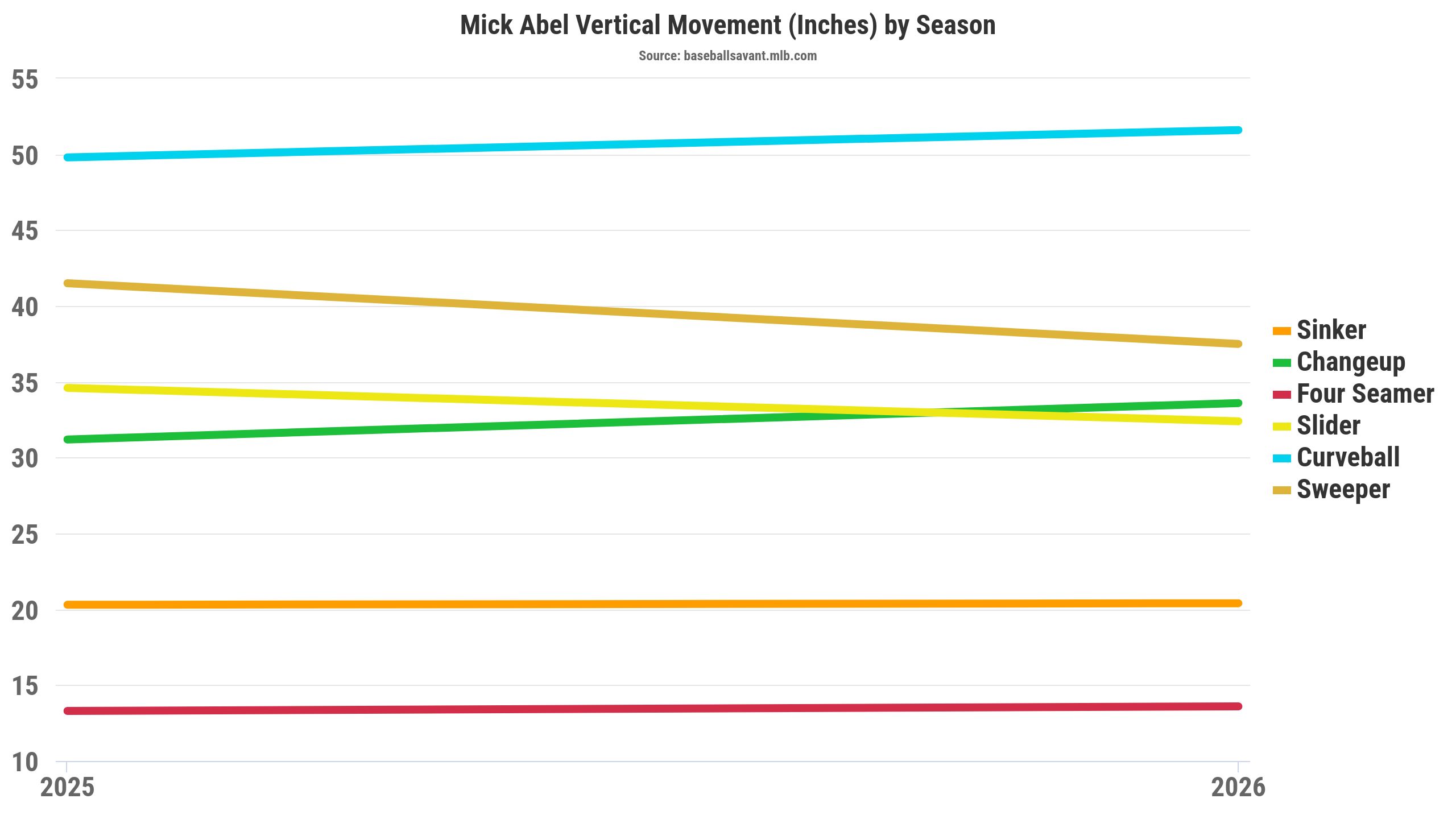
Abel's changeup added over two inches of downward movement while maintaining the arm-side fade at a slightly lower velocity (over 1 mph slower) in 2026. From the changeup heatmaps in 2025 and 2026, it appears that Abel might be commanding the pitch better in 2026.
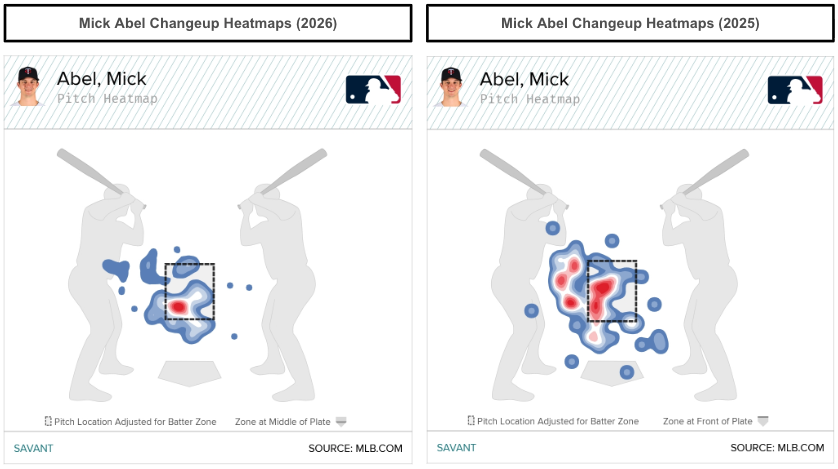
The changeup has been located low and away from left-handed hitters, moving nearly two inches (1.8) closer to the middle of the plate. Abel's changeup heatmap aligns with his 110 Location+ in 2026 compared to 2025 (83). If Abel can command his changeup well, it could outperform the stuff grades, though the movement profile intrigues us.
Besides Abel's curveball and changeup, he added 2.4 inches of extension, ranking in the 89th percentile in 2026. That theoretically helps Abel's four-seam generate better stuff and location grades, suggesting better stuff and command, evidenced by a 116 Stuff+ (eight points higher) and 104 Location+ (five points higher) in 2026.
We like the changes to Abel's pitch mix, movement profiles, and command. However, the team context might not do Abel any favors if the team continues to struggle on defense.
Connelly Early, SP, Boston Red Sox
50% Rostered
After we complained about why Johan Oviedo was in the Red Sox rotation, many hoped for Early and Payton Tolle to be starters. Early's average draft position was typically before Tolle, and the Red Sox followed suit in putting Early into the rotation.
Early has been successful in 2026, though his strikeout skills have disappeared. That's evident by Early's 9% swinging-strike rate in 2026, compared to 16.7% in 2025. It's worth pausing because we're still dealing with a small sample of under 10 total starts throughout his early MLB career.
Meanwhile, Early has shown worse control, with a 38% ball rate in 2026, three points higher than in 2025. That indicates Early has been lucky with a skill decline, though let's examine the pitch movement profiles and inputs that go into the whiffs and walks.
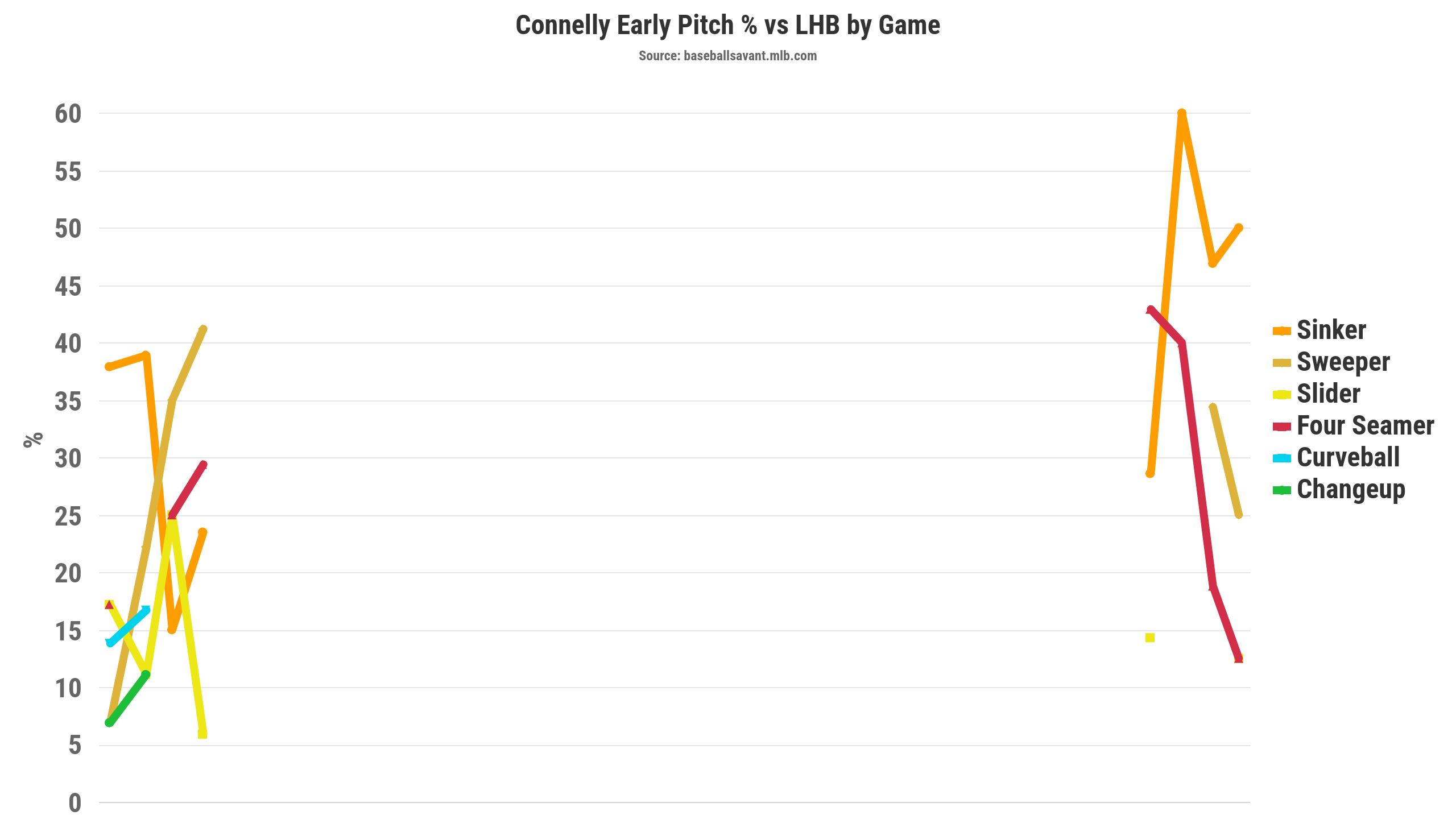
Early maintained his pitch mix against right-handed hitters, but made slight tweaks against lefties. He increased his sinker usage to 44.1% in 2026, compared to 29.8% in 2025 against left-handed hitters. With the additional sinkers, he ditched the slider usage from 15.5% (2025) to 5.1% (2026).
Early throws from a low arm angle (31 degrees), leading to his sinker generating high-end arm-side fade, over 18 inches over the past two seasons. When it's working well, it fades into the hands of left-handed hitters, leading to weak contact, evidenced by his .253 xwOBA (2026) and .232 xwOBA (2025).
As a prospect, Early's changeup graded out as one of his best pitches, possessing above-average downward movement at nearly 43 inches (7.5 inches more than the average pitch). His changeup hasn't been missing bats at an above-average rate, with a 13.2% swinging-strike rate in 2026 and 14.3% in 2025.
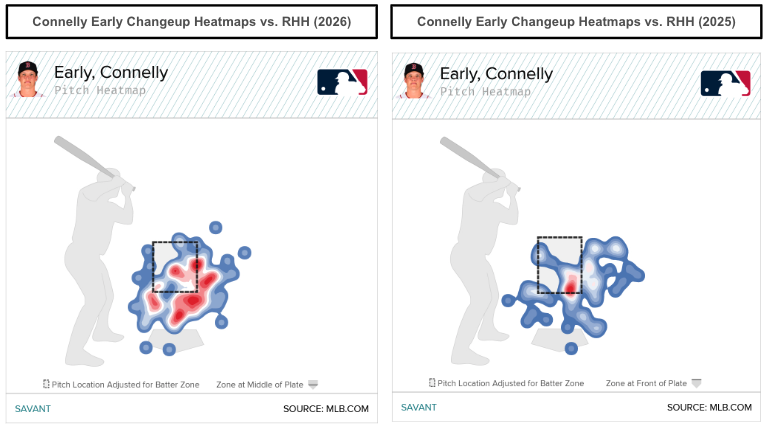
Thankfully, Early's changeup tends to elicit weak contact against right-handed hitters (.228 wOBA, .289 xwOBA). Given the changeup's elite downward movement, we might speculate about Early's pitch command and location.
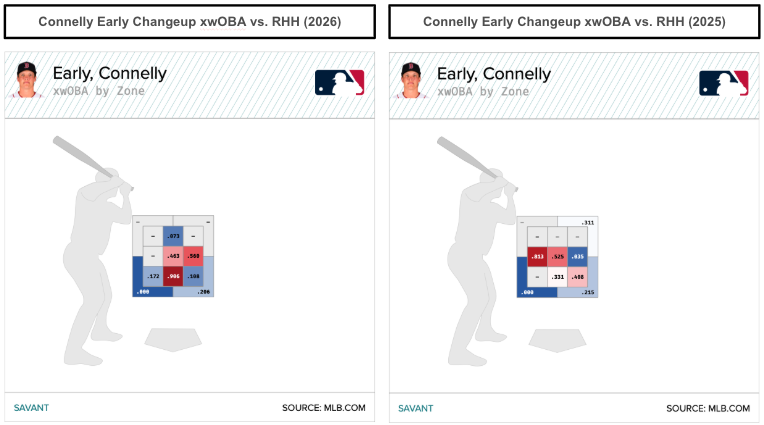
Interestingly, Early's changeup heatmaps against right-handed hitters look more scattered in 2026, yet he maintained a Location+ of around 113-114 in 2025 and 2026. When Early leaves it in the heart of the zone, right-handed hitters crush it.
I expect Early's changeup to elicit more whiffs, especially since it added three inches of downward movement, making it an above-average pitch by Stuff+ grades, too. Besides Early's changeup adding downward movement, his sweeper also added nearly three inches of drop.
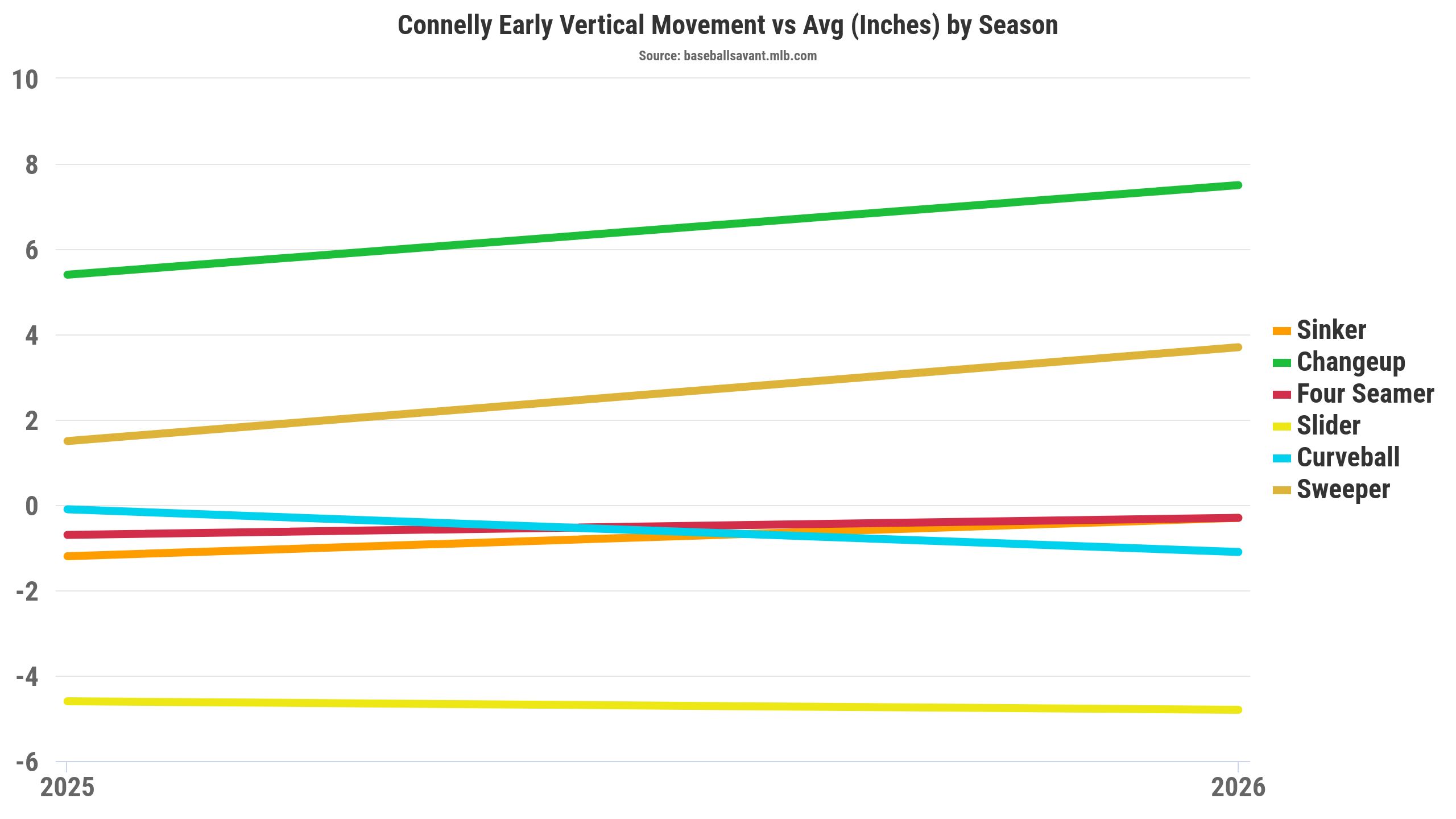
Early's sweeper has been nasty against left-handed hitters, inducing a .182 wOBA (.106 xwOBA) in 2026, with a .000 wOBA (.022 xwOBA) in 2025. He typically locates the sweeper low and away from left-handed hitters, making it a tough pitch to square up.
Early was commanding his fastballs (four-seam and sinker), sweeper, and curveball well in 2025. However, those command numbers regressed, evidenced by his 109 Location+ in 2025, down to 92 in 2026. Hopefully, that's small-sample noise because the pitch movement profiles suggest better results than the Stuff+ grades indicate.
Early's 4.21 xERA, being nearly two runs higher than his actual ERA, supports below-average skills in 2026. Since Early possesses multiple pitches with above-average movement profiles, we want to bet on the whiffs and Stuff+ grades regressing favorably.
Early is performing like an ace, but we want the skills to support the outcomes, or it's risky to expect this to sustain.
More Fantasy Baseball Advice
Download Our Free News & Alerts Mobile App
Like what you see? Download our updated fantasy baseball app for iPhone and Android with 24x7 player news, injury alerts, sleepers, prospects & more. All free!