




 RADIO
RADIO










Thunder Dan Palyo analyzes the correlations between all relevant players for Seattle and New England and gives you his favorite ways to stack both sides for Super Bowl LX in your DraftKings and FanDuel DFS showdown lineups.
The big game is nearly upon us, and with it comes the biggest single-game DFS slate of the year.
This is the fourth year in a row that I have taken on the task of building out a full chart of correlations for both teams, but it certainly paid dividends last season, as I had a pretty big win with my optimal lineup, as did one of our readers -- check it out.
Dan, I have to give you a shoutout for your "NFL DFS Stacks for Super Bowl LIX" article yesterday on Rotoballer. I played your exact "Lineup 1: Eagles win, Hurts MVP, Kicker-Defense pairing" in a $20 GPP contest and won $6k. From me and my family, sincerely thank you, man!
Bookmark our updated and revamped fantasy football rankings portal for all league formats!
PPR rankings | Half-PPR rankings | Non-PPR (Standard) rankings | Rookie rankings | Superflex rankings | Best Ball rankings | Underdog rankings | Dynasty rankings | IDP rankings | Injuries— Nathan Chesser (@NathanChes7384) February 10, 2025
The goal of this article is to help you build some correlated lineups -- lineups that contain players who are likely to perform well in the same game and not at the expense of the other player. We still have to guess the game script correctly, but having more data to inform our plays is never a bad thing! Let's see where the numbers take us this year!
A Quick Foreword on Correlation
I am not going to go overboard here, but it may have been a while since you took Statistics 101 - or maybe you didn't take it. Or maybe you had it at 8:00 AM and slept through it because you were hungover - I'll make no assumptions.
Correlation does not equal causation! It attempts to quantify the relationship between two sets of data; that is all. The correlation coefficients in the charts below range from 1 to -1, and the closer we get to either end of the spectrum, the higher the probability that those two sets of numbers are more closely related.
Positive coefficients indicate a positive relationship: as one number increases, the other increases. A negative coefficient represents a negative relationship, meaning as one number increases, the other decreases.
We usually want to see a correlation of around 0.4 or 0.5 in order to claim that there is a statistical significance between the data sets. However, it's all relative because a correlation of say 0.25 is still more significant than 0, which suggests that there is no relationship at all.
When building DFS lineups, you CAN use negatively correlated plays because it's still well within the range of outcomes for both plays to produce a high score. But the negative relationship between the two plays simply suggests that the likelihood of that happening is much lower than it is for two plays with a positive relationship.
The color-coding on the chart should also help point out what we are looking for (green is good and red is bad!)
DFS Correlations: Super Bowl LX
Seattle Seahawks
(click to enlarge)
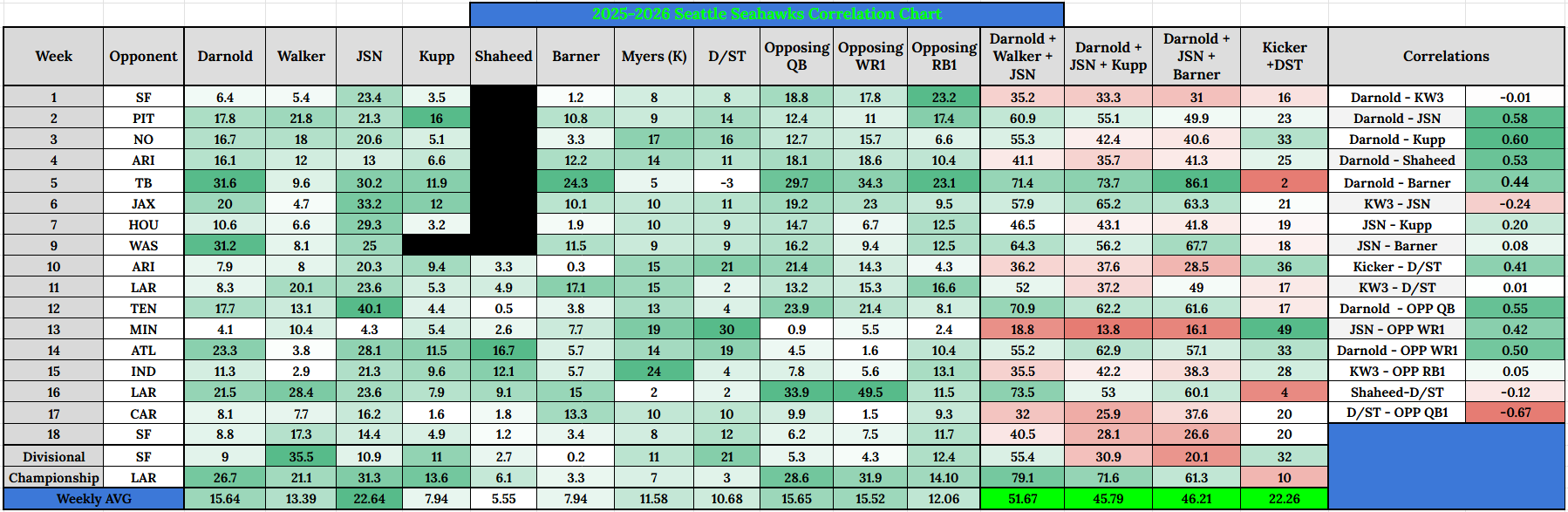
I like to start by just making some general observations before getting too deep into the strategy and picks. I charted the most popular offensive players for both teams, as well as the kickers and defenses for every game this season, including the postseason, so we have as much data as possible to chew on.
The Seahawks were a very good (but certainly not elite) offense this year under first-year offensive coordinator Klint Kubiak. They finished 10th in DVOA -- 14th in rushing offense and fifth in passing offense.
They deployed a committee in the backfield for most of the season, with Zach Charbonnet and Kenneth Walker III sharing the workload until Charbonnet was injured in Week 18. It's no coincidence, then, that KW3 has had two of his best games in the playoffs as he's inherited the goal-line touches and has only had to cede some passing down snaps to George Holani.
The other major development that occurred midseason with the Seattle offense was the acquisition of speedy receiver Rashid Shaheed. He took over as the WR3 and kick/punt returner for rookie Tory Horton, who was lost for the season.
Shaheed has taken back two kicks for touchdowns since joining the Seahawks, including the opening kickoff in their divisional round trouncing of the Niners. But he still did not correlate positively with the Seattle defense, even though a return TD counts as six DK points for the returner and the defensive unit.
RASHID SHAHEED 95-YARD KICKOFF RETURN TO START THE GAME.
SFvsSEA on FOX/FOX One
Stream on @NFLPlus pic.twitter.com/buR0WrfA6x— NFL (@NFL) January 18, 2026
There were only a few other negatively correlated plays among the Seattle options this season. Kenneth Walker III and Jaxon Smith-Njigba were negatively correlated, but so much of this season's sample is skewed, with Walker having a smaller role for much of the season. I am probably not reading too far into that, especially with the two of them combining for 54.4 DK points against the Rams in the NFC Championship.
Darnold did not correlate with Walker, either, which makes sense since Walker caught just 31 passes this season and failed to score a receiving touchdown. Despite the lack of correlation between Walker, Darnold, and JSN, deploying all three of them together isn't entirely out of the question, as they combined for more than 70 DK points four times this season.
The Week 5 combos of Darnold-JSN-Kupp (73.7) and Darnold-JSN-Barner (86.1) are the only other two three-man combos that went for more than 70 total points.
The other traditional pairing for a running back is with their team's defense, but KW3 had nearly no correlation with the Seattle defense this season. However, the Seahawks' outstanding kicker, Jason Myers, did have a fairly strong correlation with the D/ST at 0.41.
Don't sleep on these kicker-defense combos. I had both the Eagles kicker and their defense in my winning lineup last season, and at just a combined cost of $9.8K, this Seattle duo averaged 22.2 DK points per game -- nearly the same as JSN.
I should note that I intentionally included each defense with the opposing QB knowing full well that those would have a strong negative correlation, mainly to drive home the fact that you really shouldn't be playing a QB and the opposing defense in many (if any) lineups.
It's tempting to cram both QBs in for raw points and then play a defense to save salary cap, but that strategy really sacrifices an opportunity to correlate another play and rarely works out.
So, while Walker is certainly not a bad play by any means, he is the lone offensive piece that doesn't correlate with the others. Darnold had positive correlations with all of his pass-catchers, in addition to the opposing quarterback and top wide receiver. Keep that in mind, as it will be an important data point that I return to once we get more into the lineup construction section.
Seattle had eight total correlations over 0.40, including JSN with the opposing WR1, which makes some sense when you consider how elite the Seattle defense was against the run this season. Puka Nacua did account for two of those big WR1 performances, and Seattle was very tough on opposing WR1s down the stretch, so context is always important for all of this data.
New England Patriots
(click to enlarge)
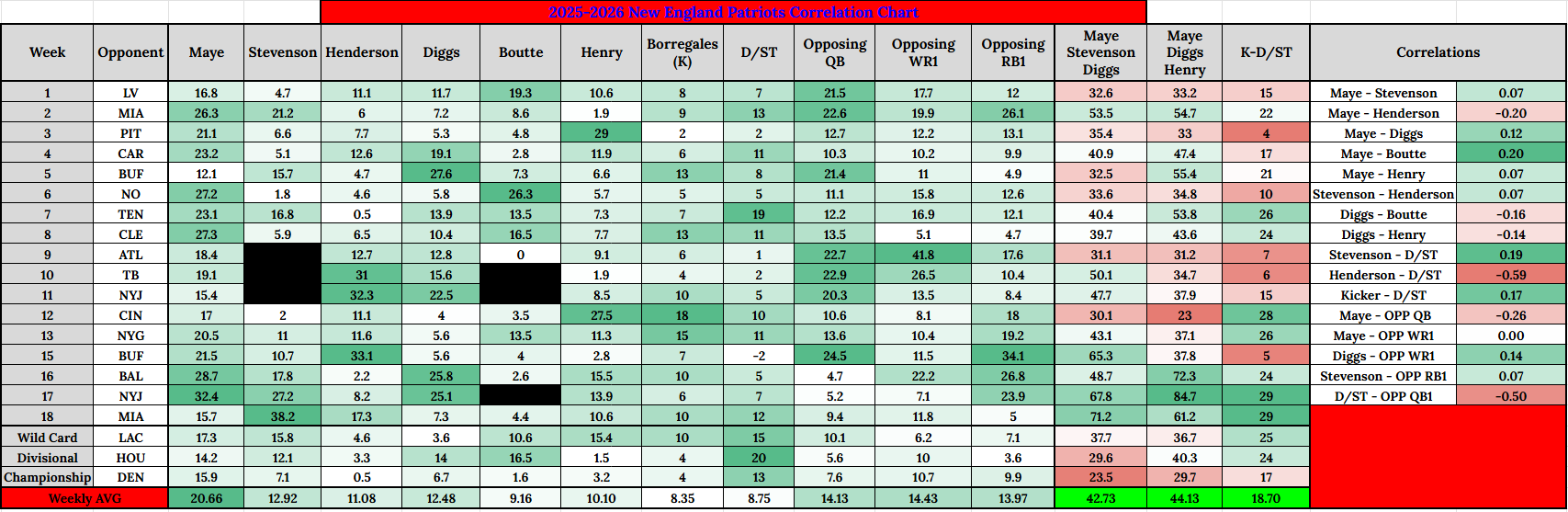
Compared to the Seahawks, the Patriots are a much tougher team to figure out, and getting the right New England pieces in your lineup might be the key to winning all the money.
First of all, the Pats still have a timeshare in place at running back, even though Rhamondre Stevenson has been dominating the touches in the postseason. TreVeyon Henderson had three huge games this season, two of which were while Rhambo was out, but he has not been all that involved lately.
Meanwhile, Stevenson struggled early on this year, especially with fumbles, and was losing touches to Antonio Gibson before Gibson went down with an injury.
It's tough to like the running game against the Seahawks' elite run defense, but both backs averaged more DK points per game than every other offensive player besides Drake Maye and Stefon Diggs, so we can't write them off entirely.
Stevenson had a slightly positive correlation with the Patriots' defense, but Henderson's was the biggest negative score, which makes sense since two of his biggest games came in shootouts against Tampa Bay and Buffalo.
Speaking of Maye, he had an incredible season, but failed to crack 20 DK points in his last four games. He has faced some pretty good defenses in the playoffs, and the weather in the AFC Championship certainly played a role in his "only" scoring 15.9 DK points. What he can do is scramble, and he finished the season with 450 yards rushing and four rushing touchdowns.
Maye's production has been the most predictable of any Patriot this season, other than maybe kicker Andy Borregales. He's going to be the more highly rostered quarterback between him and Darnold, but pairing him up with one of his receivers is far more problematic.
His correlation with Kayshon Boutte at 0.20 was the strongest of any two Patriots players, but it is a relatively weak overall positive correlation. He's technically still positively correlated with Diggs, Henry, and Stevenson, too, but barely.
ONE-HANDED TOUCHDOWN CATCH IN THE SNOW BY KAYSHON BOUTTE!
(via @Patriots)pic.twitter.com/H0EdA8AgYD
— FOX Sports: NFL (@NFLonFOX) January 18, 2026
Furthermore, building a Maye plus two receivers three-man stack doesn't add up, as each receiver was negatively correlated with the other. I don't have the Boutte-Henry correlation on the chart, but it was -0.29 and even worse than the Diggs-Boutte and Diggs-Henry pairings.
I like Hunter Henry a lot in this game, as Seattle has struggled more against tight ends than any other opposing pass-catchers, but Henry has a barely positive correlation with Maye at 0.7. You can stack him with Maye, but he's also just fine on his own, too.
Unlike Darnold, Maye actually had a negative correlation with opposing QBs this year, which means his biggest games came in blowouts, not shootouts. He did not correlate at all with opposing WR1s, which also supports the big games in blowouts theory. However, Diggs did have a slightly positive correlation with opposing WR1s, which puts a Diggs-JSN pairing on my radar.
I'll finish this section up by noting that Borregales did have a positive correlation with the Pats defense, though it was only about half as strong as Myers and the Seattle defense.
New England's defense ripped off double-digit DK points in four straight weeks, but Borregales has not exceeded 10 DK points since Week 13 against the Giants. The kicker-defense pairing averaged 18.7 points per game, a full 3.5 DK points fewer than the Seattle pairing.
DFS Lineup Construction Strategy
Three players are trending toward being the clear chalk on this slate -- JSN, KW3, and Drake Maye. Playing two of those guys in a lineup is fine, but playing all three will not only force you into multiple punt plays, but it will also make for a pretty chalky overall build.
Fading two of the three will really separate you from the pack, and if I do that, then JSN is the one guy I probably have to have in just about every build.
Understanding the correlations is just one piece of the puzzle; predicting the correct game script is arguably the hardest part of building the winning lineup. Right now, the Seahawks are 4.5-point favorites, and this total sits at a pretty neutral 45.5 points.
While I like Seattle to win, I am not so sure that it runs away with this one. The Patriots are in excellent form on the defensive side of the ball and have a young quarterback who can make plays with his big arm and his legs.
Both teams want to run the football and like using the run to set up their play-action passing games. When you combine that tendency with both defenses being pretty darn good, it makes me think that we see a lower-scoring game than an all-out shootout.
That brings kickers and defenses into the equation, and likely takes me off the double-QB builds for the most part. So, if I am predicting a lower-scoring, close game, it also puts me onto more 4-2 and 3-3 builds than 5-1 builds, which we would usually reserve for blowout game scripts.
Some other players who I am considering for my player pool who are not listed on the correlation charts would be Mack Hollins ($3.6K), George Holani ($2.4K), and Austin Hooper ($2K).
Sample DFS lineups
Lineup 1: Seahawks win, relatively low-scoring, Darnold-JSN pairing, Kicker-D/ST pairing, Diggs + Henry thrive vs. Seattle zone schemes
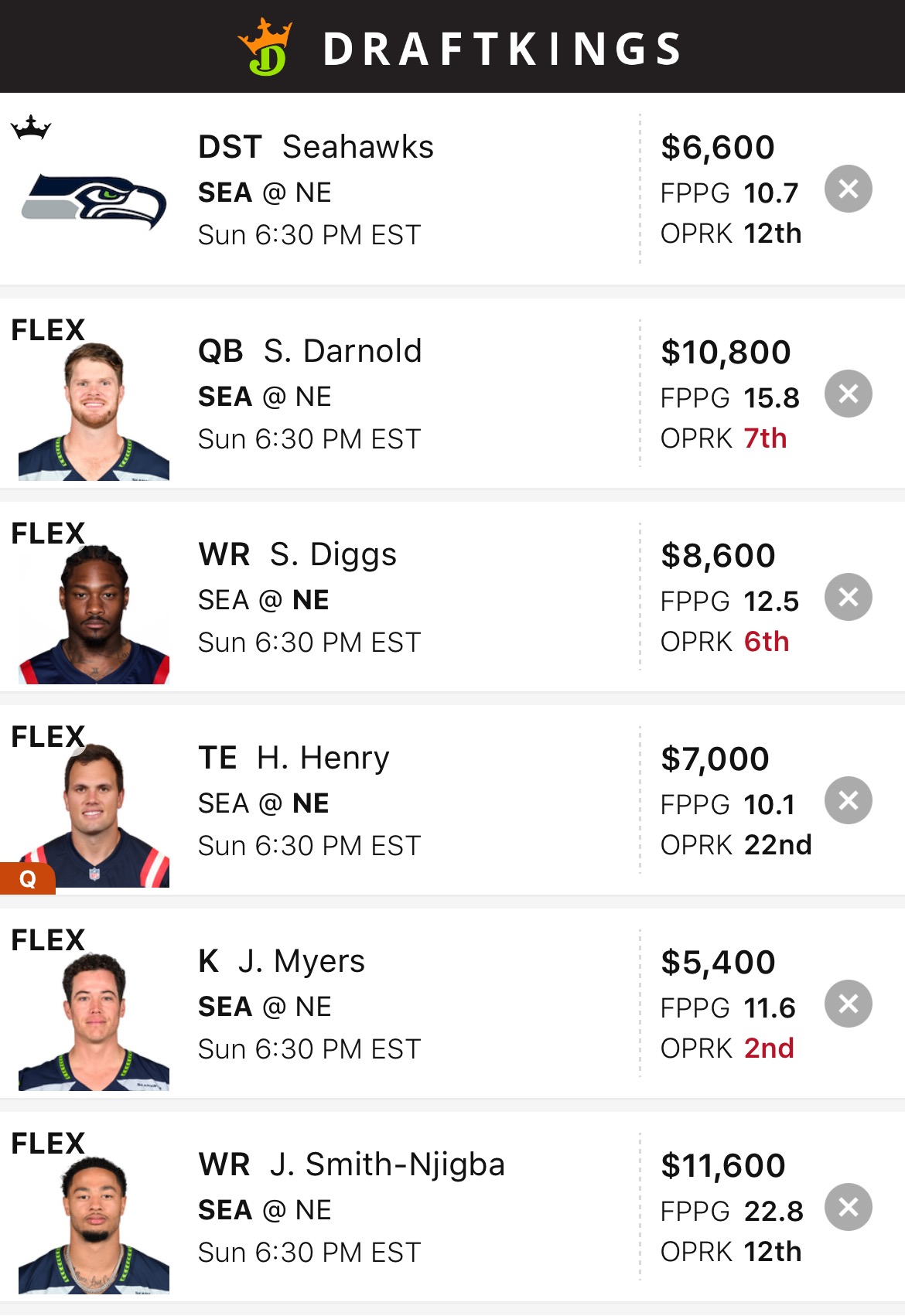
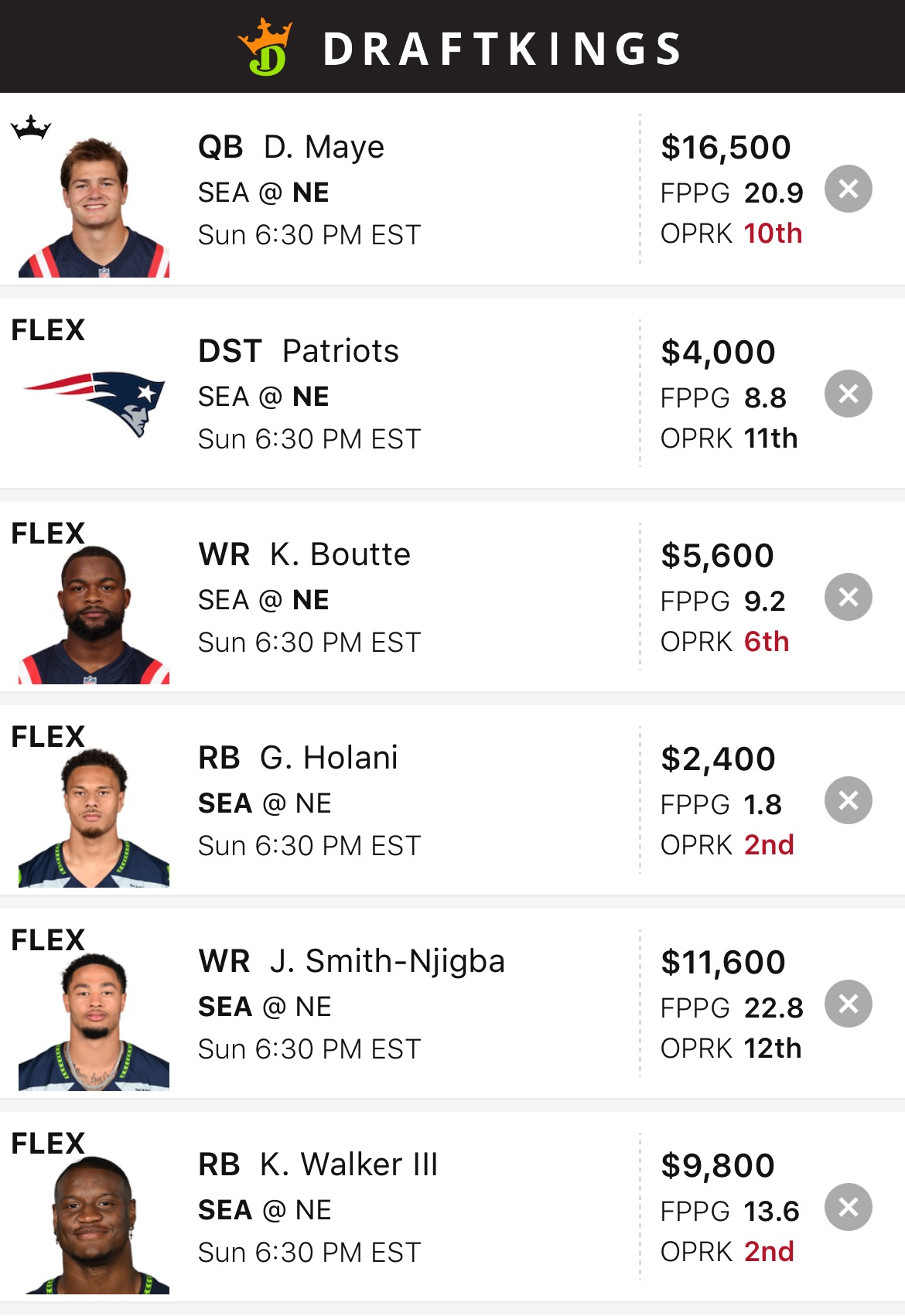
Lineup 2: Patriots upset, Maye rushing TD + passing TD to Boutte. Patriots create turnovers, Seattle's big two still make value, plus Holani gets receptions as Seattle plays from behind.
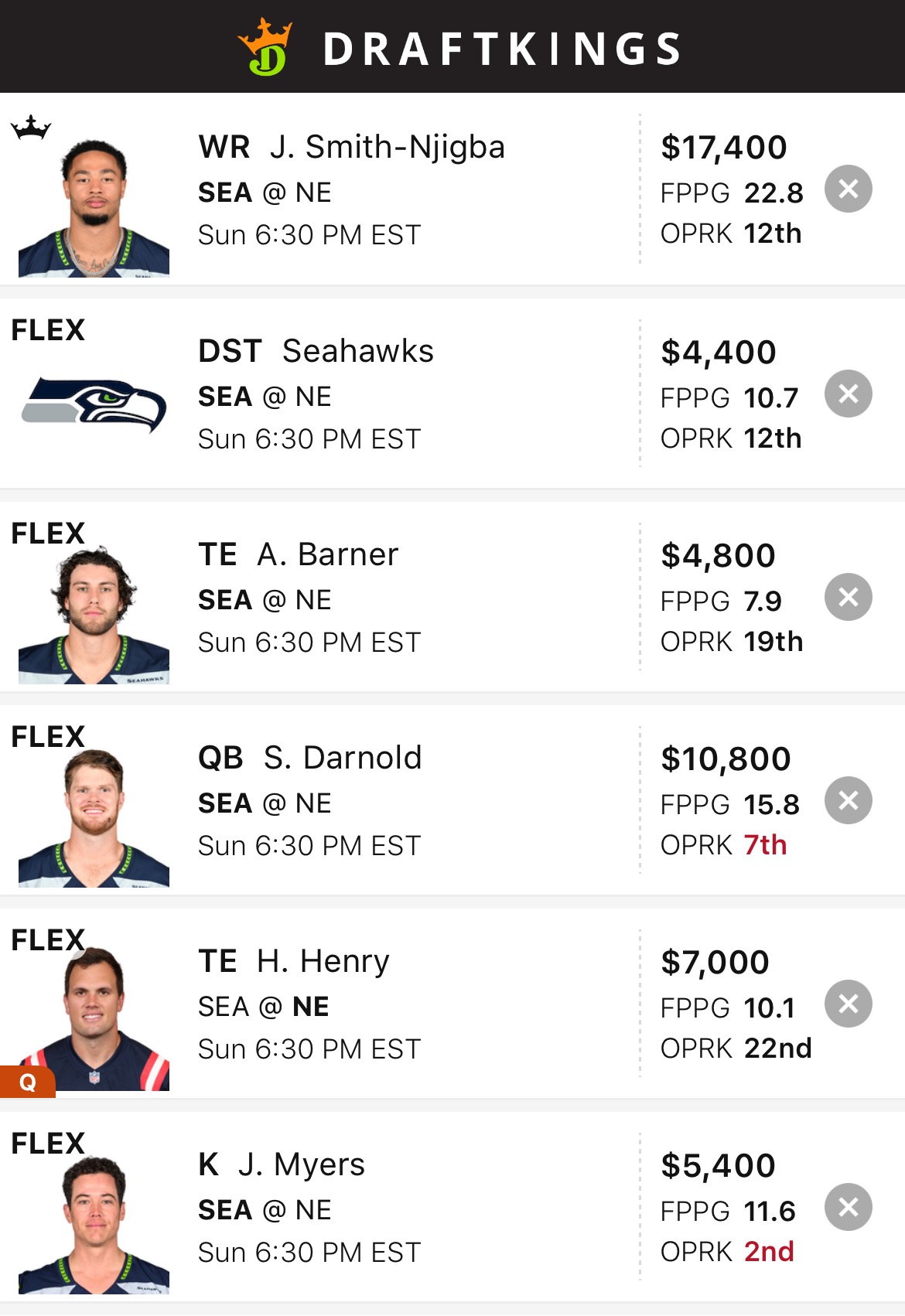
Lineup 3: Seattle wins and dominates, JSN goes off, Darnold throws a TD to Barner, Defense + Kicker pairing, and Hunter Henry is the lone Patriots bright spot
More Fantasy Football Analysis
Download Our Free News & Alerts Mobile App
Like what you see? Download our updated fantasy football app for iPhone and Android with 24x7 player news, injury alerts, rankings, starts/sits & more. All free!