




 RADIO
RADIO







Antonio Losada introduces a new set of metrics to assess the quality of Starters/Average/Replacement level players at each position and how these new stats can be used in fantasy football.
When it comes to fantasy sports, we're always looking for the highest possible Return On Investment or ROI. This concept is easy to understand: in both Daily Fantasy and re-draft/fantasy leagues, ROI would come down to how many points a player returns relative to his salary, or the price you paid (given his ADP on draft day, costs on the Waiver Wire, etc...) to acquire him. The higher the ROI, the better the investment and the results you'll obtain. While that is okay, we often need to know how much better one player is from another at his position, so we truly know the distance between the two of them and can better assess how much value each player carries.
Focusing on season-long leagues, we face the task of building rosters in which we have starters, reserves, and a plethora of available-for-free players that weren't undrafted and stay in the free-agent pool with a sweet price of nil attached to them, acquirable at any point during the season. Knowing that, it wouldn't make much sense to compare players pertaining to those different groups in most cases. Take the quarterback position during this past season. Had we wanted to pickup a QB from waivers to make him our reserve for an upcoming bye week, we might have found it more useful to compare him to the rest of the reserves or the average player at the QB position than the top-12 QBs in the league. At the end of the day, the results would be similar to a certain extent but the closer we get to the real talent/value of a player, the better we'll do.
That is why I took on the task of building three metrics to compare players given their level of play and their results in fantasy leagues: Value Over Starter, Value Over Average, and Value Over Replacement. Let's go through what is behind them, how they work, and explore some examples and cases they can help us with.
Featured Promo: Looking for some more fantasy football action? Adopt a dynasty orphan team over at FFPC. Sign up today and get $25 off any FFPC league. Sign Up Now!
The Framework of the VOS/VOA/VOR Metrics
Before I explain the aforementioned metrics, it's fair to present the framework or baseline they work upon. In order to build the metrics, I have used a personal dataset from the 2000-2019 season that follows the next parameters:
- Players (10,439 total) divided into the four fantasy skill positions: QB, RB, WR, and TE.
- Passing, receiving, and rushing statistical data used to calculate fantasy points in standard PPR-format fantasy leagues:
- 1 point per 25 yards passing
- 4 points per passing touchdown
- -2 points per interception thrown
- 1 point per reception
- 1 point per 10 yards rushing/receiving
- 6 points per TD
- 2 points per two-point conversion
- -2 points per fumble lost
- Individual calculations for passing (paPPR), receiving (rePPR), and rushing (ruPPR) fantasy points accumulated during each recorded player-season.
- Overall player ranking in PPR-format points for the season, among all players (ex: OVR1 to OVRn)
- Overall player ranking in PPR-format points for the season, among players at the position (ex: QB1 to QBn)
As I wrote in the introduction, I have developed three of them that vary in which players they use data from to calculate some of their underlying parameters. The rankings used to assigns players to groups come from the total PPR scored on the season at the position:
- Value Over Starter (VOS): Works on the basis of the starters at each position in standard, 12-team leagues:
- Top-12 Quarterbacks: QB1 to QB12, which is to say QB1s in lineups
- Top-24 Running Backs: RB1 to RB24, which is to say RB1s and RB2s in lineups
- Top-24 Wide Receivers: WR1 to WR24, which is to say WR1s and WR2s in lineups
- Top-12 Tight Ends: TE1 to TE12, which is to say TE1s and TE2s in lineups
- Value Over Average (VOA): Works on the basis of the starters and bench-players at each position in standard, 12-team leagues:
- Top-24 Quarterbacks: QB1 to QB24, which is to say QB1s in lineups, plus what would be QB2s rostered-backups
- Top-48 Running Backs: RB1 to RB48, which is to say RB1s and RB2s in lineups, plus what would be RB3s and RB4s rostered-backups
- Top-48 Wide Receivers: WR1 to WR48, which is to say WR1s and WR2s in lineups, plus what would be WR3s and WR4s rostered-backups
- Top-24 Tight Ends: TE1 to TE24, which is to say TE1s in lineups, plus what would be TE2s rostered-backups
- Value Over Replacement (VOR): Works on the basis of the players available for free (mostly non-rostered) in standard, 12-team leagues:
- Out-of-Top-24 Quarterbacks
- Out-of-Top-48 Running Backs
- Out-of-Top-48 Wide Receivers
- Out-of-Top-24 Tight Ends
With that information available, there was only one thing left to do: start building the metrics!
VOS/VOA/VOR: What Constitutes The Metrics
Each player's statistics are the inputs to the "black box" which is each of the three metrics. Inside the black boxes, though, a series of averages based on the groups of players are used to calculate how much more (or less) valuable a player was than a starter/average/replacement player at his position.
In order to be precise when using the VOS/VOA/VOR metrics, I use different averages for each of the last 20 seasons. It makes sense, as football and its environment have changed with time. Think about it: back in 2000 starting quarterbacks only averaged around 215 paPPR while in 2019 they averaged more than 250 paPPR!
I work with three tables, one per metric, that are divided into three stats (paPPR, rePPR, and ruPPR) for each position and year. For each of those stats, I know the total points the starters/average/replacement players racked that in those seasons combined.
Another table is used, this one including the percentage of points that players at each position-season scored via the three different categories. This allows us to take the football/season environment into account. For example, running backs in the 2006 season got 67% of their total PPR points via ruPPR while only 33% of them came via rePPR. In comparison, running backs in 2019 got 57% of their total points via ruPPR and 43% via rePPR.
When it comes to the calculation, here is the process I follow (using VOS for the explanation, and "Dohn Joe" in 2010 as our player):
- Find the total paPPR/rePPR/ruPPR for the starters at the position of Dohn Joe in 2010.
- If Dohn Joe ranked as a starter, then remove his total points from each category total. If not, leave those totals as calculated earlier.
- Calculate the average points per player for each category, dividing the total (or total minus Dohn Joe points) by the number of starters at the position (12 or 24; 11 or 23 if Dohn Joe ranked as one).
- Divide Dohn Joe's paPPR/rePPR/ruPPR by the averages calculated in 3). The resulting numbers would tell us if Dohn Joe was exactly average among starters (VOS equal 1), if he performed over the starters' average level at his position in that category (VOS greater than 1), or if he performed under the starters' average level in his position in that category (VOS lower than 1)
- Calculate the combined VOS of a player by adding the VOS values for each category, multiplying each for the season-environment modifiers:
- Quarterback's VOS is based on both paPPR + ruPPR
- Running Backs' VOS is based on both ruPPR + rePPR
- Wide Receivers' and Tight Ends' VOS is based just on rePPR
VOS/VOA/VOR: A Quick Calculation Example
Here is an example of the VOS calculation to make things a bit clearer. Taking Lamar Jackson's 2019 season and following the steps explained in the section above:
- Jackson scored 417.7 total points in 2019. 259.1 of those came via passing (259.1 paPPR), and 160.6 came via rushing (160.6 ruPPR).
- Top-12 QBs (starters at the position in standard leagues) combined for 3048.2 paPPR and 664.7 ruPPR.
- If Lamar Jackson had not been part of that top-12, the average starter would have averaged (3048.2-259.1 divided by 11) 253.6 paPPR, and (664.7-160.6 divided by 11) 45.8 ruPPR on the season.
- Lamar Jackson's passing VOS would come from dividing his paPPR by the average of the other 11 starters (259.1/253.6) and would yield a 1.02 paVOS. Same with the ruPPR (160.6/45.8) for a 3.50 ruVOS. Jackson's QB VOS in 2019 would be paVOS+ruVOS = 4.52 VOS
- Adjusting the paVOS and the ruVOS for the season's environment (taking into consideration the percentage of points the average starter got from passing/rushing stats), the final value comes down to 1.374 VOS on the 2019 season for Jackson, making him the leader among all starters.
VOS/VOA/VOR In Use During the 2019 Season
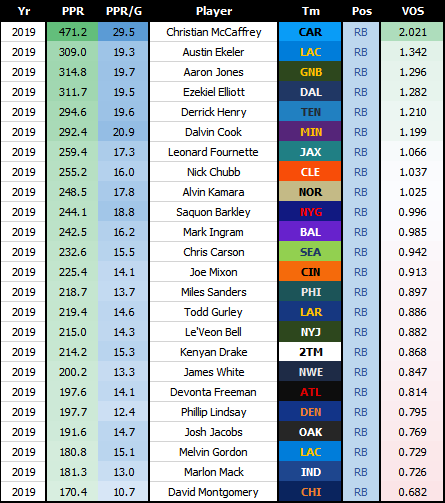
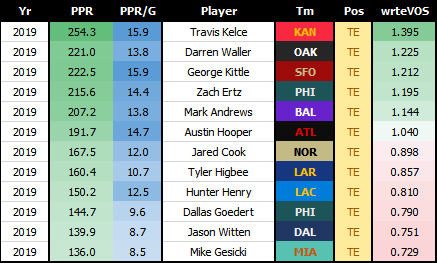
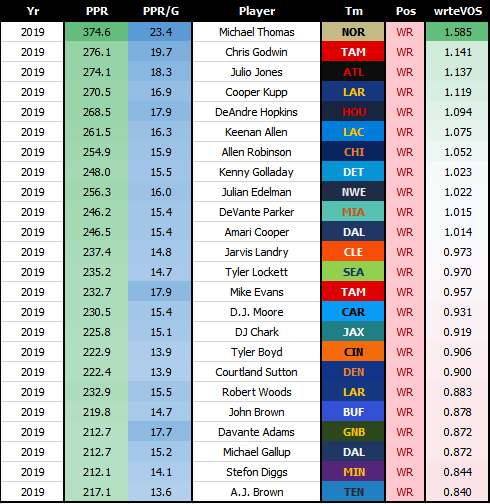
With the theory out of the way, it is time to showcase the metrics in actual use. In order to that, I have chosen the last season of fantasy football as it is still fresh in our heads. Here are the starting players' VOS values at their respective positions (*click to enlarge*):
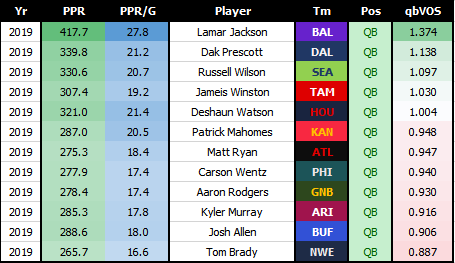
- The quarterback position had his best player, by far, in Lamar Jackson. He was better than the average starter at both passing and rushing. That, combined with the 2019 season being what in which the era-modifier bumped the value of rushing stats for quarterbacks helped him finish with the no. 1 VOS at the position.
- Christian McCaffrey was a beast at the RB position and doubled the value of the average starting running back this season. That, simply put, was just unheard of in the last 20 years. Austin Ekeler, although producing half what the average starter did on the ground, was 2.4 times better on the receiving categories and that helped him reach the second-highest VOS among rushers. CMC raised the bar so much that only other eight players had an above-average VOS this season.
- Nothing to be surprised at the wide receiver slot. Michael Thomas' season was unforgettable and record-breaking in real life and so was it in fantasy football. Chris Godwin and Cooper Kupp came out of nowhere in terms of ADP (let alone DeVante Paker) and reached strong VOS marks compared to the rest of their counterpart receivers.
- Travis Kelce keeps building an astonishing career with another top year that yielded him the best VOS among TEs in 2019. Darren Waller was the clear surprise at the spot with virtually no one expecting such an ROI and VOS coming from the new no. 1 TE of the Raiders. Although Gesicki wasn't close to becoming a league-leader and was middling when compared to the rest of starters he still made his way to the top-12 TEs on the year.
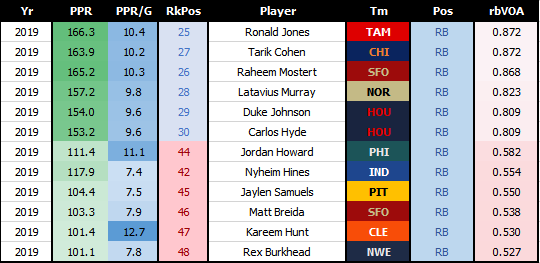
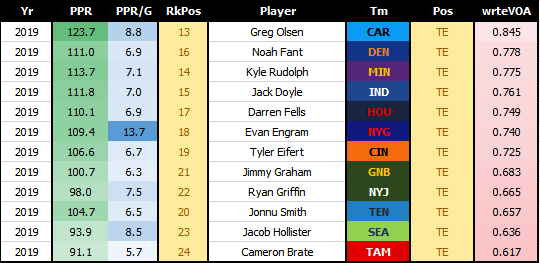
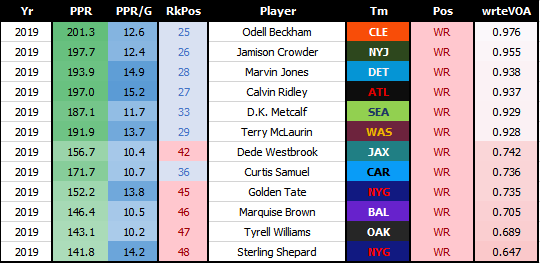
Moving onto "average" players and using VOA, here are the top-six and bottom-six non-starters-yet-rostered players at each position. I have included their rank at the position in total PPR at the end of the season for clarity, just in case it is necessary (*click to enlarge*):
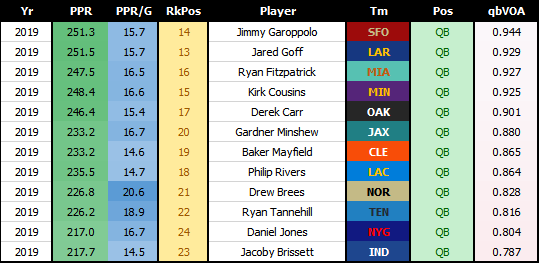
- Jimmy Garoppolo finished as the best non-starter at the quarterback position in both VOS and VOA. Lamar Jackson was even better when compared to the full pack of QB1/QB2 (1.621 VOA) than he was to the starters, as was to be expected, but the rest of the starting quarterbacks didn't separate or improved their VOS marks as much as Jackson did.
- Just as an interesting note: CMC's VOA jumped to 2.561 compared to his 2.021 VOS. Other than that, it is interesting to see how the low-end RB reserves (RB4, mostly) played to a virtual 50% level of the average rostered running back with Rex Burkhead ranked last with a measly 0.527 VOA. Tarik Cohen's amazing catching prowess bumped his VOA all the way up to 0.872.
- The average rostered non-starter at the WR position (WR2/WR3) put up a 0.818 VOA on average, a very reasonable outcome not skewed by any player as there were 11 "reserves" over that mark and 13 under it.
- It might sound weird, but both Jason Witten and Mike Gesicki (who made the cut as top-12 tight ends) were worse than both the average starter (VOS under 1) and the average rostered TE (VOA under 1). Out of the top-12, though, the jump from TE12 (Gesicki) to TE13 (Greg Olsen) was more than sizable with the Panthers tight end having a poor 0.845 VOA.
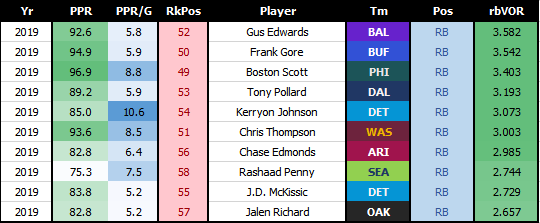
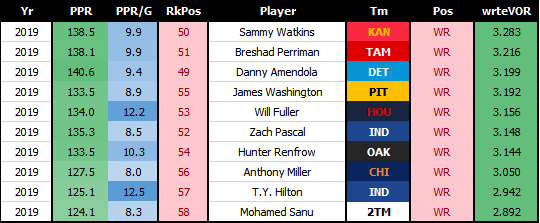
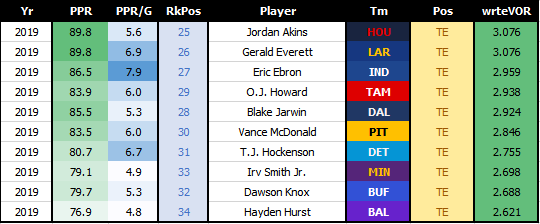
Finally, here are the top-10 players that finished the season ranked outside of what I consider "rostered" players at their position, ordered by their positional VOR. I have included their rank at the position in total PPR at the end of the season for clarity, just in case it is necessary (*click to enlarge*):
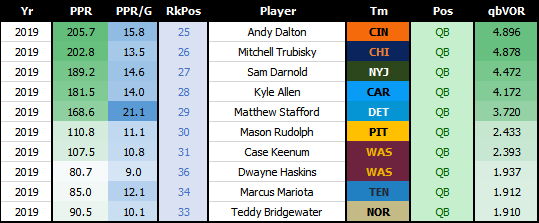
- Both Andy Dalton and Mitch Trubisky had higher VOR marks than four top-24 QBs (Jacoby Brissett, Philip Rivers, Daniel Jones, and Drew Brees) when compared to players available in the waiver wire. Of course, all of them were much better than any player available for free (Brees had the lowest VOR of them at 4.723), but on the long run and aquired for free on Week 1 Dalton and Trubisky would have been better bets.
- Be it because of injury, lack of playing time, or any other reason, some historically recognized household names such as Darren Sproles, Spencer Ware, and Ty Montgomery played at-or-under replacement-level this season with VOR marks around or under 1.000.
- One of the most-hyped players (to a certain extent) during draft-season was then-Steelers receiver Donte Moncrief. He finished the year with a mediocre 0.134 VOR, the 35th-worst among all 217 WRs to play in 2019. Devin Funchess finished just two spots ahead with a 0.143 VOR.
- Up to 50 tight ends (all players at the position considered) were at least 32% better than the average TE available for free, 45 of them performed at least 60% better, and 41 were more than 100% better (which means the at least doubled the production of the average replacement-level TE). With only one TE slot to fill in standard leagues, there were plenty of options available for everyone to use and acquire without cost during the year following a streaming strategy.
Historical Translations Based on These Metrics
One final use of these metrics is for historical translations of player-season lines. As we know the number of fantasy points each player racked up in all passing, rushing, and receiving categories, and we also have a table in which we have broken down the percentage of points that were achieved from players at QB/RB via passing/rushing and rushing/receiving respectively, it is easy to translate their fantasy points between seasons. Time-traveling!
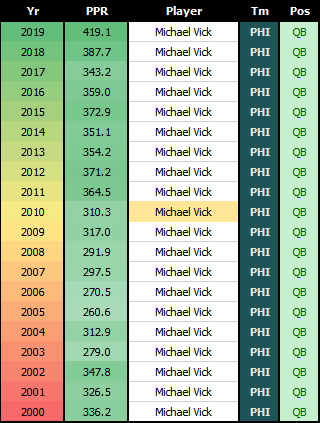
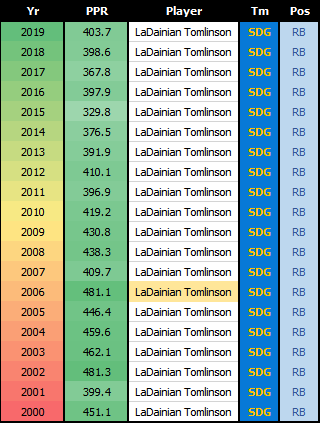
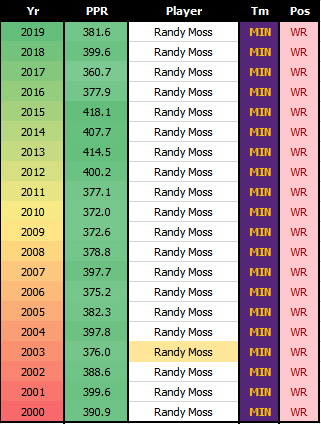
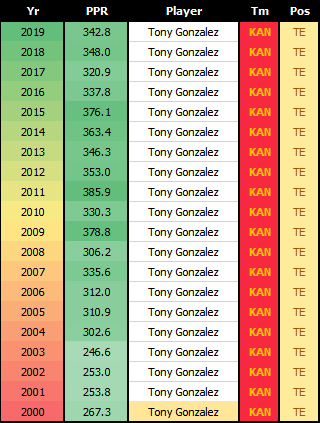
Just to give a quick example, I looked for the best seasons at each position in the span from 2000 to 2010 (just so they are a little bit separated from the present day) in terms of VOS. These are the ones I found in my dataset:
- Quarterback: 2010 Michael Vick, 310.3 FP, 1.673 VOS
- Running Back: 2006 LaDainian Tomlinson, 481.1 FP, 1.928 VOS
- Wide Receiver: 2003 Randy Moss, 376 FP, 1.609 VOS
- Tight End: 2000 Tony Gonzalez, 267.3 PF, 2.009 VOS
And here is how those players would have fared in each of the last 20 fantasy seasons (baseline highlighted), adjusting his points taking their VOS and season-environments into consideration (*click to enlarge*):
More Fantasy Football Analysis