




 RADIO
RADIO










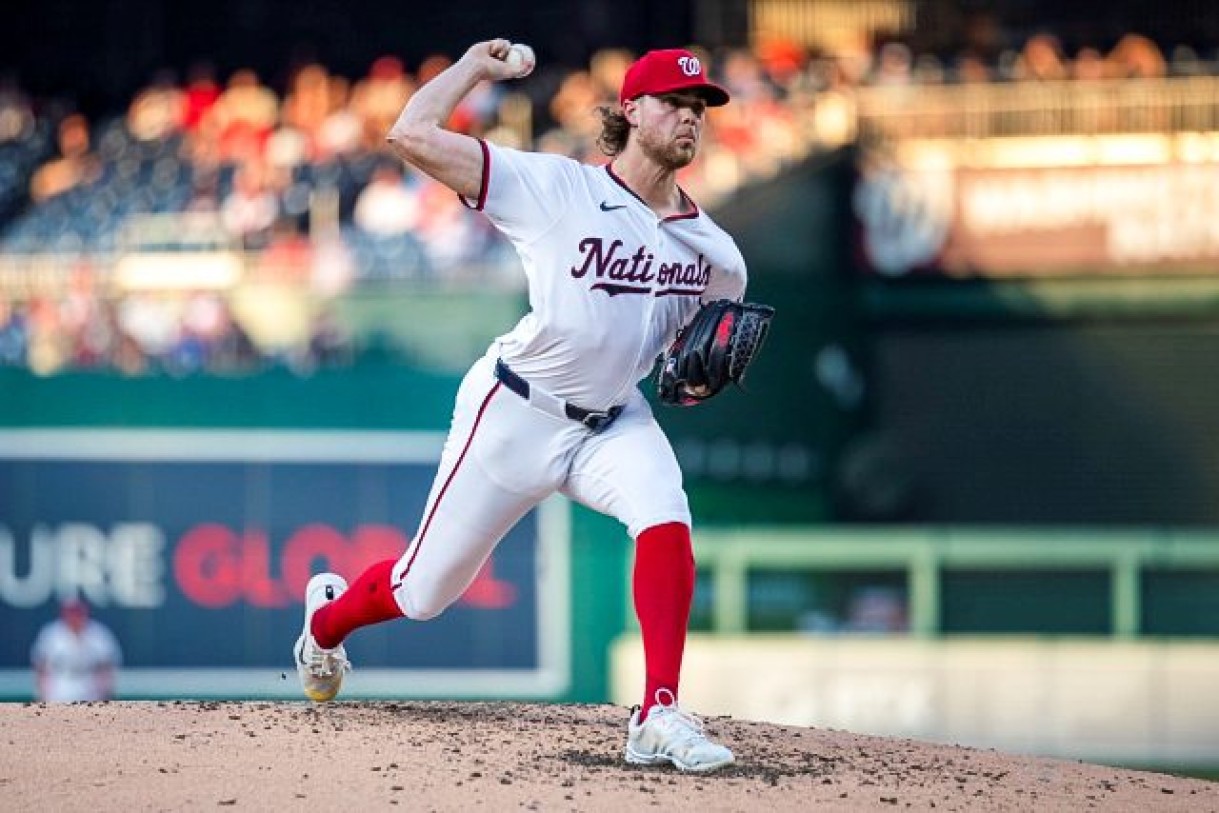
Elliott looks at pitchers with surprising starts recently. These SPs could emerge as fantasy baseball waiver wire targets for Week 5 in 2026, or just mirages.
Welcome back to the "Are You For Real?" series as we dive into Week 5 of the 2026 fantasy baseball season. For those unfamiliar, this is a weekly column where we examine starting pitchers who had surprisingly strong starts over the past week and put them under the microscope to determine whether they're legitimate or just smoke and mirrors.
It was another week of exciting baseball action, and this time we've got three hurlers who dominated over the weekend in surprising fashion. First, we'll deep dive into Jake Irvin's nine-strikeout performance on Chicago's south side. We'll also look at lefty Noah Schultz, who went toe-to-toe with Irvin for eight strikeouts himself. We'll finish it off by examining Kyle Harrison's 12-strikeout day in Milwaukee.
Roster percentages are taken from Yahoo! and are accurate as of April 27.
Featured Promo: Save 50% off the regular price with discount code CHAMP, for a limited time. Exclusive access to our Team Sync platform, DFS cheat sheets, Lineup Optimizers, betting/prop picks, and exclusive content from Nick Mariano and Eric Cross! GAIN ACCESS NOW
Jake Irvin, Washington Nationals – 3% Rostered
2026 Stats (before this start): 24 IP, 6.00 ERA, 4.96 FIP, 13.2% K-BB%
04/25 @ CHW: 5.2 IP, 4 H, 0 ER, 0 BB, 9 K
Irvin was fantastic on Saturday, blanking the White Sox over five and two-thirds innings while striking out nine. It was the best start for Irvin yet this season, who lowered his ERA a full run to 4.85 following this game. Irvin has been a fixture in Washington’s rotation these past few seasons, making 66 starts for them between 2024-25. He’s never been big on fantasy radars, however, but should that change? Is Irvin ready to turn a corner?
Originally a fourth-round pick by the Nationals back in 2018, Irvin wasn’t a huge pitching prospect by any means, but he was viewed as a future back-end starter for Washington. His fastball was rather soft, but scouts thought his big frame (6’6”, 234 LBS) and deep repertoire of secondary offerings would allow him to make it as a starter. Irvin works with a six-pitch mix consisting of a four-seam fastball, sinker, curveball, cutter, sweeper, and changeup.
Irvin’s most used pitch this season has been the four-seam fastball, which he’s thrown 29.7% of the time. That was not the case in this most recent start against Chicago, however. Instead, Irvin relied heavily on his curveball, which he threw 36% of the time in this start. It was by far his highest curveball usage this year, and boy did the pitch work for him. Irvin got an impressive 16 swinging strikes in this game, and 11 of those came from his curveball.
A 77.3 mph offering, Irvin’s curveball is soft, even relative to his 92.9 mph four-seamer. It has rather low spin for a curve at 2515 RPM, but what makes the pitch special is its movement. Irvin gets 3.5 inches of drop with the pitch and also gets a whopping 16.4 inches of glove-side movement with the pitch. That’s a lot of horizontal movement for a curveball, and it gives the pitch a unique shape. Here’s a look at Irvin’s pitch movement profile for 2026 (curveball in blue).
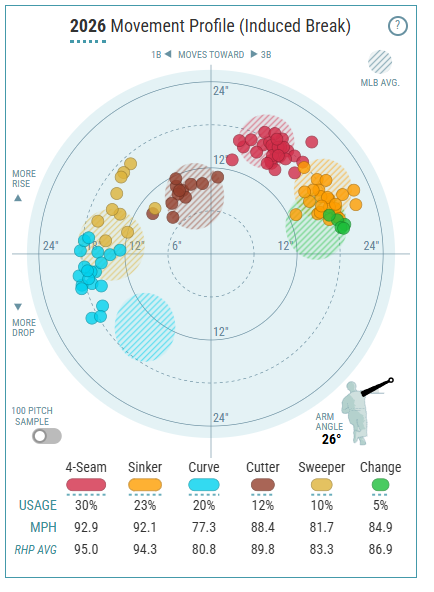
That’s a big deviation from league average, which can make the pitch difficult for hitters to read and make solid contact against. Here’s an example of the curveball from this season.
— Elliott Baas (@ElliottBaasBB) April 28, 2026
Nasty stuff, and opposing hitters have really struggled against this pitch so far. Batters have gotten zero hits off Irvin’s curveball in 2026. That’s right, a .000 AVG and .000 SLG. He also has a .166 xBA and .263 xSLG with the pitch, suggesting that the good results are sustainable.
Irvin also has an astonishing 48.8% whiff rate with the curveball so far, which is elite territory. The curveball has always been Irvin’s best pitch, but these numbers represent a whole different level. He’d never been this good before, and he also gained almost two inches of horizontal movement with the pitch compared to last season.
Irvin seems to be locating the pitch much better this season as well. His zone rate has dropped from 53.6% last season to 45.7% this year. I’m not sure I can fully buy into these results for Irvin’s curveball, as it’s a big difference over what he’s previously shown us, but he has gained movement and is throwing the pitch less in the zone (45.7% zone rate this season, 53.1% career), so perhaps these tangible changes account for the improvement.
The end results will probably be somewhere in the middle. Better than previous years for Irvin, but not .000 AVG and 48.8% whiff rate is good.
The curveball really has been his anchor this season, and it’s encouraging to see Irvin throw it more often. One reason behind that could have been the lefty-heavy lineup the White Sox put up against him. Chicago started six lefties in this game, and Irvin throws the curveball to lefties more frequently. It would be nice to see him continue this curveball reliance, as it’s clearly his best pitch.
Increased curveball usage wasn’t the only shift in pitch mix Irvin made this game. He also threw his sinker more often, tossing the sinker 31% of the time compared to 25% four-seam usage. A 92.1 mph offering, Irvin’s sinker is decidedly below average velocity. It also lacks significant movement, ranking about league average in vertical and horizontal movement. Irvin’s sinker has been hit hard over his time in the majors, with opponents hitting .321 off the pitch with an .861 OPS all-time.
Things haven’t been much better this season, as batters are hitting .296 with a .519 SLG and .389 wOBA. Opponents also have a blistering 93.3 mph average exit velocity off this pitch. The one good thing about Irvin’s sinker is that it has routinely been a solid ground-ball pitch, with a 55.4% career ground-ball rate and a 54.2% ground-ball rate this season. That hasn’t helped Irvin much, though, as Irvin has mostly shown flyball tendencies and has a career 1.58 HR/9.
The longball was really bad for Irvin last year, as the right-hander served up 38 bombs in 2025. Unfortunately, there’s nothing about this sinker or increased sinker usage that would suggest it can suddenly be effective. It’s been a vulnerable pitch throughout Irvin’s big league career, and that probably isn’t changing soon.
Irvin threw his sinker more often than his four-seamer in this start, but the four-seamer has acted as his primary fastball for most of his career. A 92.9 mph offering, it’s a slow pitch. Even worse, the pitch lacks any significant movement that could fool a big league hitter. He’s averaging just 14.4 inches of induced vertical break and 8.4 inches of arm-side run, both unremarkable numbers. Here’s a look at his pitch movement profile again (four-seamer in red).
See how the pitches are all bunched up over the league average marker? That’s not a good thing, especially when the pitcher in question can’t even average 93 mph. Yet, even with these unfavorable measurables, batters have really struggled against Irvin’s four-seamer. Opponents are hitting just .147 with zero extra-base hits and a .244 wOBA against Irvin’s four-seamer this season.
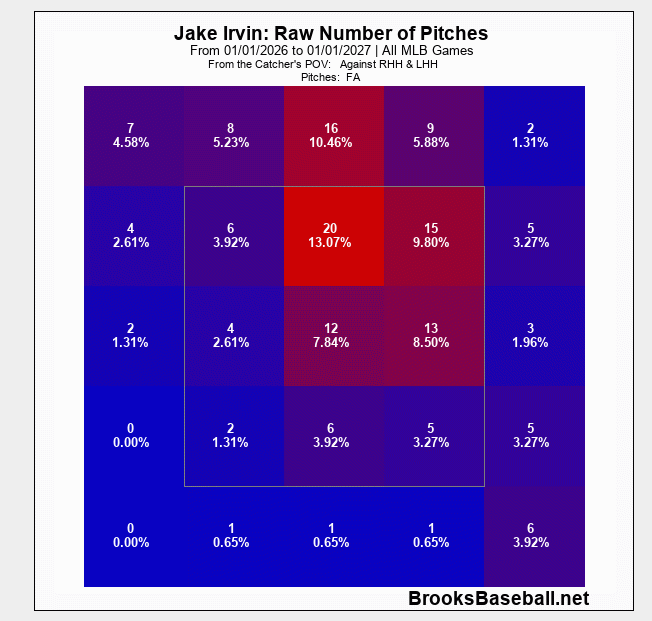
One thing that Irvin is doing differently is locating the pitch. He’s throwing it in the zone at a career-high 57.1% rate, and he’s doing so mostly by keeping the pitch up in the zone and in on left-handed batters, which is who he primarily throws the four-seamer against. Let’s compare his 2026 fastball heatmap to 2023-25.
2026:
2023-2025
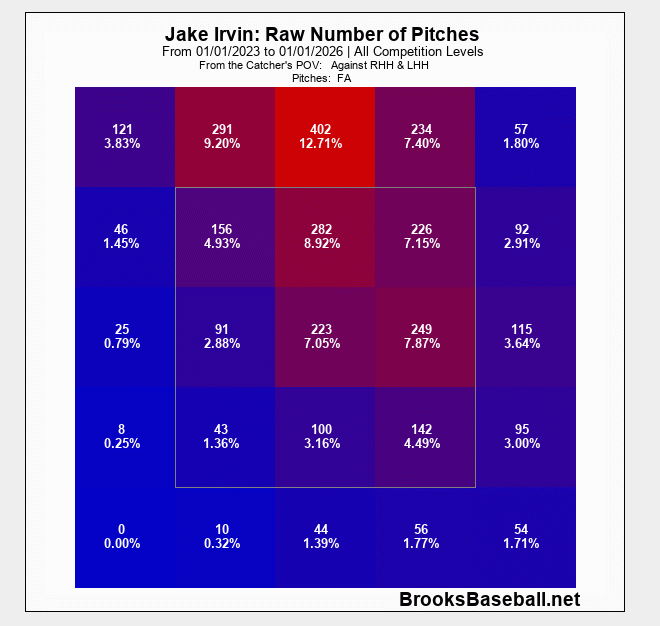
It’s not a drastic shift, but we can see how Irvin is focusing on the zone more this season, and it’s leading to better results. I’m skeptical whether this is sustainable for him, as he’s still allowing a 91 mph average exit velocity on his four-seamer. His four-seamer was crushed for a .295 xBA, .597 xSLG, and .410 xwOBA last season. I will need to see more sustained success before I can believe in these results.
The two fastballs and the curveball are Irvin’s three primary pitches. In fact, he threw these three pitches 92% of the time against Chicago on Saturday. He only threw one sweeper and one changeup each, and he uses each pitch less than 10% of the time, so neither is a big part of Irvin’s game. One pitch he has begun to throw more often is the cutter, which he only threw 6% of the time against Chicago, but has a career-high 12.1% usage rate this season.
An 88.4 mph offering, Irvin’s cutter has been hit rather hard by opponents so far. He has a .313 AVG, .625 SLG, and .402 wOBA against the pitch. He also has a 92.3 mph average exit velocity against, and hard contact is something that Irvin has struggled with this season and in previous years. He has allowed a 90.9 mph average exit velocity overall, along with an ugly 51.2% hard hit rate. That’s not what we want to see, especially for someone with Irvin’s home run issues.
Verdict: This was a great start for Irvin, and that curveball looked really effective. It’s been dominant all season, with Irvin posting a .000 AVG against and a 48.8% whiff rate. That should make him interesting from a fantasy perspective, but in this case, I’m not sure the rest of his arsenal is strong enough to support or sustain this performance.
There’s no way he maintains a .000 BABIP against the curveball, and his whiff rate had never been above 25.7% with the curveball before this season. It would be very surprising to see Irvin come close to either of those numbers at the end of the season.
The biggest problem—or problems—for Irvin are his weak fastballs. He throws both a four-seamer and sinker with regularity, but both fail to consistently generate whiffs or weak contact. The sinker has been absolutely crushed during Irvin’s major league tenure, and this season has been no different. The results on the four-seamer have been favorable so far, but with poor velocity, weak movement, and a shaky track record, I’m struggling to see a world where Irvin maintains his .147 AVG against with the four-seamer.
The curveball is good enough that Irvin should be able to take advantage of weak lineups, as he did on Saturday, but I would not trust him against more formidable opponents. He’s a weak, matchups-based streamer in most formats. His next start is Friday against the Brewers, and while the Brewers have just a .313 wOBA against righties this season, I’m not sure I’d trust Irvin there. The Brewers also have a low 21% K rate and a 12.2% BB rate against righties this season, and the Brewers have proven to be a dangerous club in the past.
Noah Schultz, Chicago White Sox – 43% Rostered
2026 Stats (before this start): 9.1 IP, 3.86 ERA, 3.98 FIP, 13.2% K-BB%
04/25 vs. WSH: 6 IP, 4 H, 2 ER, 4 BB, 8 K
Schultz dissected the Nationals opposite Irvin on Saturday, posting a career-high eight strikeouts in the no-decision. It was the first career quality start for Schultz, and the first time he’d completed more than five innings in a game. A big pitching prospect coming into the season, Schultz is looking like he might be in Chicago’s rotation all year long. But does that make him a fantasy asset?
Originally a first-round pick by the White Sox back in 2022, Schultz was considered a high-end pitching prospect and was viewed as a potential frontline starter down the line. He was known for his big size (6’10”, 240 LBs), big velocity, and wipeout sweeper. Schultz works with a five-pitch mix consisting of a four-seam fastball, sweeper, sinker, cutter, and changeup.
Schultz’s most used pitch thus far has been the four-seam fastball, and that was no different on Saturday. He threw the four-seam fastball 34% of the time against Washington, which is about in line with his usage in previous starts. A 95.6 mph offering, Schultz throws hard, though maybe not as hard as we’d expected given his size.
Still, his fastball velocity is solidly above average, and the pitch has performed quite well so far. Batters are hitting just .087 off Schultz’s four-seamer, along with a .130 SLG, .186 wOBA, and a 36.1% whiff rate. Four of his 10 whiffs on Saturday came from the four-seamer.
Schultz’s fastball has plus velocity and high spin with an average of 2516 RPM in the majors, with an 88% active spin rate so far. He was around 2400-2500 RPM in the minors, so we can expect this rate to hold. What’s interesting about this fastball isn’t necessarily the velocity or spin, but the movement.
It’s a rather flat fastball with only 12.3 inches of IVB, but it has heavy arm-side movement of 11.5 inches. Schultz also has sort of a funky delivery, with a low 21-degree arm angle and compact motions allowing him to sling the ball to the plate. Here’s an example of one of his fastballs from this year.
— Elliott Baas (@ElliottBaasBB) April 28, 2026
He’s 6’10”, but this delivery is rather efficient and compact despite his size. He’s had some interesting pitch locations with the fastball so far, too. Here’s a look at his four-seam heatmap in three starts.
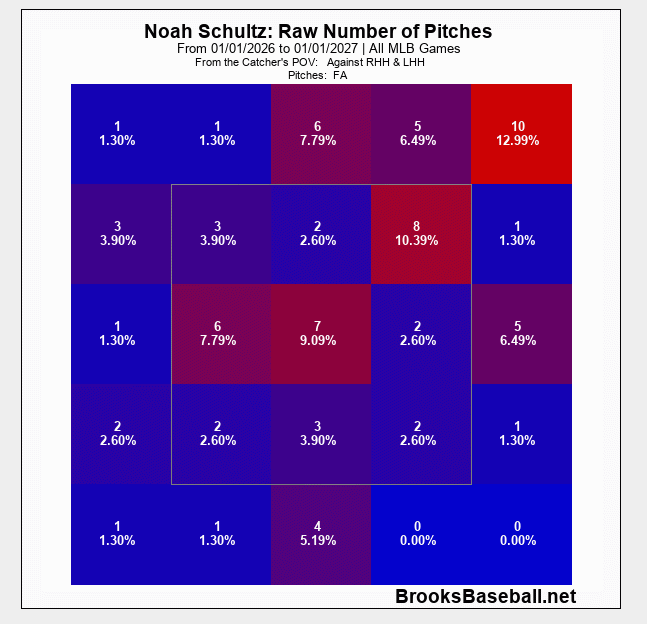
It’s a little all over the place, but as you can see, Schultz is favoring high and away fastballs to righties, who have seen most of his four-seamers. Schultz has struggled to throw strikes and locate at times, but he’s been good at putting the fastball in favorable spots so far. I sincerely doubt that the .087 AVG and 36.1% whiff rate will hold, but this looks like an above-average heater and a good anchor for Schultz on the mound.
His next most used pitch has been his sweeper, which he threw 25% of the time on Saturday. An 82.6 mph offering, the sweeper is soft relative to his fastball and has big horizontal break with 14.6 inches of glove-side movement. It’s sort of loopy, and almost resembles a slider-curveball hybrid as it drops into the plate. Here’s an example from this season.
— Elliott Baas (@ElliottBaasBB) April 28, 2026
That’s the type of pitch that can confound hitters after they’ve been trying to swing at his 95 mph heater. Schultz only has a 20% whiff rate with the pitch so far, but had a 50% whiff rate and three of his 10 whiffs with the pitch on Saturday. He also had a 61.1% whiff rate with the pitch in the minors before promotion. Schultz hasn’t been afraid to use the pitch against both righties and lefties, which is great to see as the sweeper was long touted as his best pitch. Batters are hitting just .154 against the pitch so far, and this pitch has the makings of a plus breaking ball for Schultz.
Schultz threw plenty of four-seamers and sweepers in this start, but one pitch he began to rely on more was the cutter. He threw the cutter 24.7% of the time in this start after having thrown it less than 20% of the time in his two previous outings. An 89.5 mph offering, Schultz’s cutter is between the four-seamer and sweeper in terms of velocity, and doesn’t have drastic movement, as the sweeper does.
In fact, Schultz’s cutter is just slightly above average in terms of horizontal and vertical movement. It does stand out in terms of spin rate, though, with Schultz averaging 2698 RPM with the cutter so far.
Batters have had good results against this pitch with a .500 AVG and .515 wOBA against, but the .275 xBA and .297 xwOBA suggest that Schultz has been unlucky with those results. His 75.4 mph average exit velocity against suggests that Schultz could see much better results with the pitch going forward, as batters are struggling to make hard contact. Schultz barely threw his cutter last season with a microscopic 1.3% usage rate.
He’s at 18.9% in the majors and 21.1% in the minors this year, so we’re seeing this pitch become a bigger part of his arsenal before our eyes. That’s a good thing for Schultz, because he’s sort of struggled to find a third pitch to go along with his fastballs and sweeper. He has a changeup that’s performed well in limited usage, and he used to throw a curveball, but seems to have scrapped it. Now, the cutter represents a solid third pitch for him to round out his repertoire, while the changeup remains as a rather effective show-me pitch.
The talent and stuff are there with Schultz, but there are some concerns I have for his fantasy outlook for 2026. First, he’s really struggled with injuries. He only threw 27 innings in his first professional season due to forearm troubles, and he only threw 88.1 innings in 2024 and 73 innings in 2025. I just don’t know how many innings he’ll get in the majors this year, especially with the White Sox staring down the barrel of another losing season.
He’s also really struggled with walks at times, with a 14.3% walk rate in the majors so far. Heck, he issued four free passes in this start. He had a 13.8% walk rate in the minors last season as well. That means both lots of baserunners and short outings for Schultz, as batters will likely be able to drive up his pitch count. Schultz is a raw talent, but he may not be ready to put everything together yet.
Verdict: A big pitching prospect—both literally and figuratively—Schultz has impressed thanks to his 95 mph fastball and knee-buckling sweeper. He’s been able to pair the two pitches together nicely and has put up plus strikeout rates at all minor league stops before promotion. He relies heavily on the fastball and sweeper, but a cutter and changeup help deepen his arsenal and make him a well-rounded starting pitcher.
The biggest drawbacks for Schultz in fantasy are his lack of experience, injury history, and control issues. He’s never thrown more than 88 innings in a season, and it’s difficult to say how many innings the White Sox will allow him. He’s also had some ugly control issues in the minors, and even allowed four walks in this great outing. I like the talent here, but I don’t think the breakout will happen quite yet.
Schultz is raw and will take his lumps on the mound. He’s good enough to take advantage of weak lineups like Washington, and for now, I’d probably use him as a streamer against bad teams. He’s also the kind of pitcher I don’t mind using in weekly formats when trying to make up ground or my weekly ratios are already shot. He’s liable to have a big start like this now and then, even if it’s a risky proposition to start him every time out.
Kyle Harrison, Milwaukee Brewers – 35% Rostered
2026 Stats (before this start): 17.2 IP, 3.06 ERA, 4.26 FIP, 14.3% K-BB%
04/26 vs. PIT: 6 IP, 1 H, 0 ER, 1 BB, 12 K
Harrison was unreal on Sunday, fanning 12 Pirates for a new career-high in strikeouts. He also picked up his second win and first quality start of the season. A former top prospect, Harrison has been traded twice in less than a calendar year. Has he finally found a home in Milwaukee? And more importantly, is he going to be good for our fantasy teams?
Originally a third-round pick by the Giants in 2020, Harrison became a huge pitching prospect in San Francisco’s organization thanks to his deep arsenal and strong minor league performances. He was a big part of the Rafael Devers trade in 2025 and was traded again to Milwaukee ahead of the 2026 season. Harrison works with a four-pitch mix consisting of a four-seam fastball, slurve, changeup, and sinker.
Harrison may have four pitches to work with, but his functional arsenal is more like three pitches because he rarely throws the sinker. He’s thrown a total of nine sinkers this season, a 2.1% usage rate, which is quite a bit higher than his career usage rate of 0.3%. For Harrison, he lives and dies by the four-seamer.
He throws his four-seamer 59.2% of the time, which is among the highest four-seam usage rates in the majors this season. A 94.6 mph offering, Harrison has gained some velocity over the years. He was averaging just 92.6 mph in 2024, when he made a career-high 24 starts. Like Schultz, Harrison has sort of a flat fastball. It only has 15 inches of IVB, which isn’t a ton of rise for a four-seamer. He does get strong horizontal movement with the pitch, though, averaging 13.1 inches of arm-side run with the pitch so far.
What’s interesting is just how well the pitch has performed, and not just this season. This season has been great, with batters hitting just .196 off Harrison’s four-seamer, along with a .304 SLG and .292 wOBA. He also has an impressive 32.1% whiff rate. He somehow had 13 whiffs with the pitch out of 23 total on Sunday, both of which are astonishing numbers. A pitcher getting 13 whiffs total is a pretty good start, but Harrison got 13 with one pitch, and 10 more to boot.
Those are all strong numbers from the fastball, but all-time batters are hitting just .225 off the pitch, and Harrison has never had a whiff rate below 23%, which is very good for a fastball. Harrison’s fastball has proven to be an effective pitch for him throughout his major league career, and it was working well for him on Sunday. I wouldn’t expect 12 strikeouts every time, but he has the potential to be an above-average strikeout pitcher.
The four-seamer did a lot of the heavy lifting on Sunday, but another pitch that was quite effective for Harrison was the slurve. He threw it 28% of the time and got eight whiffs on 15 swings as well. He more than doubled his season-long whiff rate with the pitch, as it went from 12.9% prior to this start to 26.1% after the start. An 81.9 mph offering, Harrison’s slurve is soft in terms of velocity but sharp in terms of horizontal movement. Here’s an example from this season.
— Elliott Baas (@ElliottBaasBB) April 28, 2026
Looks pretty nasty there, and batters have really struggled against this pitch. Overall, opponents are hitting just .091 with zero extra base hits and a .136 wOBA off Harrison’s slurve. These results probably won’t hold, as it’s taken a .133 BABIP to achieve this. Plus, batters hit .333 off the slurve last season; the pitch doesn’t have a great track record of success.
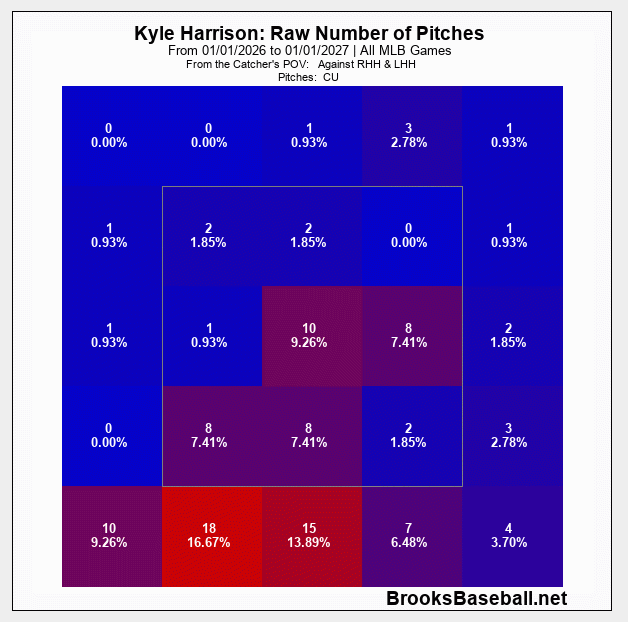
Harrison hasn’t been able to consistently generate whiffs with the slurve, and before this season, batters have been able to handle it pretty well. It does seem as though Harrison is taking a new approach with this pitch. His zone rate is a career-low 39.8%, and he has a 30.8% chase rate with the pitch. Let’s compare his 2026 slurve heatmap to the rest of his career.
2026:
2023-2025:
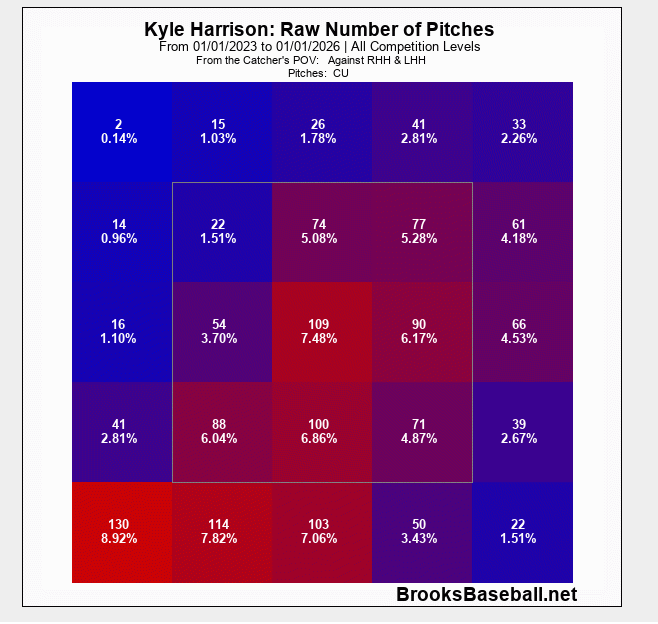
His low and away spots have gone way up, and he’s virtually never throwing it above the middle of the zone. Harrison has roughly average command, so it remains to be seen whether he can sustain this going forward, but it’s a good change to have made. If Harrison can continue to hit his spots, he may turn a corner with his slurve.
The four-seamer and slurve made up the bulk of his pitch usage on Sunday, but Harrison did mix in a changeup 17% of the time as well. An 86.3 mph offering, Harrison’s changeup usage has fluctuated throughout his career. He threw it 19.8% of the time in 2024, when he tossed a career-high 124.1 innings. But he only threw it 8% of the time last season.
Perhaps poor results deterred him from throwing it, because Harrison allowed a .287 AVG with a .287 xBA with his changeup in 2024, and a .300 AVG with a .384 xBA in 2025. It’s a pitch he throws almost exclusively to right-handed hitters, but it’s never been all that effective for him. The pitch does have 2.8 inches of drop, which is a lot for a changeup, but Harrison hasn’t been able to generate whiffs with the pitch. Even in this start, when it seemed like Pittsburgh was missing everything, Harrison had just two whiffs with the change.
Opponents are hitting .286 with a .500 SLG and a .368 wOBA off Harrison’s changeup this season as well. This is a fine third option for Harrison on the mound, a good pitch to fill out his arsenal. But it’s nothing special, and Harrison will likely fail to generate plus whiffs with the pitch.
Overall, I’m a little skeptical of Harrison’s strikeout abilities. He had 12 strikeouts in this one, but he had 10 strikeouts combined in his three starts prior to this game. His four-seam fastball is probably his best strikeout pitch, but I’d be surprised to see him maintain his current 32.1% whiff rate with the pitch. I’d expect Harrison’s strikeout rate to be between the 22-24% range, rather than his current 31.3% K rate.
Verdict: It doesn’t get much better than what we saw from Harrison on Sunday. 12 strikeouts is a truly dominant game, and Harrison was able to mystify Pirates hitters with his four-seamer and slurve. He’s made some velocity gains with the fastball over the past two years, and he’s made some improvements to his slurve’s pitch location this season. Those are both steps in the right direction, and I think Harrison could be a good mid-rotation or back-end starter this season.
I wouldn’t expect 12 strikeouts every time. Heck, I wouldn’t expect a strikeout rate above 25% when it’s all said and done. He’s probably pitching over his head with his current 2.28 ERA and 11.4 K/9, but he could still be a solid fantasy asset, and someone you can trust in most matchups. His next start comes Saturday against the Nationals, and I think he’s usable there as Washington has a 25.8% K rate against left-handed pitchers this season, and we already saw them get carved up by Schultz.
More Fantasy Baseball Advice
Download Our Free News & Alerts Mobile App
Like what you see? Download our updated fantasy baseball app for iPhone and Android with 24x7 player news, injury alerts, sleepers, prospects & more. All free!