




 RADIO
RADIO








Are these pitchers fantasy baseball breakouts or fake outs? Dan analyzes advanced pitcher statistics and surging fantasy baseball SPs for Week 5 of 2026, including Payton Tolle and more!
Another week of baseball games is in the book, and we have some more young pitchers emerging on the scene to discuss. This week, I'm going to dig into the first two starts of the Payton Tolle era in Boston, a potential new ace on the White Sox in Davis Martin, and a possible post-hype sleeper in Miami's Max Meyer.
If you are new to this column, remember that the goal is to look at several pitchers each week who are showing signs of "breaking out." That term gets thrown a lot in our industry, but for me, it simply means they're flirting with the possibility of improving their baseline performance over a larger sample size.
So, while we typically look at younger pitchers as potential "breakouts," I won't limit myself to only youngsters. The concept of the breakout can be applied to pitchers of all experience levels, as we have seen numerous examples of pitchers improving significantly from season to season, even into their 30s. All rostership percentages are courtesy of Yahoo! Let's see which of these arms we can trust going forward, and also where to expect regression in the future!
Featured Promo: Save 50% off the regular price with discount code CHAMP, for a limited time. Exclusive access to our Team Sync platform, DFS cheat sheets, Lineup Optimizers, betting/prop picks, and exclusive content from Nick Mariano and Eric Cross! GAIN ACCESS NOW
Payton Tolle, Boston Red Sox
- 48% Rostered
- 2025 stats: 16.3 IP, 6.06 ERA, 1.59 WHIP, 25.7% K%, 10.8% BB%
- 2026 stats: 10.2 IP, 3.38 ERA, 1.03 WHIP, 35.7% K%, 11.9% BB%
There's certainly a lot to like about the overall numbers, but Tolle's first two starts were quite different as he dominated the Yankees in his debut and then labored through 4 2/3 innings against Toronto. Let's take a quick look at both outings and see what was so different from his first start to his second start.
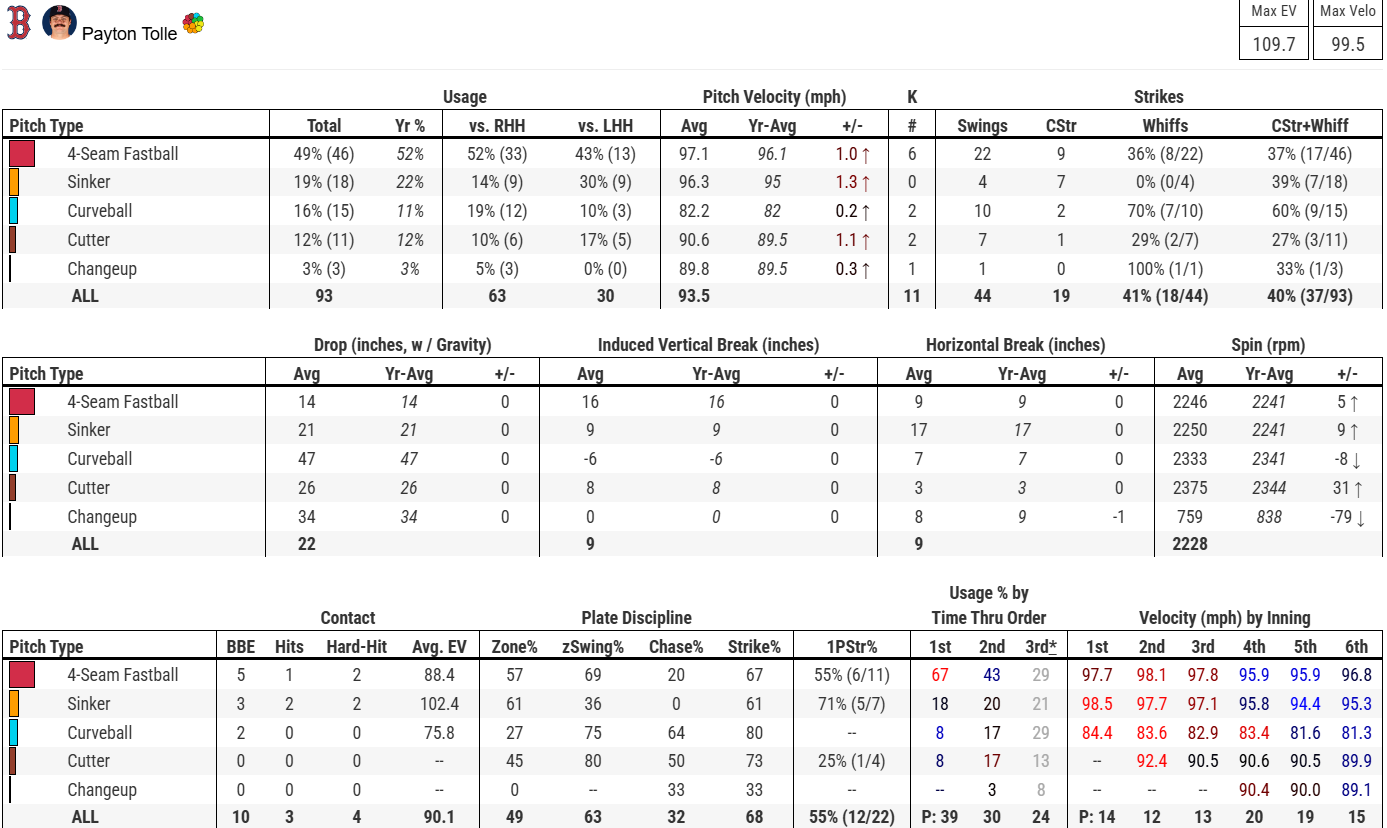
Against the Yankees, Tolle racked up 11 strikeouts over six innings on 93 total pitches. He was pounding the zone with fastballs and getting whiffs with both the four-seamer and curveball (70%). His velocity was up on all of his pitches, and the only real damage done came on a solo home run by Jazz Chisholm. He also only walked one hitter and had the Yankees chasing his secondary stuff out of the zone.
It was about as good as we could have dreamed up for a debut as he finished with a 19.3% SwStr% and a 40% CSW%. Tolle leaned heavily on his four-seamer and sinker, but worked ahead in the count and was able to maximize his offspeed stuff as a result. The Yankees are also a good target for strikeouts, even if they are a dangerous lineup in terms of power and run production.
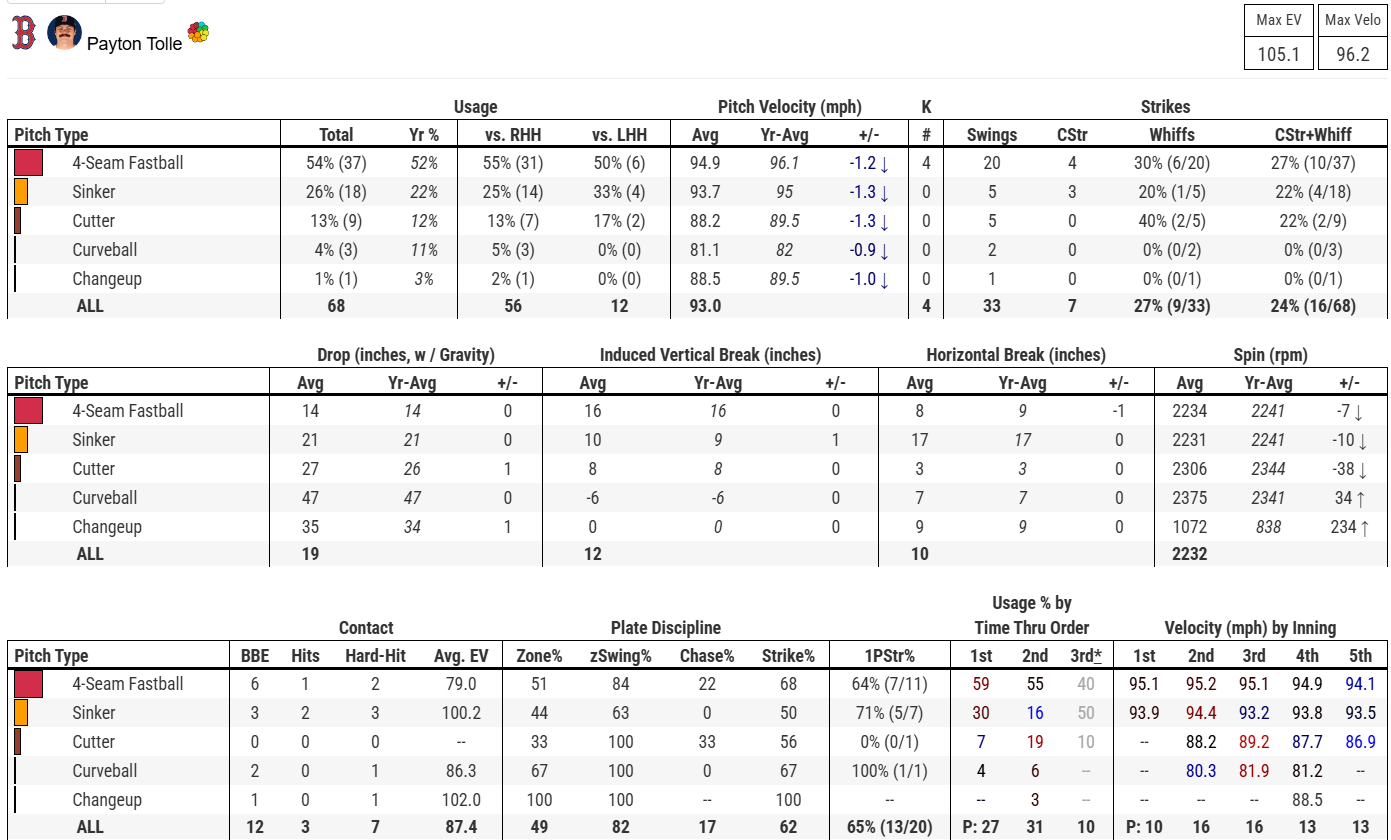
Toronto is a more patient group of hitters and a tougher lineup to accrue strikeouts against. They threw seven right-handed hitters at him and were able to draw four walks and three hits, ultimately forcing Tolle to leave without finishing the fifth inning after throwing just 68 pitches. Not only were the strikeouts down and walks up, but Tolle also allowed a 58% HardHit%.
The velocity was down in this outing, around 1 mph lower on every pitch type. I'm not sure if he was running on adrenaline against the Yankees, and this was closer to what we should expect from him in terms of velocity, but his average fastball velocity has been between 95-96 mph in both the minor and major leagues, so it's not all that concerning yet unless it starts to become a trend.
He looked a lot more human in this outing, finishing with a 13.2% SwStr% and a 27% CSW%. That's still nothing to sneeze at, and perhaps if he was allowed to pitch his way out of the fifth, he would have come back out for the sixth inning and had a chance at a quality start. But it was quite clear that he was nowhere as sharp as he was against New York a week earlier.
Verdict: Ultimately, the profile here is still one of a promising young pitcher with a lot of strikeout potential. Tolle's ratios could end up being really good if he can dial in the control. His walk rates in the minors have been quite good, but haven't translated to the big leagues yet.
He's still a fly-ball pitcher who is going to be vulnerable to the home run, especially when he's so fastball-heavy with his approach. But his curveball and cutter are solid complementary pitches, and he should provide enough value in the strikeout department to make him worth rostering until we see how he fares in his next few starts.
It's not a full-on breakout yet, but there's enough good stuff here to keep me interested going forward. If he were dropped in your league after his second start, I'd consider picking him up.
Davis Martin, Chicago White Sox
- 52% Rostered
- 2025 stats: 7 W, 142.2 IP, 4.10 ERA, 1.29WHIP, 17.3% K%, 8% BB%
- 2026 stats: 4 W, 37 IP, 1.95 ERA, 1.08 WHIP, 22.9% K%, 5.6% BB%
I thought we'd be celebrating the successes of Shane Smith as the ace of the White Sox staff by this time, but Smith had a rough start to his year and was demoted to Triple-A. Meanwhile, it's been Martin who has emerged as the top arm on Chicago's staff instead.
Martin is already on pace to shatter his win total from last season, while lowering his ratios to borderline elite levels, increasing his strikeouts, and cutting down on his walks. He's been terrific in each of his last two outings against the Diamondbacks and Angels, striking out seven hitters in each start while allowing only one earned run.
Davis Martin's 7th K pic.twitter.com/aIsO28xKea
— Rob Friedman (@PitchingNinja) April 29, 2026
So what gives? How has Martin gone from putting up rather pedestrian numbers last season to becoming one of the hottest pickups among starting pitchers in fantasy baseball?
Well, the answer is a bit more complicated than I had hoped for. Martin's underlying numbers look largely the same as they did last season. The SwStr% is virtually the same, as are the F-Strike%, Z-Contact%, and even a lot of his batted ball numbers (HardHit%, average exit velocity, etc...)
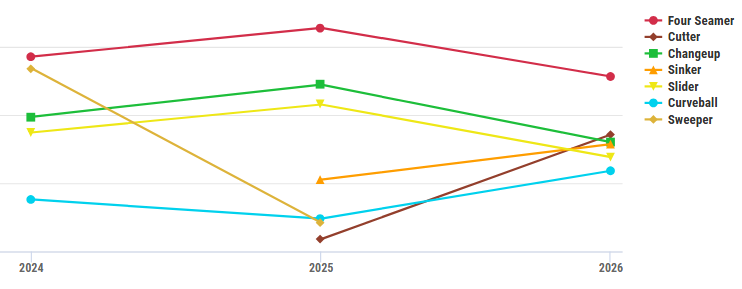
When we look at his pitch mix, it's pretty similar, though he has had a more balanced approach to his arsenal than ever before - throwing six different pitches and none of them more than 26% of the time.
If we are looking for positive factors, he's increased his CStr% (called strike percentage) by 4% and cut his Ball% by 3%, meaning the decrease in walks could be very real. There's also no real regression expected to his BABIP (.303) either. It seems like he's figuring out how to pitch and maximize his stuff, which he'll have to do since none of his pitches really profile as anything better than average.
We've seen other right-handers have some success with a deep arsenal and solid control, despite not having a true out pitch (Aaron Civale and Joe Musgrove come to mind), but the margins are always slimmer for these types of pitchers, who often provide a pretty solid floor but lack much of a ceiling.
And if we want to look for regression, Martin's LOB% and HR/FB are both career-highs and well above (or in the case of HR/FB - below) the league average. His SIERA of 3.66 is quite solid, but his xERA of 4.52 is lagging, suggesting that the hard contact will eventually catch up with him.
Verdict: Martin has definitely turned a corner and could be a relatively reliable fantasy asset this season. But let's pump the brakes on his breakout just a bit, as there's surely some regression coming to his ratios, and his profile doesn't really support the increase in strikeouts either.
If the improved control sticks, and he can continue to sequence his pitches successfully, there's a very real chance that he can easily beat his numbers from last year. He could be pretty good, but he's not likely to be anywhere nearly as good as his surface stats from the first month either. He belongs on fantasy baseball rosters for now.
Max Meyer, Miami Marlins
- 22% Rostered
- 2025 stats: 3 W, 64.2 IP, 4.73 ERA, 1.42 WHIP, 23.9% K%, 7% BB%
- 2026 stats: 1 W, 30 IP, 3.30 ERA, 1.20 WHIP, 25% K%, 9.1% BB%
Max Meyer is now 27 years old! I honestly did not realize he was this old, as it seems like not that long ago he was making his Marlins debut as their top pitching prospect. But that was all the way back in 2022, and he only threw six big league innings before getting hurt and requiring Tommy John surgery that forced him to miss all of the 2023 season.
Injuries have limited Meyer to just 127 2/3 innings in Miami over his first three MLB seasons. His 2024 numbers across 11 starts were quite bad, but he was significantly better (though still not "good") last year across 13 starts with the Marlins. The strikeouts at least started coming back, even if the ERA and WHIP were still elevated.
So far this year, he's on pace for his best numbers across the board, with the exception of his walk rate. The only other real complaint with Meyer would be the lack of innings, as he's yet to pitch into the sixth inning this season. Part of that might not be his fault, as the organization could easily be limiting his innings to try to keep him healthy for the entire season - something he's yet to do in his career.
Max Meyer, 3 Sweeper K...with 2 Swords. ⚔️⚔️ pic.twitter.com/3pT1xjpkSW
— Rob Friedman (@PitchingNinja) April 26, 2026
There's no doubting that Meyer has some solid pitches in his arsenal. His sweeper and slider are both generating a ton of whiffs and have plus vertical movement compared to other right-handers. His fastball is quite average, but he's also only throwing it around 20% of the time, leaning on his sinker to righties and his changeup to lefties. Both the sinker and changeup have plus movement profiles and get hit a lot less hard than his fastball.

But can he really sustain this production while using his slider and sweeper 53% of the time? That's a whopping 59% usage against righties and 48% against lefties.
I wrote an entire article this summer that was dedicated to examining the importance of a good four-seam fastball for starting pitchers, and one of my conclusions was that while it's not entirely necessary for every pitcher (as there are always going to be exceptions), it's significantly harder to do.
It's working for Meyer right now, but that many breaking balls makes me a bit nervous about the long-term health of his arm. He's certainly a viable option right now in the right matchup, but until he is allowed to pitch deeper into games, he really doesn't bring much upside.
Verdict: The makings of a mini-breakout are here, but Meyer's checkered track record makes him a risky pickup until we see him perform like this over a larger sample of starts. For now, he's a guy you can probably leave on the waiver wire outside of deep leagues. I'm intrigued but also skeptical about whether he can sustain this level of success, given how reliant he is on his breaking pitches.
More Fantasy Baseball Advice
Download Our Free News & Alerts Mobile App
Like what you see? Download our updated fantasy baseball app for iPhone and Android with 24x7 player news, injury alerts, sleepers, prospects & more. All free!