RADIO
RADIO






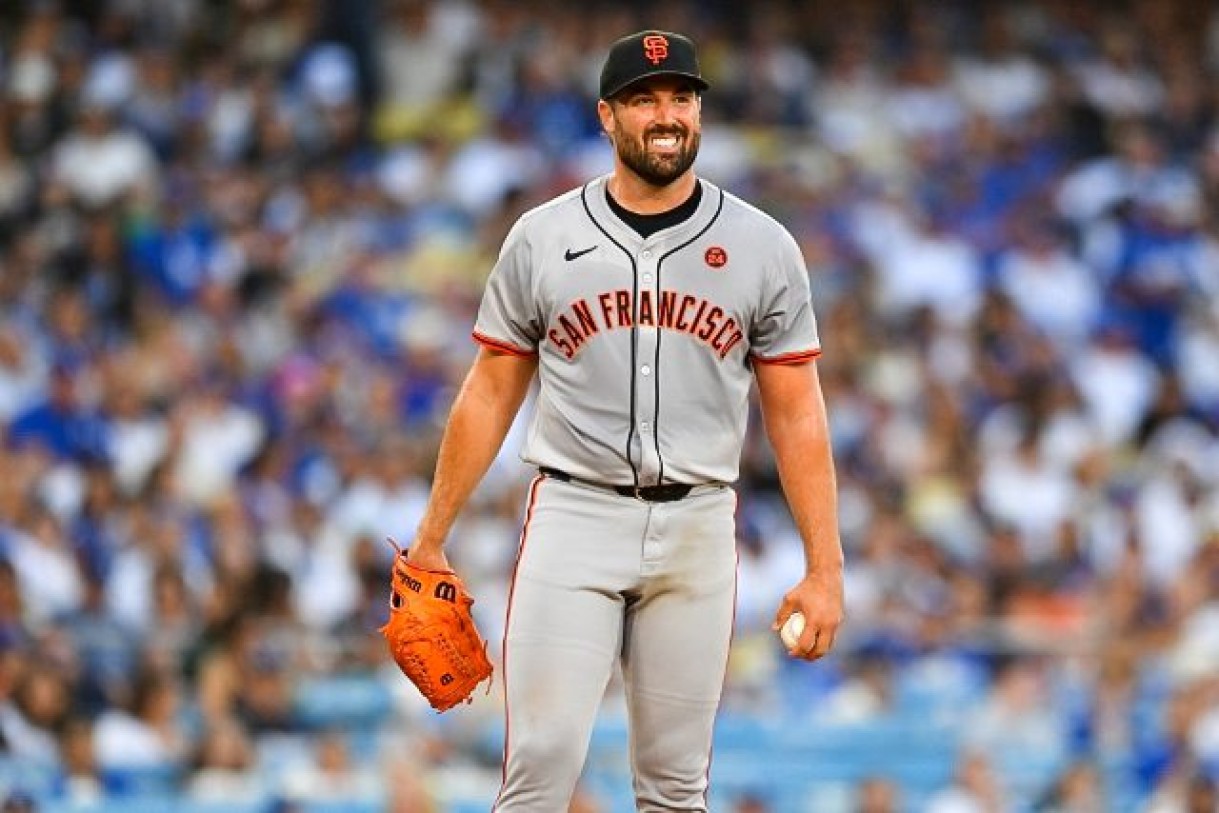
Identify which fantasy baseball starting pitchers to avoid in 2026 drafts. Corbin Young uses ATC Projections to reveal his top SP busts and fantasy baseball pitcher fades for your draft.
Using projections in the fantasy baseball draft process helps give us a baseline of numbers to build a balanced team. Roster construction becomes more challenging with deeper rosters. Though the ADP market pushes pitchers up in rotisserie, category, and points leagues, the projections suggest avoiding them at their prices. That's important because many positive pitcher surprises in ATC projections have been relievers or undervalued starters.
The process for identifying potential starting pitchers to consider fading involves determining whether players have a projected rank below their positional ADP according to the ATC Projections. If a pitcher lands on this list, it doesn't mean they're an automatic bust. However, it's a list that allows us to dive deeper into the pitch mix, movement profile, release points, and locations.
We used an ADP cutoff of pick 200 since it's hard to fade starting pitchers in the middle-to-late rounds. Based on the list above, we chose five starting pitchers to examine and determine whether to trust the projections or override them when drafting in our fantasy baseball leagues.
Featured Promo: Save 50% off the regular price with discount code CHAMP, for a limited time. Exclusive access to our Team Sync platform, DFS cheat sheets, Lineup Optimizers, betting/prop picks, and exclusive content from Nick Mariano and Eric Cross! GAIN ACCESS NOW
Starting Pitcher Busts Based on ATC Projections
The ATC Pos Rank is a positional ranking based on the projections. We included the auction dollar values, which helped to generate the rankings based on the ATC projections. The visual below shows the pitchers that project as overvalued starting pitchers based on the ATC Projections for 15-team leagues.
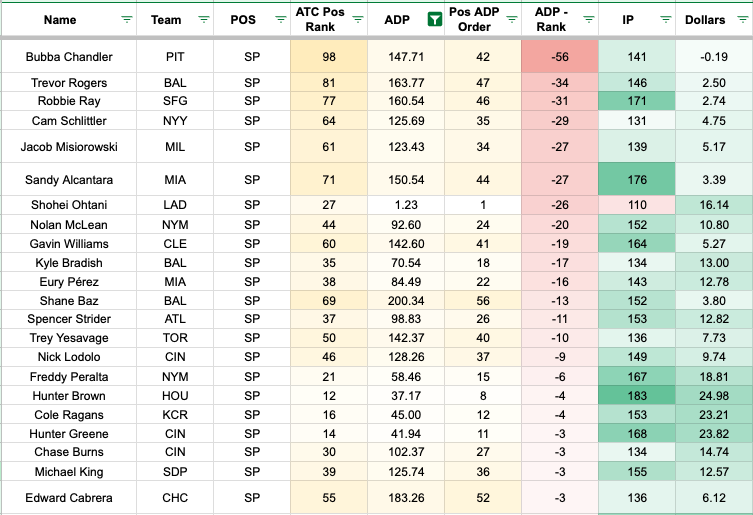
Although the ATC Projections suggest these starting pitchers might be overvalued, it's not an automatic fade because there might be information the projections haven't considered. We'll provide the overvalued starting pitchers based on the BAT X (which added a stuff model) and OOPSY projections that include Stuff+ to provide context.
The visual below shows the BAT X projections and their starting pitcher positional rankings. It was surprising to see Spencer Strider up there since his stuff has been good. However, the BAT X is the only projection system projecting Strider's ERA above 4.00, the worst among the publicly available projections. Similarly, the BAT X has Strider's WHIP at 1.29, the worst among the public projections.
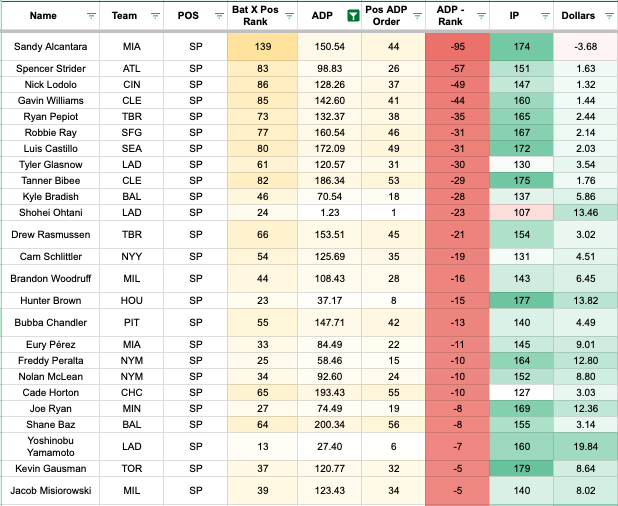
We have similar names on these visuals for the ATC and BAT X projections for starting pitchers based on the market price. Finally, the visual below shows the OOPSY projections and the positional ranking for starting pitchers.
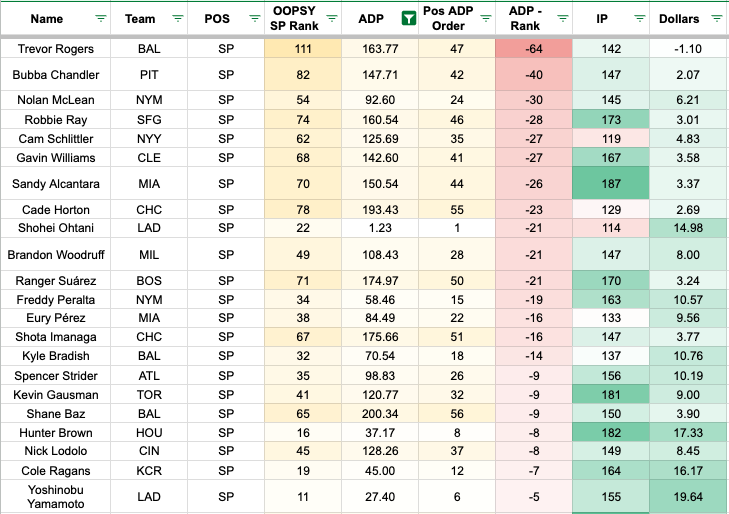
We could conclude that the projection systems struggle to value starting pitchers, especially prospects, low-inning samples (Eury Perez, Kyle Bradish, etc.), or poor recent outcomes. Sometimes the draft market tends to value starting pitchers higher than projection systems suggest.
As someone who studies starting pitchers, I search for edges in our player-level research that may go against the projections.
Bubba Chandler, SP, PIT
- NFBC ADP: 147.7 ADP, SP42 (Since February 1)
- ATC Value: SP98
- ATC Projections: 4.20 ERA, 1.29 WHIP, 21.7% K%, 8.4% BB%, 141 IP
The Pirates called up Chandler in late August and ramped him up slowly. Besides the nine-run outing against the Brewers, Chandler showed a better xERA (3.13) and a near-elite swinging-strike rate of 14.1 percent in the small 31-inning sample as a rookie. Projection systems often struggle to quantify a rookie or player with a limited sample, so there's a chance Chandler becomes a value pick based on the skills.
Chandler's changeup headlines his arsenal, with a 17.3 percent swinging-strike rate, while his four-seamer averages 14.1 percent. He throws a hard changeup (91.7 mph) that doesn't drop much, yet generates nearly 17 inches (16.7) of arm-side fade. In the small sample of 92 changeups against left-handed hitters, it allows a .118 wOBA (.162 xwOBA) in 2025.
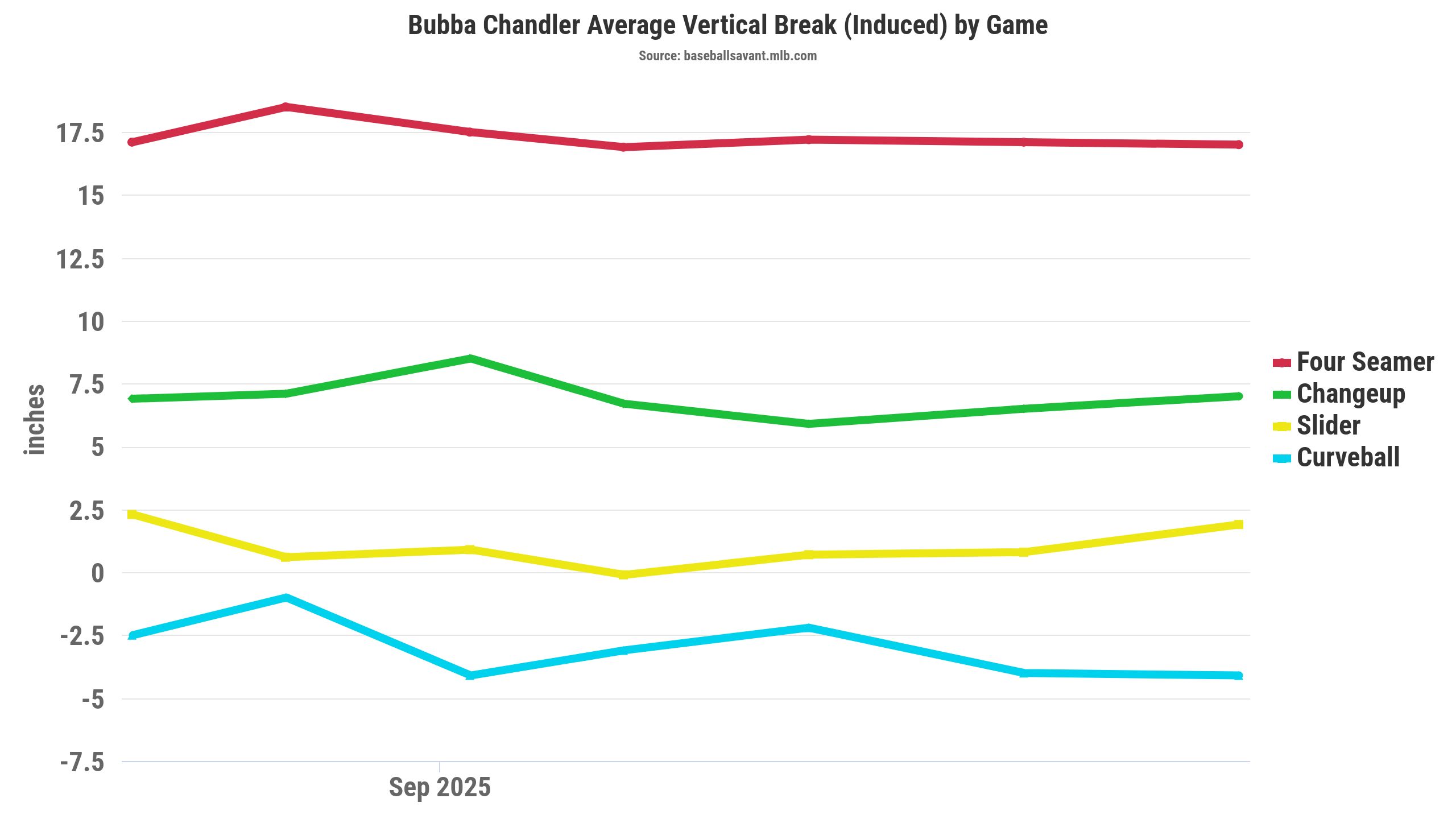
Chandler's four-seam possesses 17.3 inches of induced vertical break, coming in at 98-99 mph, with a theoretical above-average movement profile. That's further evident by Chandler generating above-average extension and locating the four-seamer in the upper third of the zone, making it a dangerous heater when he commands it well.
Add in Chandler's gyro-like slider, which found success against right-handed hitters (.098 wOBA, .173 xwOBA), and there's a fairly deep arsenal for the former top prospect. Chandler might be a player to target and go against the ATC Projections based on the strikeout skills, arsenal depth, and a good chance at 140+ innings with high quality.
Robbie Ray, SP, SFG
- NFBC ADP: 160.5 ADP, SP47 (Since February 1)
- ATC Value: SP77
- ATC Projections: 4.22 ERA, 1.28 WHIP, 24.7% K%, 9.2% BB%
Ray was healthy in 2025, throwing the most innings (182) since the 2022 season. His 4.26 xERA was slightly worse than his actual outcomes (3.65), partly because his swinging-strike rate fell to 13 percent in 2025, below his career average (14.4 percent). Ray still posted a solid swinging-strike rate, though his slider lost whiffs, with a 14.9 percent swinging-strike rate in 2025, 5.5 points below his career norm (20.6 percent).
He throws the slider 32.4 percent of the time to left-handed hitters, one of his two primary pitches, besides the four-seamer (60 percent). It's been a mixed bag for Ray's slider, allowing a .253 wOBA (.250 xwOBA). That's somewhat similar to his previous seasons when healthy. Besides Ray's slider, the changeup headlined the arsenal, with a 15.8 percent swinging-strike rate in 2025. That's over five points higher than Ray's career swinging-strike rate on changeups.
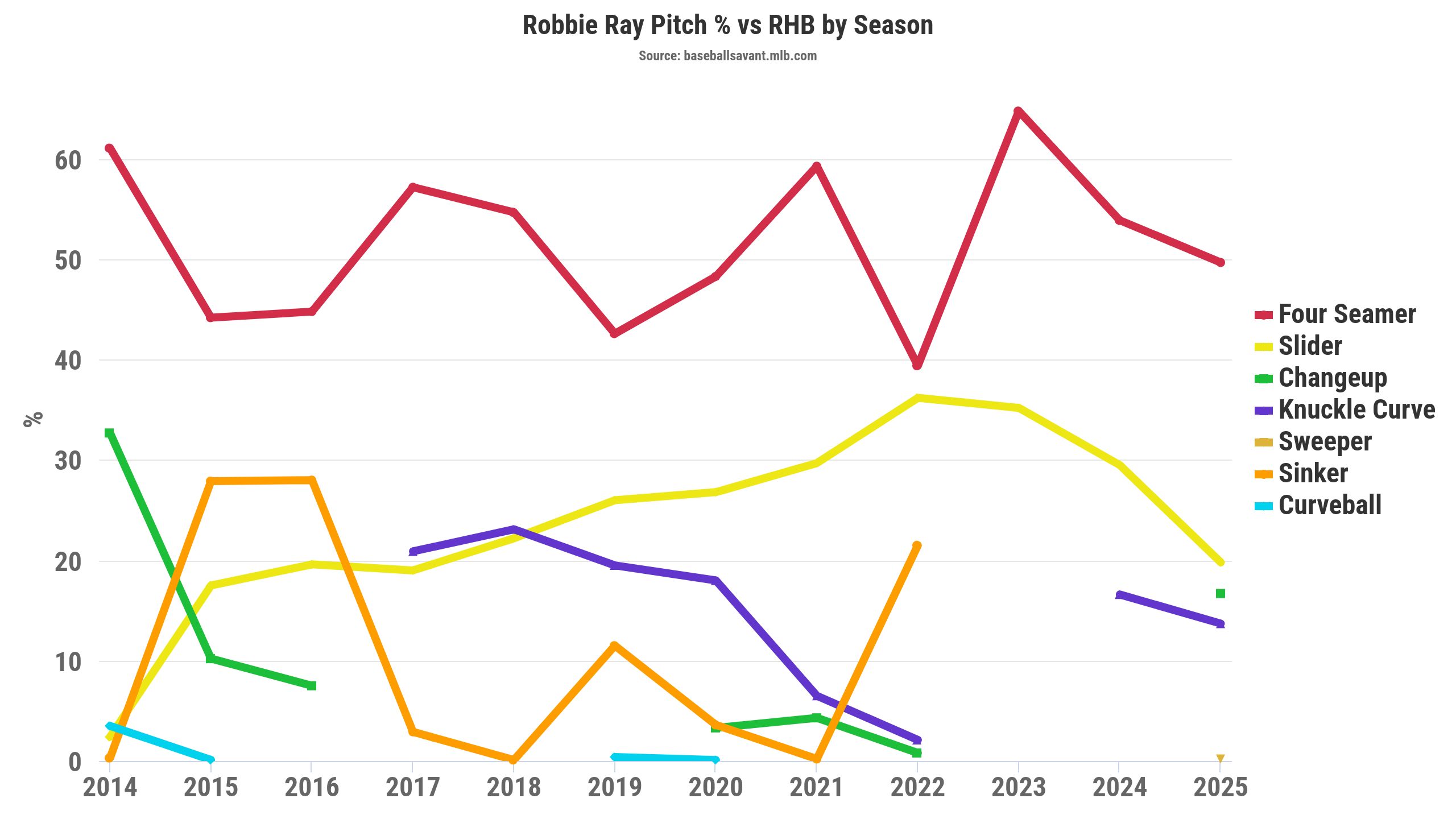
Ray hadn't thrown a changeup to right-handed hitters since 2022. He threw the changeup 16.7 percent of the time, the highest since 2014 in the Statcast era. Ray adjusted his changeup grip because it was 2-4 mph slower, aligning with a significant drop in spin rate during the 2025 season. That led to an additional three-to-five inches of downward movement for the changeup, coinciding with an increase in whiffs.
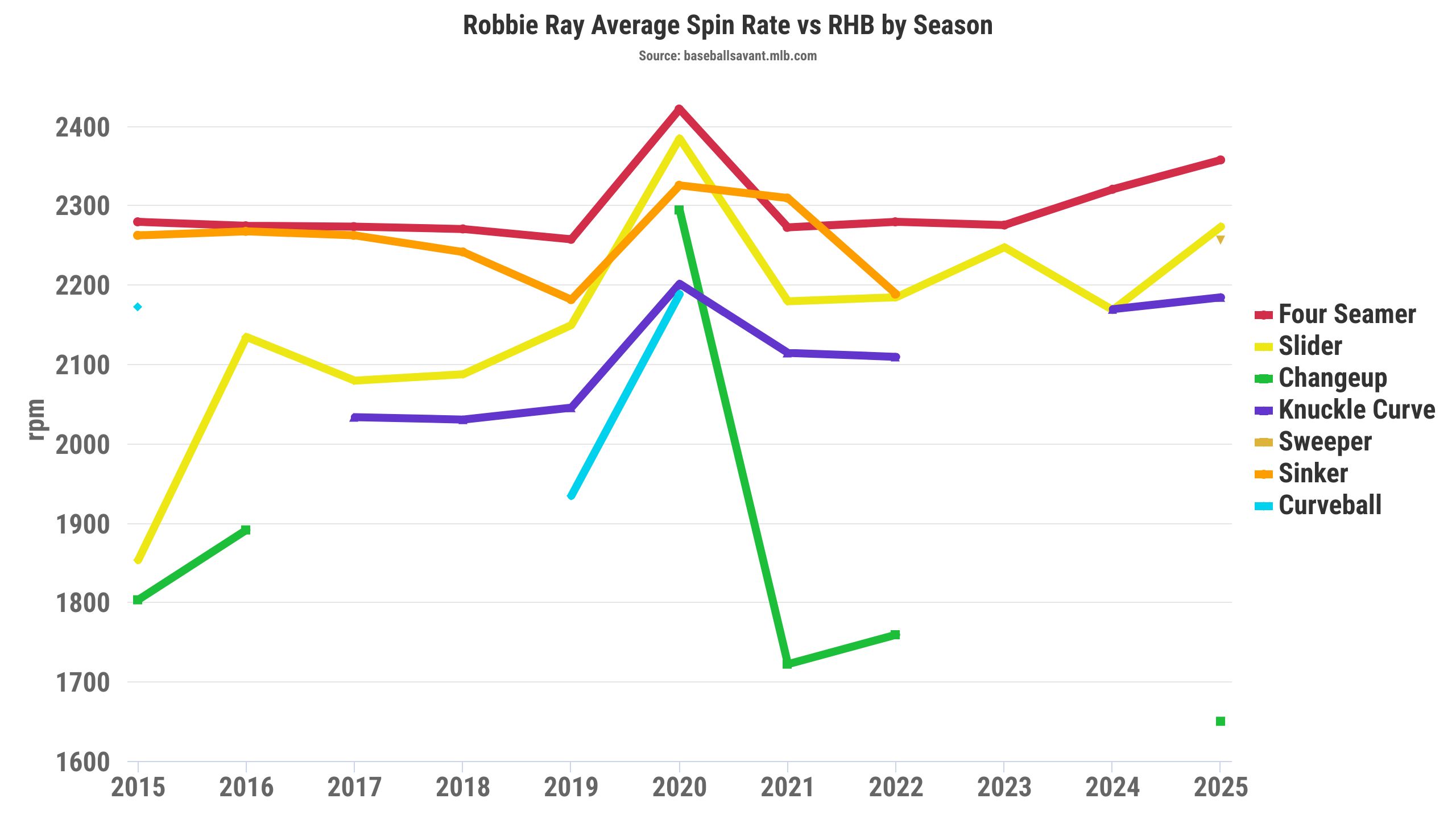
Ray's new changeup can help keep right-handed hitters off balance, while the slider is decent but not overwhelming to righties. Like prospects, new pitches might not be quantified or included in the ATC Projections. However, there's a good chance Ray's strikeout skills might not be near-elite, and more so in the above-average to high-end range. That's valuable in deeper formats, though ATC suggests being cautious about the strikeout skills bouncing back.
Trevor Rogers, SP, BAL
- NFBC ADP: 163.8 ADP, SP47 (Since February 1)
- ATC Value: SP81
- ATC Projections: 4.01 ERA, 1.27 WHIP, 20.6% K%, 7.6% BB%, 146 IP
It's 2026, and Rogers had his best ERA (1.81) and WHIP (0.90) in his career. After little expectations heading into the 2025 season, Rogers reminded us to remember his name. Rogers's 3.65 xERA screams at regression coming, but when in 2026? He showed his best ball rate (31 percent) and an above-average swinging-strike rate (12.7 percent), suggesting the skills support the outcomes, even with ratio regression.
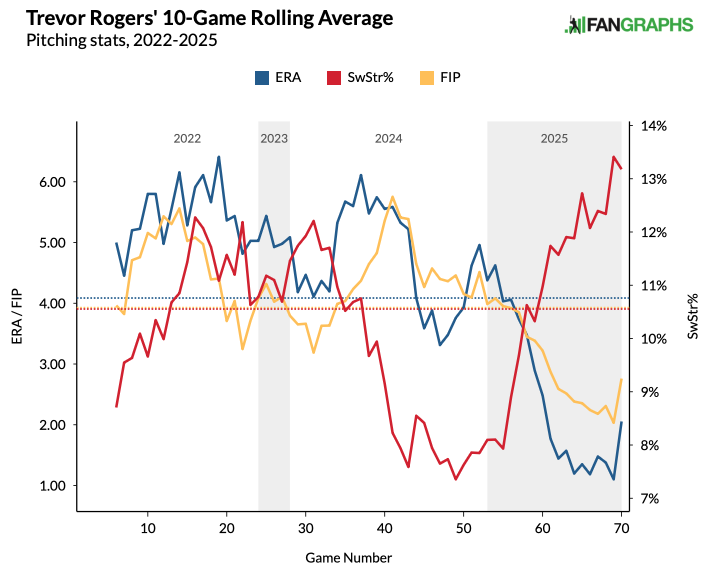
Rogers's changeup typically highlighted his arsenal from a whiff standpoint, evidenced by a career 15.4 percent swinging-strike rate, compared to 14.3 percent in 2025. Based on the changeup's movement profile, we would expect the whiffs to return, especially if he continues to locate it low and below the zone. The changeup allowed a .248 wOBA (.308 xwOBA) against right-handed hitters in 2025.
That's better than the 2024 numbers, with the changeup giving up a .334 wOBA (.300 xwOBA), though the expected numbers align.
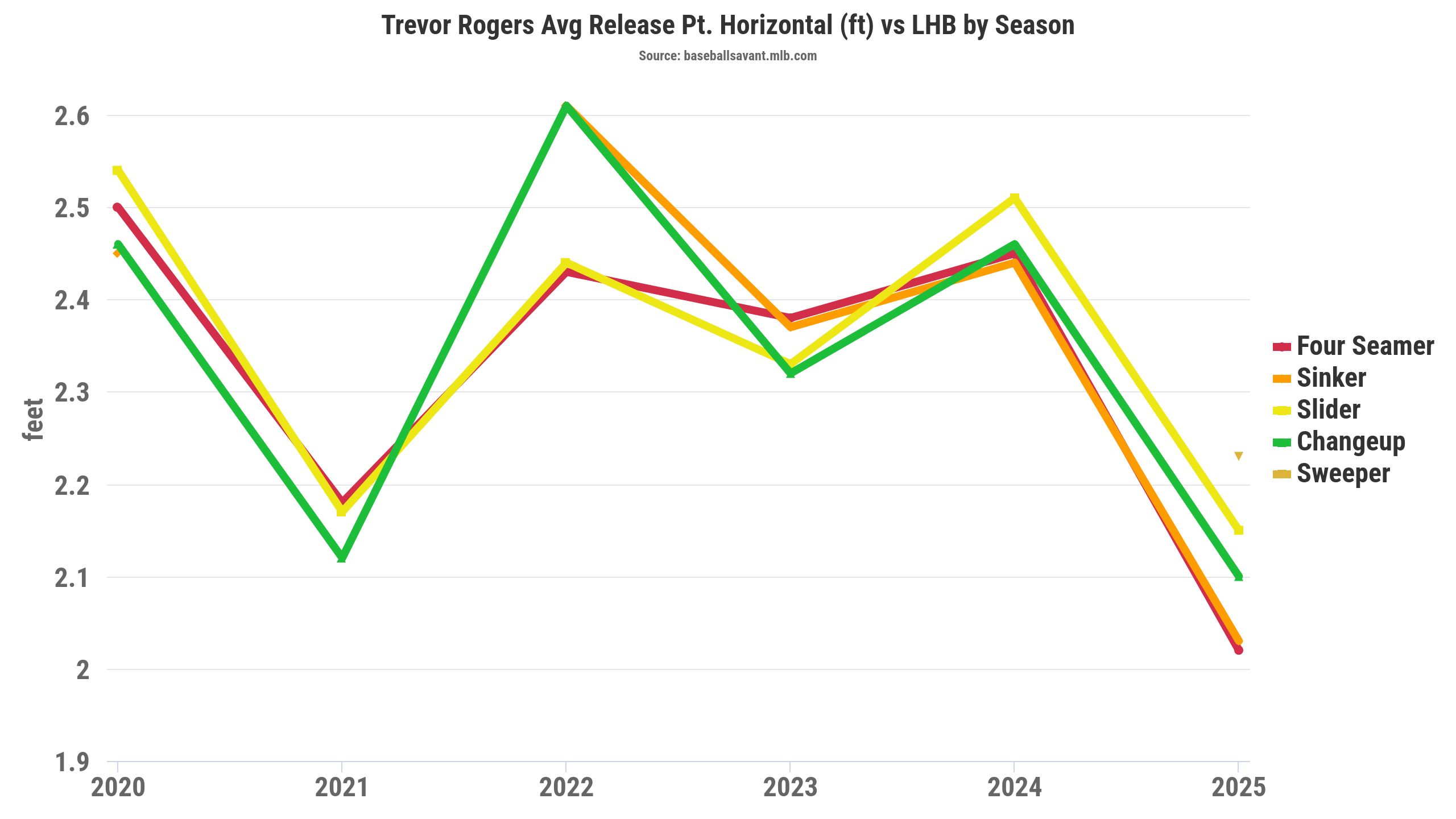
Rogers saw his slider overtake the changeup in swinging-strike rate at 17.6 percent in 2025, four points above his career norm. The slider was nasty, with a 23.1 percent swinging-strike rate against left-handed hitters while allowing a .043 wOBA (.095 xwOBA) in 2025. Rogers's slider dropped by over 37 inches, closer to the 2021 and 2022. He lowered his arm angle, mainly by bringing his horizontal release point over four inches (4.3) closer to the midline of his body.
We can't expect Rogers to maintain the elite results in 2025, which seems to be built into his draft cost. However, the ATC Projections suggest we're overpaying for Rogers at the price. The optimistic outlook might indicate taking a chance on Rogers with reasonable expectations heading into 2026. If you believed in Rogers before, like me, you're probably overriding the ATC Projections.
Cam Schlittler, SP, NYY
- NFBC ADP: 125.7 ADP, SP35 (Since February 1)
- ATC Value: SP64
- ATC Projections: 3.90 ERA, 1.26 WHIP, 23.6% K%, 9% BB%, 131 IP
Schlittler outperformed (2.96 ERA) his expected results (3.72 xERA) because he was fortunate with a high strand rate. The skills were decent, with a 34 percent ball rate and a 12.1 percent swinging-strike rate across 73 innings as a rookie. Schlittler showed better swinging-strike rates in the minors (14-15 percent), so maybe we see an uptick in whiffs in 2026.
Schlittler had three pitches with a double-digit swinging strike rate, but they were around 10-12 percent. His four-seam led the arsenal with a 12.1 percent swinging-strike rate. Meanwhile, the cutter (10.4 percent) and sinker (11.1 percent) were the other two pitches with a double-digit swinging-strike rate.
Besides the four-seam velocity, the pitch movement characteristics don't stand out. It performed better against left-handed hitters in the majors, allowing a .257 wOBA (.281 xwOBA). The cutter weirdly possesses a near-elite amount of glove-side sweep, like a hard-thrown slider. Often, we'll see cutters look more like gyro-type sliders and lack horizontal sweep.
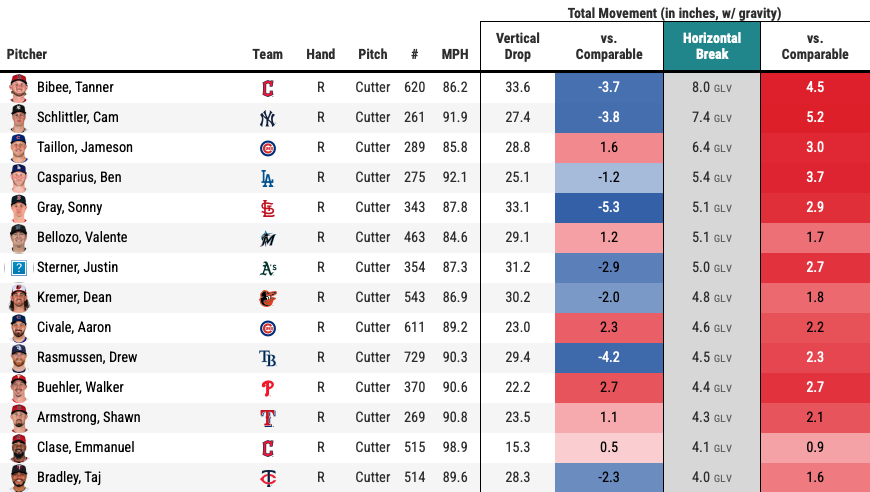
Schlittler's cutter is unique for how hard it's thrown (91.9 mph), the sixth-highest among cutters thrown by starting pitchers. Only Tanner Bibee's cutter moves more horizontally than Schlittler's among right-handed pitchers with 250 thrown. That type of cutter profile aligns with the right-handed hitter's struggles, as Schlittler peppers it low and away.
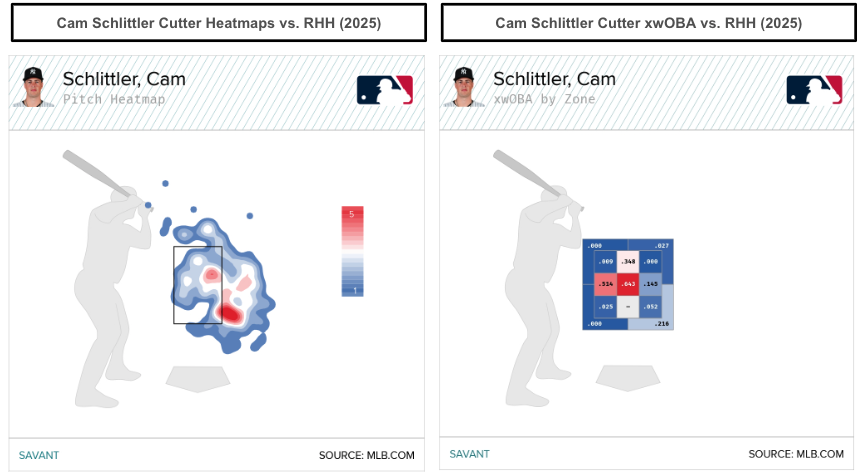
We're dealing with a small sample size, but there could be concerns about Schlittler's approach against left-handed hitters. The four-seamer has been the most successful, allowing a .257 wOBA (.281 xwOBA), and the curveball has been the second most successful, allowing a .296 wOBA (.277 xwOBA). Schlittler seems to have supinator bias based on the pitch profiles, so maybe a kick-change or a splitter could be an interesting addition to the arsenal.
There's a path for Schlittler to take a step forward, but we might need a discount to invest after digging deeper into the arsenal.
Gavin Williams, SP, CLE
-
- NFBC ADP: 142.6 ADP, SP41 (Since February 1)
- ATC Value: SP60
- ATC Projections: 3.96 ERA, 1.30 WHIP, 24% K%, 10.1% BB%, 164 IP
There's a load of starting pitchers between picks 150 and 250, making this a potential area to feast on if we can find the ones to target on the fade list. After an awful, injury-riddled (elbow inflammation, 95 days missed) 2024 season (4.86 ERA), Williams bounced back in 2025. Williams went from unlucky to fortunate in 2025, with the skills being similar to the career norm.
That's evident in Williams's 37-38 percent ball rate and 12 percent swinging-strike rate. The slider highlights the arsenal, given a 19.3 percent swinging-strike rate in 2025. Williams throws a sweeping slider, which replaced his traditional one. The sweeper drops nine inches more while sweeping toward his glove side, more than seven inches.
Like other Guardians' starting pitchers of the past, Williams adjusted the pitch mix to rely on the sweeper (33 percent) most often against right-handed hitters.
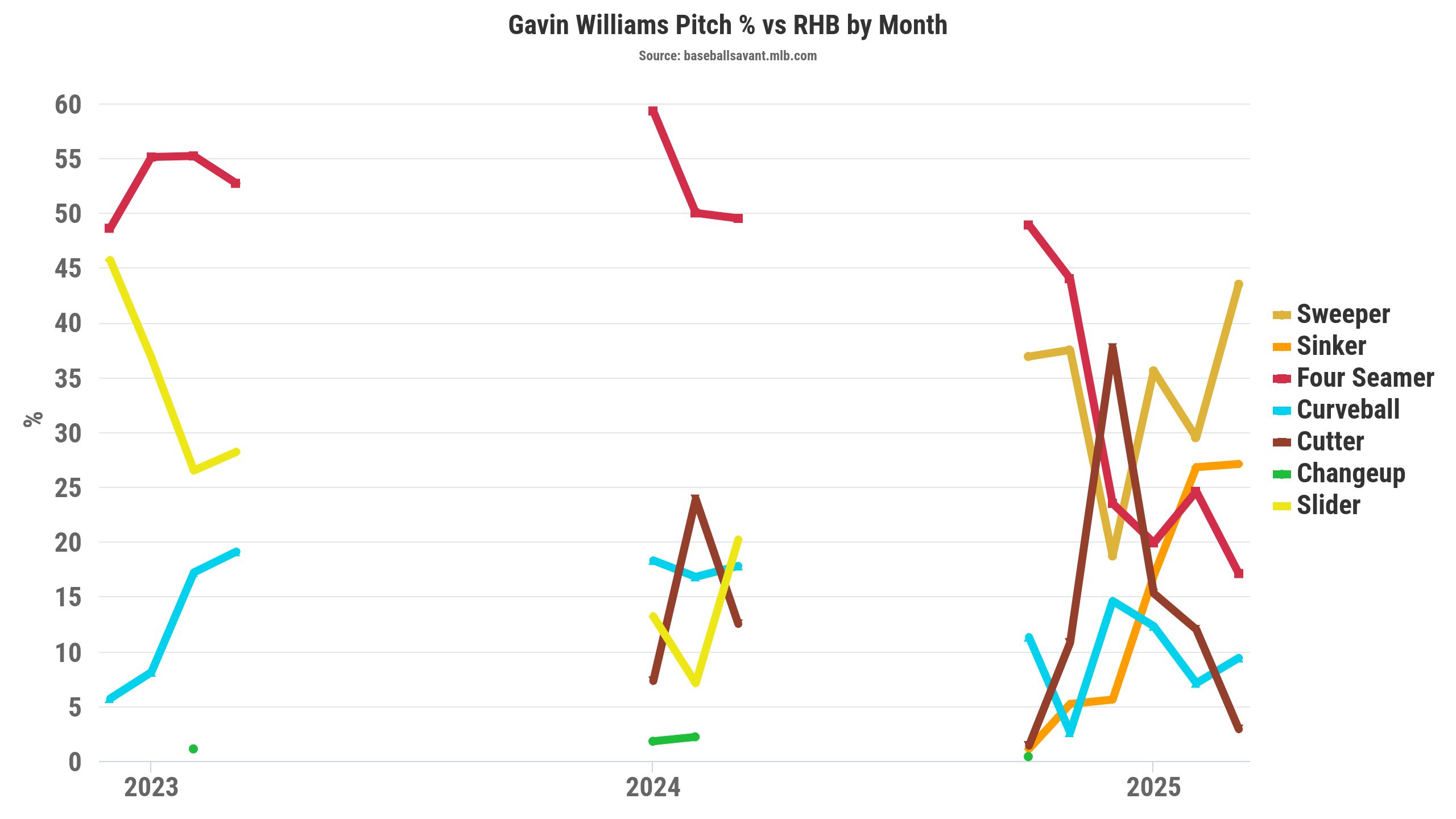
For context, the four-seamer (53.7 percent) was the primary pitch against right-handed hitters before 2025. When there's a change to the pitch mix, it doesn't automatically lead to success. Fortunately, Williams threw his best pitch (sweeper) more often against right-handed hitters, leading the arsenal in whiffs (22.7 percent swinging-strike rate) and weak contact (.191 wOBA, .210 xwOBA). The ATC Projections might not be accounting for this change.
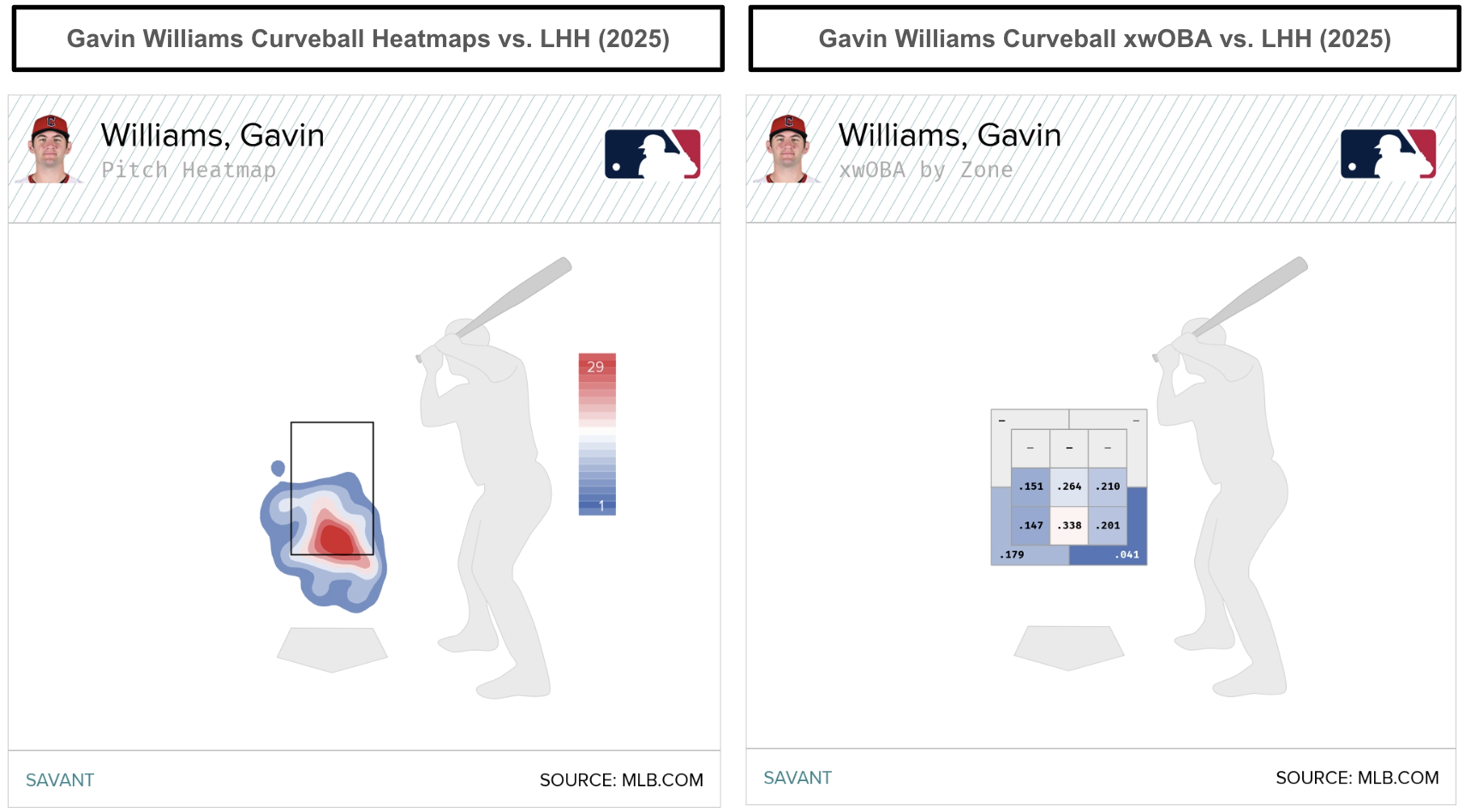
Similar to Williams's sweeper against right-handed hitters, we saw him increase the number of curveballs he threw to left-handed hitters. Williams threw his curveball 11 percentage points more (32.8 percent) against lefties in 2025, allowing a .146 wOBA (.220 xwOBA). He buries the curveball low and below the zone against left-handed hitters, with nearly three inches more downward and horizontal movement compared to the average.
As long as we're using Williams' 4.08 xERA as the floor, there are strikeout skills to build upon, especially if he continues to use breaking pitches more often. Be mindful of the WHIP around 1.30 for Williams due to control issues. This feels like a Mitch Keller-type profile, with slightly more strikeouts at a higher price.
More Fantasy Baseball Advice
Download Our Free News & Alerts Mobile App
Like what you see? Download our updated fantasy baseball app for iPhone and Android with 24x7 player news, injury alerts, sleepers, prospects & more. All free!