




 RADIO
RADIO







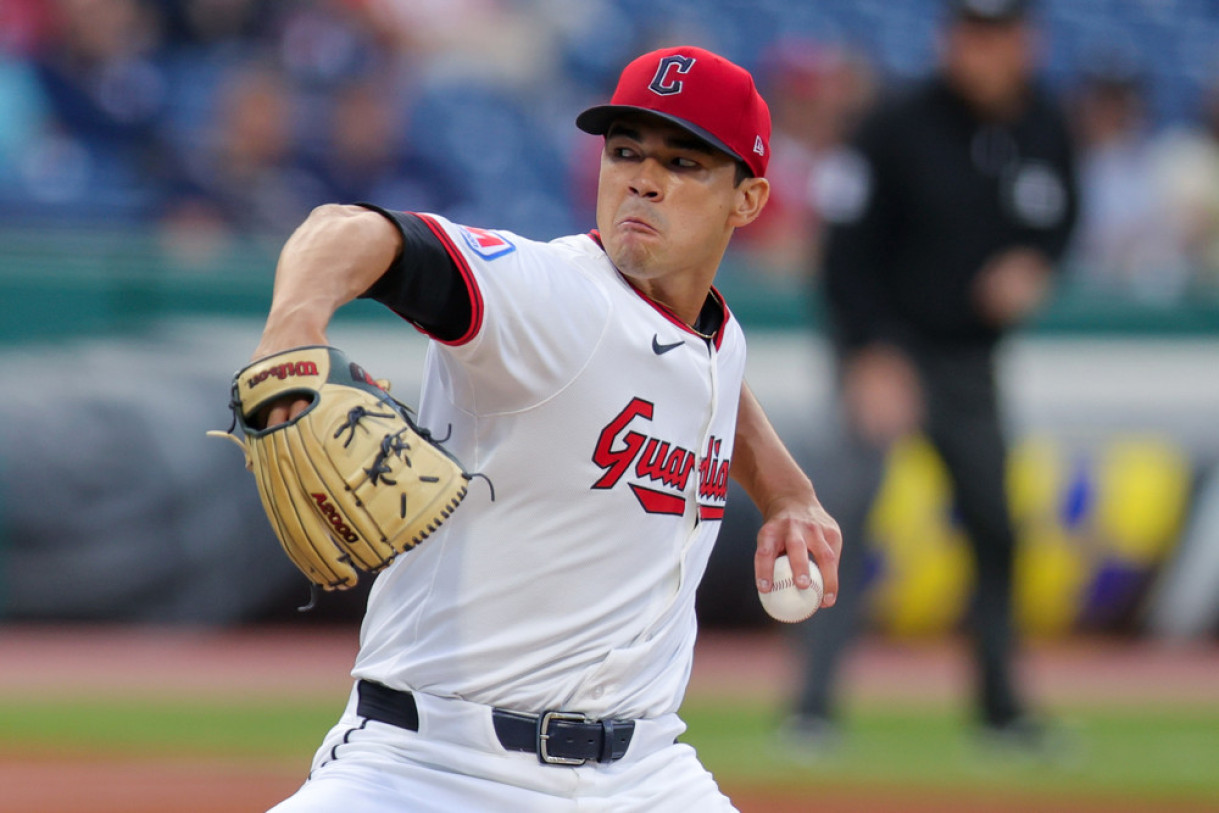
Are these pitchers fantasy baseball breakouts or fake outs? Dan analyzes advanced pitcher statistics and surging fantasy baseball SPs for Week 3 of 2026, including Jeffrey Springs, Joey Cantillo, and Ryne Nelson.
Another week has come and gone, and we're now getting a larger sample size from our starting pitchers, with most pitchers now having three or four starts under their belts. This week, I'll look at three new pitchers who have performed well, and all three are pitchers who are likely already rostered in standard-sized leagues.
If you are new to this column, remember that the goal is to look at several pitchers each week who are showing signs of "breaking out." That term gets thrown a lot in our industry, but for me, it simply means they're flirting with the possibility of improving their baseline performance over a larger sample size.
So, while we typically look at younger pitchers as potential "breakouts," I won't limit myself to only youngsters. The concept of the breakout can be applied to pitchers of all experience levels, as we have seen numerous examples of pitchers improving in a big way from season to season, even into their 30s. All rostership percentages are courtesy of Yahoo! Let's see which of these arms we can trust going forward, and also where to expect regression in the future!
Featured Promo: Save 50% off the regular price with discount code CHAMP, for a limited time. Exclusive access to our Team Sync platform, DFS cheat sheets, Lineup Optimizers, betting/prop picks, and exclusive content from Nick Mariano and Eric Cross! GAIN ACCESS NOW
Jeffrey Springs, Athletics
- 66% Rostered
- 2025 stats: 11 W, 171 IP, 4.11 ERA, 1.21 WHIP, 19.4% K%, 7.6% BB%
- 2026 stats: 3 W, 24.2 IP, 1.46 ERA, 0.77 WHIP, 22% K%, 8.8% BB%
After turning in a pretty mediocre 2025 campaign in his first year with the Athletics, Springs is off to a tremendous start in 2026, winning three of his first four starts and posting some of the best ratios of any starting pitcher in Major League Baseball.
Springs started 30 games last year and logged a career-high in innings, but failed to show the same type of strikeout upside that he once possessed in Tampa Bay before having Tommy John surgery in 2023. He also had a tough time keeping the ball in the yard, allowing 28 home runs (17 of which came at home at the homer-friendly Sutter Health Park).
Is Springs' resurgence further evidence (with Sandy Alcantara being Exhibit A) that pitchers who have Tommy John surgery need two full years of recovery before returning to form?
With these pitchers, it's not so much the stuff that doesn't come back quickly; it's the command. Alcantara is a great example of that, given his results at the end of last season and the beginning of this year. Springs is a guy with top-notch stuff who has always relied on control and precision in hitting his spots, and so far this season, he's been doing just that with a 20.6% called strike rate.
Jeffrey Springs, 92mph Paint. 🖌️🎨 pic.twitter.com/uOfUTqUuf3
— Rob Friedman (@PitchingNinja) April 9, 2026
Relying heavily on called strikes is always risky, and I should point out that Springs swinging strike rate is down this year at just 8.9%. He gained about 0.6 mph of velocity back on his four-seamer this year, but still only averages just over 91 mph on his heater. He does have a good induced vertical break (17.9 inches) on the pitch, which helps it play up a bit, as well as 10.6 inches of arm-side run that helps prevent hitters from squaring him up.
The rest of the arsenal is largely the same, with the changeup being Springs' best secondary offering and two breaking pitches, a slider and sweeper. The changeup has been tough on righties, resulting in a 44.7% Whiff% and an xSLG% of just .200.
There are certainly some statistics that suggest regression, starting with a 4.04 SIERA, a 0% HR/FB, and a .175 BABIP. While the BABIP isn't entirely sustainable, it's certainly a good sign to see a 20% IFFB% (infield fly ball percentage), which shows that he's creating weak contact in the air. Furthermore, his xERA of 2.47 and measly 4.8% barrel% is proof that hitters really aren't hitting him hard, too.
This is a tough one to diagnose because Springs is a 33-year-old veteran who can likely outperform his advanced metrics, but he has a bad home ballpark working against him and very little margin for error without elite velocity or plus breaking pitches.
Verdict: Some regression in his ratios is inevitable, but I'm not willing to label Springs a full "fakeout" as he's doing a lot of things really well that could be sustainable. The strikeout rate is probably as high as it will be this year, and there will surely be some rough outings in the warm weather at Sutter Health down the road.
Enjoy the mini-breakout for now, but keep expectations in check as Springs is closer to an average starting pitcher than he is to an elite one.
Joey Cantillo, Cleveland Guardians
- 52% Rostered
- 2025 stats: 5 W, 95.1 IP, 3.21 ERA, 1.26 WHIP, 26.9% K%, 10.5% BB%
- 2026 stats: 1 W, 20.2 IP, 2.61 ERA, 1.21 WHIP, 29.6% K%, 11.1% BB%
I was very skeptical about Cantillo's ability to replicate his 2025 success this year, and I am here to admit that I was wrong! My biggest beef with Cantillo coming into the year was that his fastball graded out as one of the worst in the league among qualified starters, but he's been even better this year with three really strong starts in a row now after a somewhat shaky debut against Seattle.
Cleveland #Guardians LHP Joey Cantillo extended his streak to 11 straight starts allowing two runs or less.
During streak:
IP) 60.1
H) 44
R) 14
ER) 13
BB) 21
SO) 60
ERA) 1.94#GuardsBall pic.twitter.com/tU3fVwAdyb— Guardians Prospective (@CleGuardPro) April 15, 2026
Cantillo's arsenal is a beautiful thing to visualize on the Baseball Savant pitch movement profile. He sits 92 mph on his four-seamer, but throws from a high arm slot (55 degrees) and has elite extension (7.2 feet), which helps that heater play up a bit.
His changeup doesn't have the same sharp downward movement that we see from others, but it looks exactly like his fastball coming out of his hand and is 10 mph slower. It generates a ton of whiffs (49% last season, 47% so far this year).
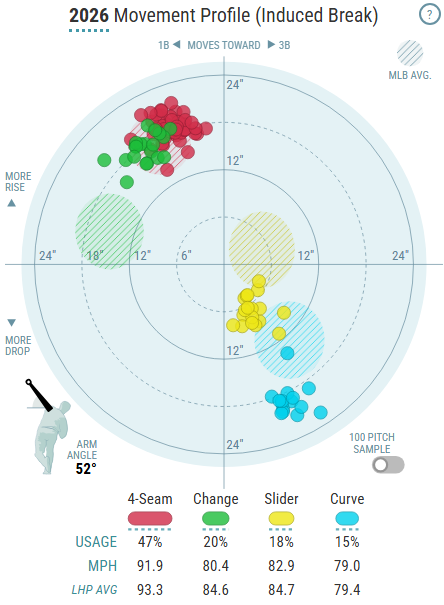
He has a 12-6 curveball that falls off the table with a 30% whiff rate of its own. The fascinating change this season has been Cantillo's slider, which has a much different shape and increased usage as he's throwing it 18% of the time compared to just 8% of the time last year.
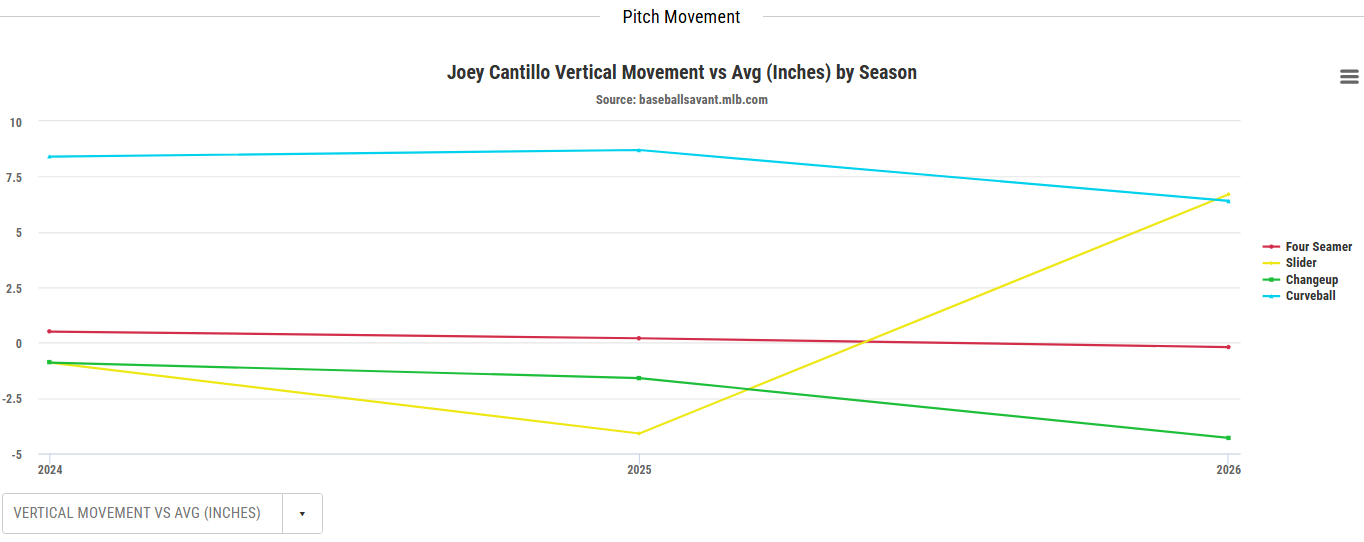
The slider looks more like a "slurve," with much more vertical than horizontal movement. It's his main weapon against lefties, and it remains to be seen if he'll continue to feature it as much as he already has, but it's eliciting a 30% whiff rate as well.
While Cantillo's stats are not dramatically better across the board, the good news is that there aren't really any red flags here with his BABIP, HR/FB, or strand rates either. His SIERA is 3.52, but as we saw last year, his xERA is just 3.19 as he continues to show the ability to get solid results on batted balls.
Verdict: Let's go ahead and label this one a true breakout, even if it's just a continuation of last year. Cantillo shows no sign of slowing down, and other than a relatively high walk rate, there's a lot to like here, especially if the additional strikeouts stick. Roster Cantillo with confidence. The sample size of his solid results continues to grow with each start, and I think I'm finally a believer.
Ryne Nelson, Arizona Diamondbacks
- 67% Rostered
- 2025 stats: 7 W, 154 IP, 3.39 ERA, 1.07 WHIP, 21.3% K%, 6.6% BB%
- 2026 stats: 1 W, 20.1 IP, 3.54 ERA, 1.03 WHIP, 22.1% K%, 9.3% BB%
Another pitcher whom I had a bit of a hard time endorsing this offseason was Nelson. While I didn't think he was a major regression candidate, I wasn't sure that he was going to take another step forward either. The jury is still out on that last part, but he's been just as good in 2026 through his first four starts with Arizona.
The numbers are, in fact, nearly identical across the board, with a few more strikeouts and walks. He's throwing fewer cutters and more sliders, which bodes well for his K%, but he's still very fastball heavy at 62% usage, the exact same rate we saw last season.
Ryne Nelson's 3Ks in the 5th pic.twitter.com/7sAhdSYUke
— Rob Friedman (@PitchingNinja) April 14, 2026
The heavy fastball usage and lack of a great secondary pitch are really what made me hesitate on endorsing him. Now, the fastball is a very good one, with good velocity (96 mph) and elite iVB (nearly 20 inches!) as he throws it out of a high arm slot (55 degrees). But he's going to have to lean into his other pitches eventually if he's going to improve any further.
There are definitely some regression indicators here for his ERA, too, as his FIP is 5.03, xERA is 4.47, and SIERA is 4.27. He's been even more fly-ball heavy this year (50%) and has an unsustainable BABIP of .164 (his career average is .278).
Ultimately, he's a two-pitch pitcher, throwing fastball/slider to righties and fastball/curveball to lefties. Even with good "stuff" that can get pretty predictable over time, not seeing any major changes to his approach this year makes me think he's not all that different of a pitcher.
Verdict: The results have been good, but there's little reason to believe that Nelson is going to provide more than a handful more strikeouts this season, while maintaining similar ratios to last season. He's a very useful fantasy player and a guy I have on a few rosters. But in terms of a true breakout, I don't see it here, as it simply looks like more of what we saw from him last season (which was still pretty good!)
More Fantasy Baseball Advice
Download Our Free News & Alerts Mobile App
Like what you see? Download our updated fantasy baseball app for iPhone and Android with 24x7 player news, injury alerts, sleepers, prospects & more. All free!