RADIO
RADIO






Rick Lucks breaks down how to use minor league stats to identify potential sleepers and busts as his series on making sabermetrics more accessible to fantasy owners continues.
Once you've grown accustomed to having advanced tools to help make fantasy decisions, it can feel disorientating to be without them. Prospects are increasingly becoming a focal point in both real and fantasy baseball, but the minors simply do not have all of the data publically available for MLB players. For example, advanced plate discipline stats, Pitch Info, and anything Statcast-related are all currently unavailable for minor league campaigns.
Does this mean we go back to looking at ERA and batting average as the only indicators of future performance? Of course not! Instead, we do our best to work with what we have. The process begins by looking at the environment. Higher levels of competition result in more accurate data, so you should start by excluding anything lower than Double-A if a player's track record allows it.
Here's how to effectively use this data to give you an edge in your fantasy baseball league throughout the season.
Featured Promo: Save 50% off the regular price with discount code CHAMP, for a limited time. Exclusive access to our Team Sync platform, DFS cheat sheets, Lineup Optimizers, betting/prop picks, and exclusive content from Nick Mariano and Eric Cross! GAIN ACCESS NOW
In Leagues Of Their Own
The first point to remember is that the baseline for certain predictive metrics is different on the farm. Mike Podhorzer of FanGraphs.com had an excellent article detailing the specifics in 2017. For example, Double-A hitters collectively posted a .306 BABIP that year, while their Triple-A counterparts managed a .317 figure. Both marks are significantly higher than the MLB average, making a performance that looks fluky league-average.
Another common sticking point is IFFB%. Double-A batters posted a ludicrous 21.6% IFFB% on their fly balls in 2017, while their Triple-A counterparts were only slightly better (20.8%). This leads many fantasy owners to conclude that EVERY minor league prospect has a massive pop-up problem, but this is not the case. The stat is calculated differently on the farm, and you need to halve it to get something approaching an MLB projection.
Like MLB, each minor league and ballpark also has its own unique quirks and tendencies. For example, the Pacific Coast League is a Triple-A league notorious for inflating offensive statistics. If you want minor league ballpark factors, Baseball America posted them for 2019 here. If you want three-year factors, MiLB.com posted them for AA and AAA for 2014-2016.
If memorizing each league's tendencies is too overwhelming for you, you can look at Weighted Runs Created Plus (wRC+) as a shortcut. This metric sets 100 as the league's average offensive output, with each number higher or lower representing a one percent difference in either direction. This means that a wRC+ of 95 is five percent worse than league average, while a mark of 110 is 10 percent better. While the formula does not directly translate to fantasy value, park and league adjustments are already included in the calculation.
Forecasting MiLB Performance
Another common problem with minor league statistics is sample size. It is easier to run an unsustainable BABIP in a small sample than a larger one. The minor leagues compound this problem by allowing a healthy player to be called up or demoted multiple times in one season, leaving us with two or more partial season samples instead of one full season of statistics.
Due to the small sample, metrics such as BABIP can be unreliable for minor league players. In this situation, it's advisable to examine the player's plate discipline numbers and batted ball distribution (GB% vs. FB%) because they stabilize (or become predictive) more quickly. We don't have the additional information provided by metrics such as O-Swing%, but these metrics are still a good way to start MiLB analysis.
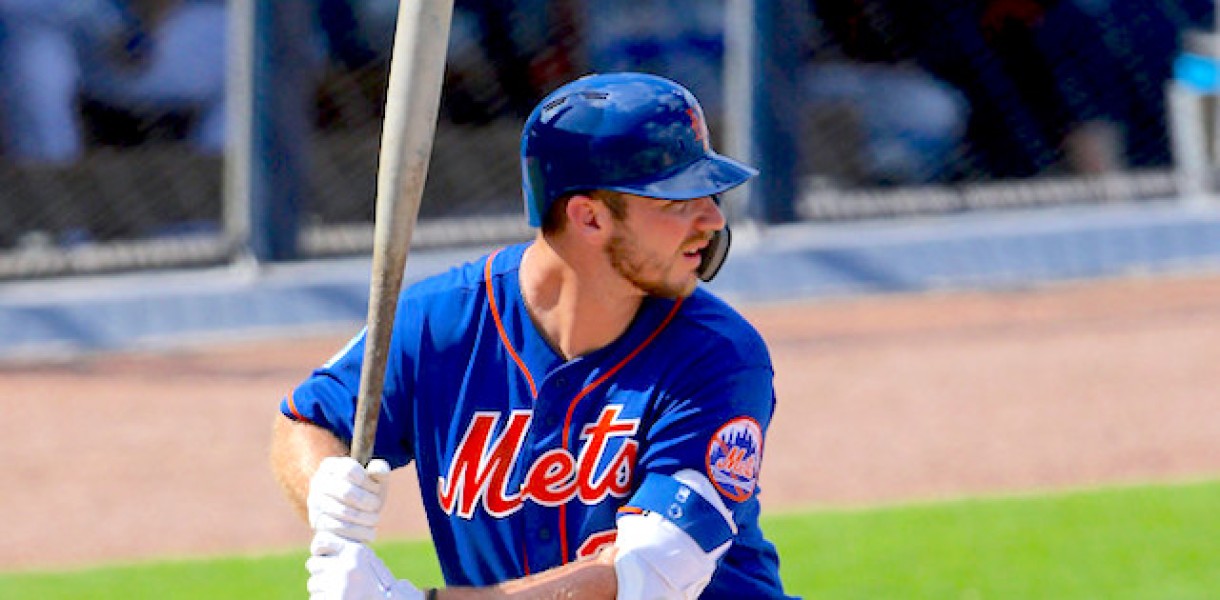
For example, Peter Alonso of the Mets organization received 273 PAs at Double-A (.314/.440/.573 with 15 HR) and 301 PAs at Triple-A (.260/355/.585 with 21 HR) in 2018. He hit a lot of fly balls (44.2% FB% at Double-A, 40.4% at Triple-A) with authority (HR/FB rates of 20.5% and 28.4%, respectively) while walking enough (15.8% BB% at Double-A, 11% at Triple-A) to project for a reasonable average.
With the benefit of hindsight, we know that Alonso was a tremendous fantasy asset last season. He slashed an impressive .260/.358/.583 with 53 HR in 693 PAs, posting the elevated FB% (41.5%), HR/FB (30.6%), and BB% (10.4%) that his minor league resume suggested.
Stealing bases is easier in the minors, but elite success rates are still something to look for when projecting fast players. Age is also a factor for minor leaguers, as a 28-year-old dominating a bunch of teenagers at Rookie ball isn't really that impressive.
Conclusion
To conclude, the fact that we do not know a minor leaguer's average airborne exit velocity or BABIP on ground balls does not prevent us from analyzing minor league players for fantasy purposes. We have tools such as FB% and BB% for hitters and FIP and LOB% for pitchers. We can still place these numbers into context by examining any given league's tendencies. Finding rookie breakouts before they happen is still challenging, but that's what makes it a worthy endeavor. Check out this link to learn more about how to apply advanced stats within a fantasy context.
More Sabermetrics & Statcast for Fantasy Baseball