




 RADIO
RADIO






Corbin's later round fantasy baseball draft sleepers power hitters to target for 2026. His upside home run hitters with legit power upside for fantasy baseball drafts.
The hitter equivalent for pitcher whiffs might be power. Yes, making contact matters, but not so much if the hitter doesn't make loud contact. We know hitting the ball hard matters, but optimizing launch angles to generate barrels will lead to home runs. The best hitters do both consistently.
To hit the ball hard, hitters need to swing fast and have a high bat speed. That makes sense since bat speed correlates well with hard-hit percentage (0.554) and barrels per plate appearance (0.464). Furthermore, barrels per plate appearance correlates well with home runs (0.550).
That said, we're using bat speed and power skill leaders to find a list of later-round power hitters to target. The draft market has become sharper, so we find possible platoon options or those with risks later in drafts. We're using the National Fantasy Baseball Championship (NFBC) Average Draft Positions (ADP) as a guide to working backward. These five hitters look like potential values for power in the later rounds.
Featured Promo: Save 50% off the regular price with discount code CHAMP, for a limited time. Exclusive access to our Team Sync platform, DFS cheat sheets, Lineup Optimizers, betting/prop picks, and exclusive content from Nick Mariano and Eric Cross! GAIN ACCESS NOW
Addison Barger, 3B/OF, Toronto Blue Jays
NFBC ADP: 191.2 (Since January 15)
With Anthony Santander undergoing shoulder surgery in February 2026, Barger might be locked into more playing time in the outfield. However, Barger might remain a strong side-platoon option even while Santander is out. That's evident in Barger's 69 wRC+ against left-handed pitchers and a 115 wRC+ against righties in 2025.
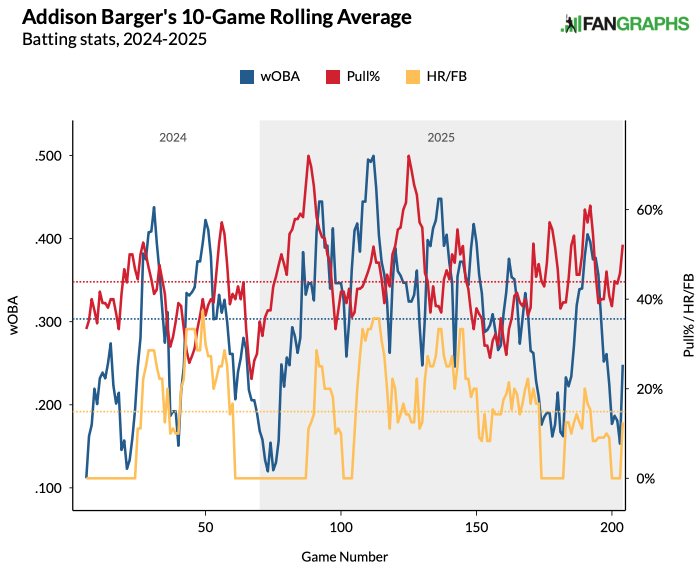
Barger ranked 26th in bat speed (75.9 mph) and 24th in fast swing rate (62.7 percent). For context, the league average bat speed was around 72 mph. Meanwhile, Statcast defines fast swing rate as the percentage of swings at 75 mph or higher. He leans into the pull-heavy (46.3 percent), flyball approach (39.3 percent) to tap into the pull-side power.
Interestingly, Barger's Expected Power Index (xPX) was lower than his actual output via his Power Index (139). One could argue that Barger may want to elevate the ball more consistently with a 42 percent ground-ball rate. Thankfully, Barger hits the ball hard with a high-end barrel rate per plate appearance (7.8 percent). Barger's main issue involves his plate discipline, given the league-average 73 percent contact rate.
If given more playing time, Barger could hit 25 or more home runs, though the 2025 season feels like the baseline expectation heading into 2026.
Carter Jensen, C, Kansas City Royals
NFBC ADP: 201 (Since January 15)
In the second half of the 2025 season, Jensen ranked seventh in barrel rate and 44th in Exit Velocity 90 (EV90) among hitters with 50 or more plate appearances. It's a small sample of 69 plate appearances, but Jensen was uber-efficient, with the seventh-highest blast per contact and the fifth-highest blast per swing percentage.
The visual below shows the hitters sorted by blasts per contact rate. Baseball Savant defines blasts as optimal swings, as they combine elite bat speed with efficient contact.
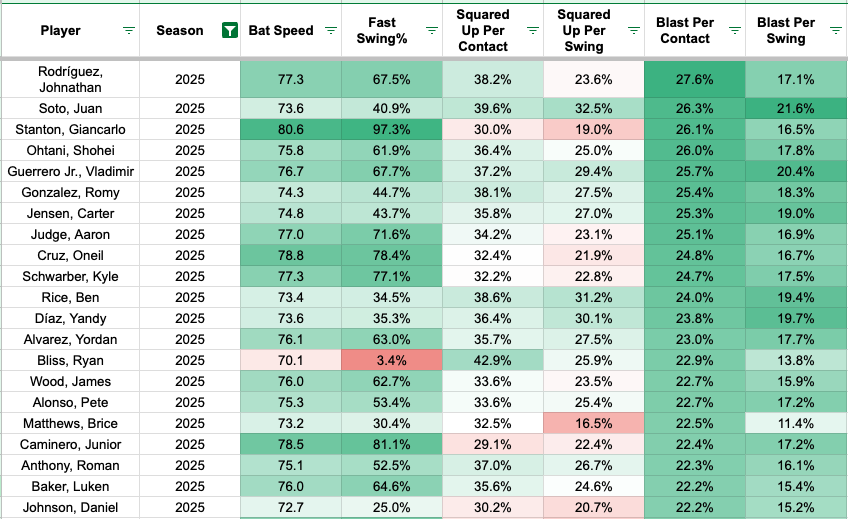
Jensen boasts an above-average bat speed (74.8 mph), showing he can barrel up the ball in a limited rookie sample. That's not surprising since Jensen was graded with plus raw power, which we saw in 2025. Jensen sells out for pull-side (45.8 percent) power, with an efficient home run rate (18.8 percent) while hitting flyballs 33.3 percent of the time.
There have been reports that they're bringing in and lowering the wall in the Royals' home ballpark. That should positively impact Jensen and the Royals' hitters, especially since Kauffman Stadium was ranked last in home run park factor for left-handed hitters. The projection systems have playing time concerns, with most under 400 plate appearances.
Keep in mind that the draft cost is for 15-team leagues with two catcher spots, as the 17th catcher off the board. Jensen flashed the power skills in the small rookie sample, and it's a medium-risk, high-reward type player. Besides the power and high-end exit velocities, we'll want to monitor Jensen's splits against left-handed hitters because he may become a strong-side platoon option.
Colson Montgomery, SS, Chicago White Sox
NFBC ADP: 218.3 (Since January 15)
Montgomery came up in early July, showing tons of power with 21 home runs in 283 plate appearances. He ranked 11th in fast-swing rate (71.7 percent) and ranked 12th in bat speed (77 mph). Montgomery struggled to make contact (67 percent), but he smashed the ball while hitting flyballs 46 percent of the time.
Though we typically expect a hitter's home run rate (HR/F) to regress, Montgomery possesses near-elite power skills and could maintain a high HR/F.
For context, hitters with similar power skills tend to have a 90th-percentile HR/F at 17-20 percent, so there's a good chance that Montgomery's home run efficiency will regress. Montgomery has a long swing (7.8 feet), as he pulls the ball over 51 percent of the time in the majors. With the optimal launch angles and strong exit velocities, Montgomery rocks a 27.2 percent pulled-air rate, nearly seven percentage points above the league average.
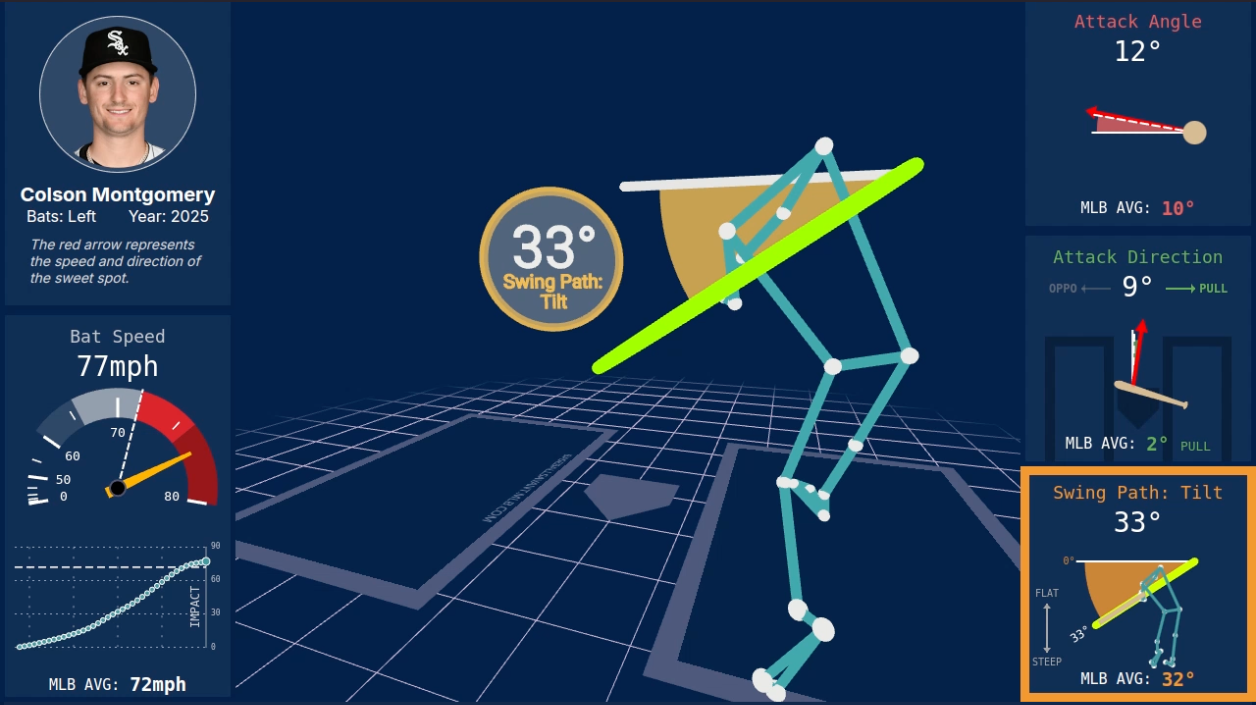
Montgomery tends to have a slightly steep swing (33 degrees), leading to him hitting tons of flyballs. That might make him vulnerable to fastballs in the upper third of the zone. In the small sample of 56 four-seamers in the upper third of the zone, Montgomery had a .118 wOBA (.191 xwOBA) with zero barrels and a bat speed at 74.7 mph.
When we filter by pitches low in the zone, Montgomery had a .439 wOBA (.434 xwOBA), 13.3 percent barrel rate, and 78.8 mph bat speed.
Besides the pitch location and swing path concerns, the main question will be whether Montgomery can make enough contact with the near-elite power skills. If Montgomery's contact rate is around 70 percent or slightly higher, there will be a power surge.
Giancarlo Stanton, DH, New York Yankees
NFBC ADP: 253 (Since January 15)
Stanton dealt with multiple injuries over the past four seasons, causing him to miss over one month from 2022 to 2025. When healthy, Stanton mashes, with outfield eligibility in NFBC leagues after just hitting the 20-game threshold, which adds value after being slotted into a utility-only role. We discussed Montgomery's plate discipline risk, similar to Stanton's 61 percent contact rate, six points below his career average in 2025.
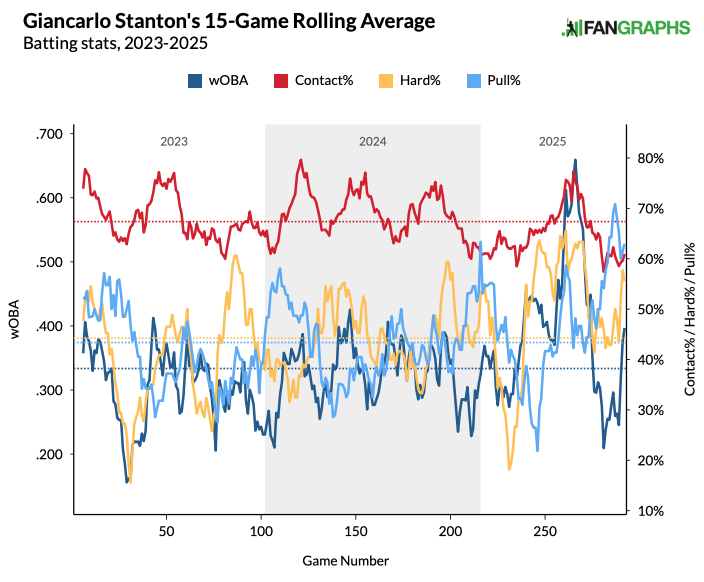
No wonder Stanton suffers many injuries because he rocked a 97.3 percent fast-swing rate, meaning nearly all of his swings came at 75 mph or higher. That's over 16 percentage points higher than Junior Caminero, ranking second in fast-swing rate (81.1 percent) in 2025. Stanton was fortunate, with a 34 percent hit rate and 33 percent HR/F, both behind 4-7 percentage points higher than his career norm.
Expect Stanton's batting average to regress, but he'll be a cheap source of 25+ home runs and a .230 batting average at the price.
Matt Wallner, OF, Minnesota Twins
NFBC ADP: 349.6 (Since January 15)
It's hard not to think of Wallner as a Joey Gallo-like player who makes more contact. Wallner sits on the scary threshold for contact rate under 70 percent at 66 percent in 2025. For context, Wallner's contact was 10 percentage points below the league average. Wallner deploys that pull-heavy (52.2 percent), flyball (50 percent) approach, with massive raw power, ranking 15th in bat speed, 15th in fast-swing rate, and a 131 xPX.
That puts Wallner's power skills in the near-elite range for hitters.
The visual below shows the top hitters sorted by bat speed, including other bat tracking metrics in 2025.
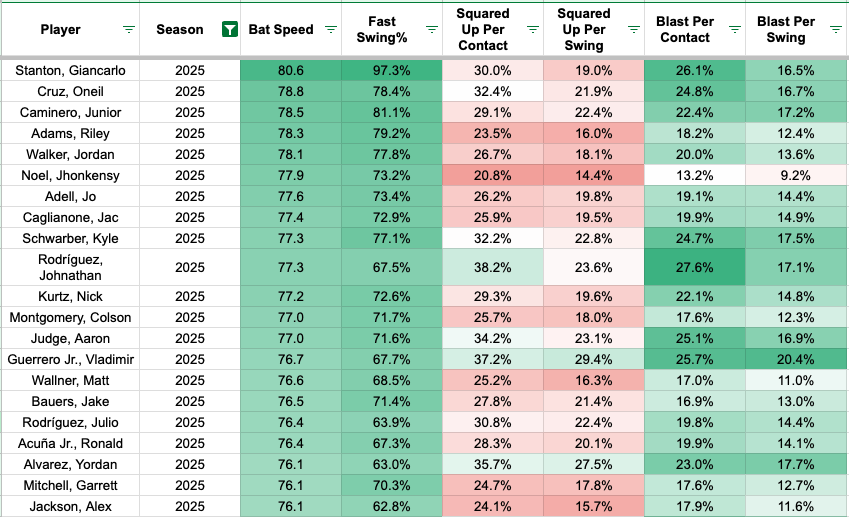
Though Wallner's career xBA (.240) hints at a reasonable outcome, there might be diminishing returns, since he pulls the ball in the air so often. For context, Wallner's 29 percent pulled-air rate was over 12 percentage points above the league average. Too many flyballs will lower the chances of hits, yet increase the odds of home runs. Regardless, Wallner possesses the power skills and hits at an optimal launch angle for late-round power.
The Twins moved on from Rocco Baldelli, with Derek Shelton taking over. Under Baldelli, the Twins often used platoons, including Wallner. It was a small sample of 97 plate appearances, but Wallner had a 118 wRC+ against left-handed pitchers, compared to a 113 wRC+ versus right-handed pitchers in 295 plate appearances in 2025. That's significantly more even compared to drastic career splits, with a 79 wRC+ against lefties and a 145 wRC+ against righties.
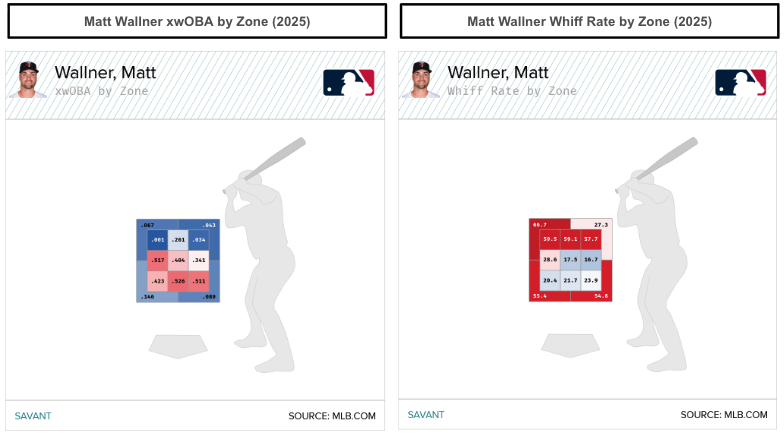
With the pull-heavy, flyball approach, Wallner might have a hole in his swing in the upper third of the zone. That's evident in Wallner struggling against pitches in the upper third with a .116 wOBA, .138 xwOBA, and 5.7 percent barrel rate, especially against four-seamers (.151 wOBA, .168 xwOBA) in 2025. Meanwhile, Wallner destroys pitches low in the zone, given a .515 wOBA (.479 xwOB) and a 12.2 percent barrel rate.
More Fantasy Baseball Advice
Download Our Free News & Alerts Mobile App
Like what you see? Download our updated fantasy baseball app for iPhone and Android with 24x7 player news, injury alerts, sleepers, prospects & more. All free!