



 RADIO
RADIO









Which fantasy football players' stock rose and which fell due to their games in the 2025-26 NFL playoffs? Andy breaks down the biggest postseason risers and fallers.
With the NFL Playoffs officially in the books and the Lombardi Trophy heading to Seattle, dynasty managers can begin to turn their focus to the upcoming rookie class.
However, even though the "fantasy season" was over in Week 17, the dynasty market has shifted quite substantially following a wild postseason that saw a budding rookie continue their late-season breakout and struggling quarterbacks continue to plummet on dynasty boards.
Who were the biggest risers and fallers from the NFL playoffs, and who should managers look to buy or sell following their recent shift? Let's dive in!
Bookmark our updated and revamped fantasy football rankings portal for all league formats!PPR rankings | Half-PPR rankings | Non-PPR (Standard) rankings | Rookie rankings | Superflex rankings | Best Ball rankings | Underdog rankings | Dynasty rankings | IDP rankings | Injuries
Dynasty Fantasy Football Risers From the 2025-26 NFL Playoffs
Rhamondre Stevenson, New England Patriots
Rhamondre Stevenson opened the season as New England's RB1 but would eventually cede nearly half of the workload to breakout rookie TreVeyon Henderson by the halfway point of the campaign. However, down the stretch, the Patriots turned back to their veteran to lead the backfield, and his role only grew in the postseason.
In Weeks 16 through 18, Stevenson punched in an eye-catching six touchdowns but was only given 7.7 rushing attempts per game, suggesting Henderson was still viewed as a primary option in the backfield.
Once the playoffs came around, Mike Vrabel and his staff deployed Stevenson as the bell cow. In the Wild Card Round, Stevenson took 10 carries for 53 yards and saw four targets in the passing game, while Henderson earned just 10 total touches. Then, in the Divisional Round and Conference Championship, Stevenson averaged a hefty 20.5 attempts per game with 3.0 targets per game, compared to Henderson's mere 7.5 attempts per game.
When the game mattered most, the Patriots trusted Stevenson's experience in favor of their budding rookie. While this will likely change as Henderson finds his footing in the pros, for now, it appears to be Stevenson's backfield heading into 2026. The 27-year-old is signed in New England through the 2027 season, and given that the team will be in the Super Bowl mix once again with a franchise QB under center, Stevenson should take on a similar role once again in 2026.
After a disappointing 2023 season, Stevenson had a strong bounce-back campaign, averaging 4.6 YPC compared to the much lower 3.9 YPC in the previous season. He also scored nine total TDs, setting a career high.
Rhamondre Stevenson's 57-yard run set up the Patriots touchdown!
📺: FOX pic.twitter.com/g0oQpEFl3Z
— FOX Sports: NFL (@NFLonFOX) January 4, 2026
Currently valued as the RB34 on KeepTradeCut.com (KTC), Stevenson is a top buy candidate for continuing teams needing a high-floor RB2/high-end FLEX option on a weekly basis. The market is still not valuing Stevenson as a starting running back, even though the Patriots made his role quite clear on the national stage.
Colston Loveland, Chicago Bears
Following a slow start, Colston Loveland quickly proved to fantasy managers why the Bears selected him with the 10th overall pick in last year’s draft. From Weeks 9 through 18, the former Michigan standout would total 14.3 PPR points per game with 59.7 yards per game. During this 10-game stretch, Loveland would score six touchdowns and see 6.4 targets per game, despite playing in a crowded offense.
In their thrilling Wild Card victory, Loveland continued to emerge as the team’s No. 1 pass catcher, bringing eight of his 15 targets for 137 yards. Then, in their Divisional Round loss to the Rams, Loveland once again saw double-digit targets (10) but only managed to bring in four of them for 56 yards.
While the Chicago offense does figure to be crowded for the foreseeable future with the late-season emergence of Luther Burden III, a healthy Rome Odunze, and a strong No. 2 WR in DJ Moore, Loveland may end up being the “WR1” on his club.
His QB, Caleb Williams, took a massive step forward, and Loveland may only be scratching the surface of his potential. His head coach, Ben Johnson, was responsible for making Sam LaPorta a must-start TE1 right out of college.
Loveland entered the draft with far more prospect pedigree than LaPorta, and figures to be a top-4 dynasty TE for years to come. While he may not have as much upside as Trey McBride, he is making a strong case to be valued near Brock Bowers, for the TE2/3.
Jalen Coker, Carolina Panthers
The final playoff riser we will discuss only had one game to showcase his talent, but he made it count. After beginning the season on the IR and only finding his footing late in the season, Jalen Coker turned in a breakout game on the national stage.
In their Wild Card loss to the Rams, Coker outshone his teammate Tetairoa McMillan as he brought in nine of his 12 targets for 134 yards and a touchdown. He began to show similar potential in Weeks 13 through 18, where he tallied 12.3 PPR points per game. This was a significant jump from the 4.8 PPR points he averaged over his first six games of the season (Weeks 7-12).
YOUNG. COKER. @PANTHERS LEAD ONCE AGAIN!
LARvsCAR on FOX/FOX One
Stream on @NFLPlus pic.twitter.com/9V5X60bAJL— NFL (@NFL) January 11, 2026
While McMillan will remain the team’s WR1, Coker faces minimal competition to enter the 2026 season as the team’s clear WR2. In fact, head coach Dave Canales has already acknowledged this.
Jalen Coker Enters the Offseason as No. 2 Receiver in Carolina https://t.co/Ub27u7mRsX
— RotoBaller NFL (@RotoBallerNFL) January 31, 2026
His breakout game did raise his value on KTC, but the undrafted pass catcher out of Holy Cross is still quite affordable despite his near clear path to prominence in 2026. He is currently ranked WR49, behind players who are prime “tier-down” candidates with questionable profiles, such as Quentin Johnston, Xavier Worthy, and Ricky Pearsall. The “buy” window is still open, but won’t be for much longer.
Dynasty Fantasy Football Fallers From the 2025-26 NFL Playoffs
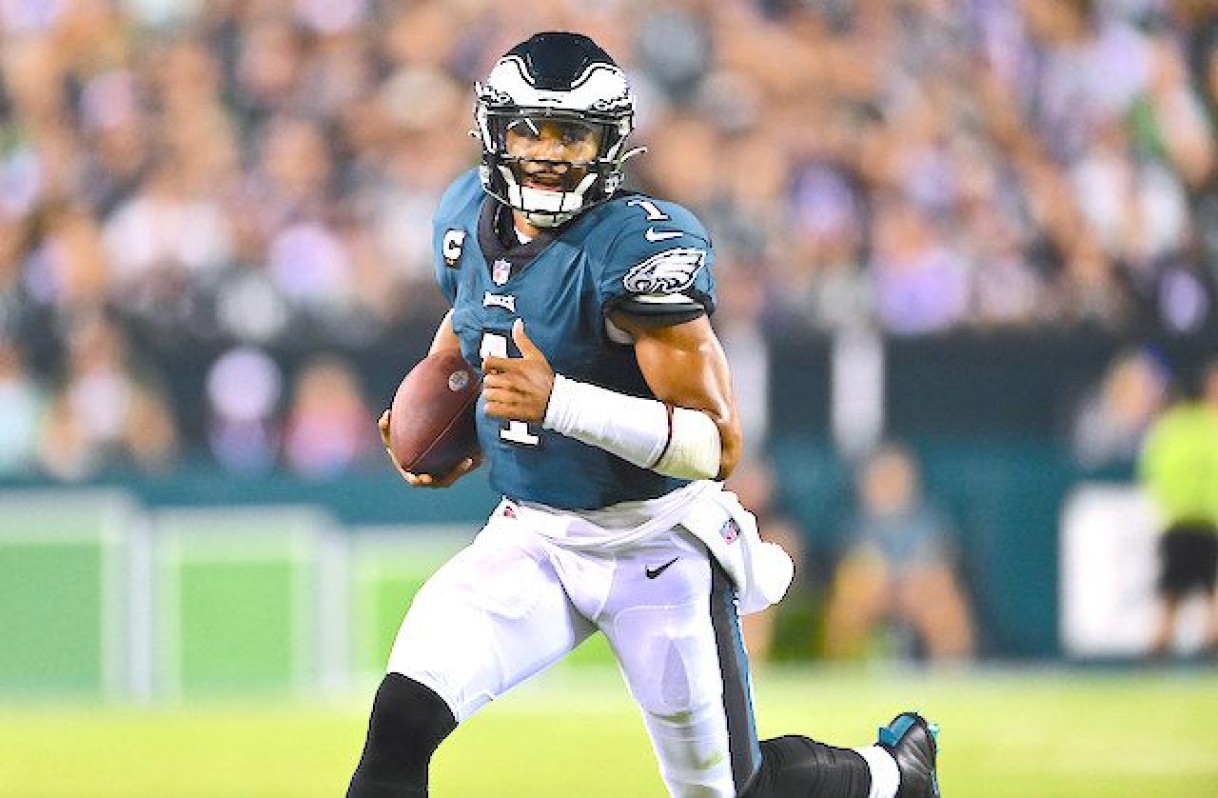
Jalen Hurts, Philadelphia Eagles
Jalen Hurts saw his value steadily decline all season, but his disappointing conclusion pushed him to the QB10 in current KTC rankings. This is a stark decline, as he began the 2025 season sitting as the overall QB4.
The entire Philadelphia offense was out of sorts in 2025 following their dominant 2024 campaign, which ended with a Super Bowl victory. While Hurts threw a career-best 25 passing scores in 2025, he ran for only eight touchdowns, a stark drop from the double-digit mark he posted in each of his last four.
He also ran for only 421 yards on the ground, his lowest mark since his rookie campaign, where he ran for only 354 yards. In the Kevin Patullo offense, Hurts would only hit the 30-point PPR mark in two total games and would fall under the 25.0 PPR point mark in 11 games, including their disastrous showing in the postseason.
In their Wild Card loss to the 49ers, their struggles were even more apparent as Hurts went 20-for-35 with just 168 yards and one passing score.
While trust in Hurts appears to be at an all-time low with his top wideout, A.J. Brown, potentially moving out of Philadelphia, savvy managers should jump at this buying opportunity. Following Patullo's departure, the Eagles brought in Sean Mannion to run the offense. Mannion will bring a fresh voice and has experience working with several of the top head coaches in the sport.
With the Packers in 2025, Mannion helped Jordan Love turn in a strong showing in 2025 and was on pace to finish as a low-end QB1 before is late season injury. From Weeks 1 through 15, Love totaled 19.8 PPR points per game and was without his top wideout, Christian Watson, for Tucker Kraft for nearly half the season.
Hurts is one of the best true “buy-low” candidates in dynasty as he enters the offseason in the same range as Bo Nix, Brock Purdy, and Love, who does not possess the QB1-outcome that Hurts does. With a revamped offense, Hurts should quickly jump Justin Herbert, Patrick Mahomes, and Jaxson Dart in dynasty rankings and return to his top-5 QB level.
TreVeyon Henderson, RB, New England Patriots
What comes up, must come down. With Stevenson exiting the playoffs as a dynasty riser, his backfield mate will hold a spot on our fallers section.
Henderson had a quiet start to his debut season, averaging just 7.5 PPR points per game over the first nine contests. However, once the training wheels came off, Henderson began to showcase his true potential.
From Weeks 10 through 18, the Ohio State Buckeye running back averaged an elite 17.8 PPR points per game at an elite 5.6 YPC clip. During this stretch, the second-round pick found the back of the end zone nine times and posted four rushes of greater than 40 yards.
TreVeyon Henderson takes off for 55 yards and a touchdown!
NEvsTB on CBS/Paramount+https://t.co/HkKw7uXVnt pic.twitter.com/xZtvUZTvId
— NFL (@NFL) November 9, 2025
However, once the playoffs came around, Henderson headed to the bench as Stevenson commanded the workload. In the Conference Championship, Henderson took a very low three carries for just five yards. Overall, in four playoff games, he took 30 attempts and posted a much lower 2.5 YPC, and failed to score a touchdown.
With his efficiency dropping, Henderson’s short-term value has taken a hit. With Stevenson under contract for the foreseeable future, Henderson’s current value as the RB7 on KTC still provides managers on competing clubs the opportunity to flip him for a more proven back in the short term. Contending teams can move Henderson in a deal to acquire a Jonathan Taylor-type back with a much safer floor heading into 2026.
While Henderson remains the RB of the future in New England, given Stevenson's postseason usage, managers should not expect a dramatic shift in the 2026 campaign.
C.J. Stroud, QB, Houston Texans
Rounding out this list will be another QB, C.J. Stroud. The former No. 2 overall pick has seen his dynasty value steadily decline following his incredible rookie season. While many dynasty managers often viewed him as overvalued during that stretch, he was still firmly in the QB1 range in most dynasty leagues.
However, following another mediocre season and a disappointing postseason showing, Stroud enters the offseason as the QB15 on KTC and closer to the QB20 than the QB10.
While the Texans got the victory in the Wild Card Round, much of it was due to the elite Houston defense as Stroud went 21-for-32 with 250 yards and a 1:1 TD:INT in their matchup against the Steelers. The following weekend, Stroud would have one of the worst games of his professional career, throwing four interceptions in their loss to the Patriots.
MARCUS JONES PICK-6!
HOUvsNE on ESPN/ABC
Stream on @NFLPlus and ESPN App pic.twitter.com/kHL1V0kHCn— NFL (@NFL) January 18, 2026
He has now fallen short of the 4,000-yard passing mark in back-to-back seasons and threw for a career-low 3,041 yards in 2025 (in 14 games).
While Stroud’s job security in Houston appears safe heading into 2026, given that he is still on his rookie contract, he is quickly falling into low-end QB2 territory rather than high-end QB2 territory. If Stroud cannot get the job done in 2026, expect Houston to have serious conversations about looking in a different direction for 2027, which could tank his dynasty value.
It may be tougher to move Stroud in competitive leagues, given the playoff disaster, but managers in more casual fantasy formats could still find a sell window before free agency. Stroud remains a top-15 QB on KTC primarily due to his age, but it will be hard to see him outproducing players like Baker Mayfield, Jared Goff, and even Tyler Shough next season, who are all currently ranked below him.
Managers who have the opportunity to flip Stroud for a QB like Goff should do so, even though Goff is seven years older.
More Fantasy Football Analysis
Download Our Free News & Alerts Mobile App
Like what you see? Download our updated fantasy football app for iPhone and Android with 24x7 player news, injury alerts, rankings, starts/sits & more. All free!