RADIO
RADIO






Thunder Dan's biggest K-BB% fallers, analyzing fantasy baseball starting pitchers with warning signals for 2026. These SPs struggled with K-BB% and may bust in 2026.
We could argue all day about which statistics and metrics are the most reflective of a pitcher's success. But the consensus is that a pitcher's strikeout-minus-walk rate (K-BB%) is a pretty solid barometer for overall performance, and I would agree.
In the complex world of baseball statistics, sometimes simpler is better. When it comes to K-BB%, the bigger the number (which represents a wider gap between their K% and BB%), the better.
For this piece, I looked at all starting pitchers who threw at least 50 innings in the last two seasons to see which pitchers had the biggest decreases in their K-BB% from the 2024 season to the 2025 season. Let's see which pitchers saw the biggest decreases in this important ratio last year and whether it's enough to dissuade us from drafting them this year.
Featured Promo: Save 50% off the regular price with discount code CHAMP, for a limited time. Exclusive access to our Team Sync platform, DFS cheat sheets, Lineup Optimizers, betting/prop picks, and exclusive content from Nick Mariano and Eric Cross! GAIN ACCESS NOW
The Usefulness of K-BB%
We all have our favorite statistics, but K-BB% has been pretty universally accepted as a solid overall metric in evaluating a pitcher's effectiveness. It's not rocket science that we prefer more strikeouts and fewer walks for our starting pitchers, but K-BB% usually correlates positively with both ERA and WHIP.
The more strikeouts a pitcher can create, the less dependent they are on their defense and the less vulnerable they are to batted ball unluckiness, too. Fewer walks also means fewer baserunners, which helps run prevention.
We usually see the average strikeout rate for starting pitchers somewhere around 22-23%, and the average walk rate hovers between 7-8%. That means the average K-BB% is typically around 14-15%, and we will use that as a baseline when evaluating pitchers who saw the biggest decreases in their K-BB% last season.
Biggest Decreases in K-BB% Last Season
The pitchers appearing on this list are showing warning signals for fantasy baseball. Whether it's fewer strikeouts, more walks, or both -- these decreases in K-BB% may be a sign of trouble for 2026. I pulled the data from all starters who logged 60 innings in both 2024 and 2025. Here are those who saw a decrease of 4.0% or more in their K-BB% last season.
| Pitcher | 2025 IP |
2025 ERA |
2024 K-BB |
2025 K-BB% |
Difference |
| Bowden Francis | 64 | 6.05 | 20.70% | 9.40% | -11.30% |
| Erick Fedde | 120.2 | 5.52 | 14.00% | 3.20% | -10.80% |
| Yusei Kikuchi | 178.1 | 3.99 | 22.00% | 13.00% | -9.00% |
| Tyler Glasnow | 90.1 | 3.19 | 25.50% | 17.20% | -8.30% |
| Andrew Heaney | 117 | 4.85 | 17.30% | 9.10% | -8.20% |
| Bryce Miller | 90.1 | 5.68 | 17.90% | 10.20% | -7.70% |
| Mitchell Parker | 158.1 | 5.85 | 13.90% | 6.30% | -7.60% |
| Taj Bradley | 142.2 | 5.05 | 18.50% | 11.70% | -6.80% |
| Bailey Ober | 146.1 | 5.1 | 20.90% | 14.30% | -6.60% |
| Blake Snell | 61.1 | 2.35 | 24.20% | 18.10% | -6.10% |
| Tanner Bibee | 182.1 | 4.24 | 20.10% | 14.20% | -5.90% |
| Jake Irvin | 180 | 5.7 | 13.50% | 7.90% | -5.60% |
| Walker Buehler | 120 | 5.03 | 10.50% | 5.40% | -5.10% |
| Jack Flaherty | 161 | 4.64 | 24.00% | 18.90% | -5.10% |
| Shota Imanaga | 144.2 | 3.73 | 21.00% | 16.00% | -5.00% |
| Brandon Pfaadt | 176.2 | 5.25 | 18.80% | 14.30% | -4.50% |
| Seth Lugo | 145.1 | 4.15 | 15.90% | 11.50% | -4.40% |
| Chris Paddack | 145.1 | 5.14 | 15.10% | 10.70% | -4.40% |
| Clarke Schmidt | 78.2 | 3.32 | 17.80% | 13.60% | -4.20% |
| Miles Mikolas | 156.1 | 4.84 | 13.50% | 9.40% | -4.10% |
| Zach Eflin | 71.1 | 5.93 | 16.10% | 12.00% | -4.10% |
| Nick Martinez | 145 | 4.72 | 15.80% | 11.80% | -4.00% |
| Trevor Williams | 82.2 | 6.21 | 15.80% | 11.80% | -4.00% |
There are quite a few irrelevant pitchers for fantasy purposes on this list. So I omitted them from my analysis and grouped the remaining pitchers based on their K-BB%. I have more concerns about some of these pitchers than others, but everything is context-dependent, with ADP a major factor to consider.
They Were Still Very Good
| Pitcher | 2025 ERA |
2024 K-BB% |
2025 K-BB% |
Difference | K% Decrease | BB% Increase |
| Tyler Glasnow | 3.19 | 25.50% | 17.20% | -8.30% | -3.20% | 5.00% |
| Blake Snell | 2.35 | 24.20% | 18.10% | -6.10% | -6.40% | 0.30% |
| Jack Flaherty | 4.64 | 24.00% | 18.90% | -5.10% | -2.30% | 2.80% |
| Shota Imanaga | 3.73 | 21.00% | 16.00% | -5.00% | -4.50% | 0.60% |
This is where we figure out if the issue was fewer strikeouts, more walks, or both. It speaks to Glasnow's ceiling that he can see such a big increase in his walk rate (up to 11.7%) and a drop in his K% (down to 29%) and still finish with a low-3.00 ERA.
It was Glasnow's worst season since 2018; his advanced metrics were down across the board. He had elite Stuff+ and Pitching+ ratings in 2024, but saw some of the biggest decreases of any starting pitcher in both metrics in 2025 (more on Stuff+ stats coming in my next piece).
Glasnow's SwStr% dipped to 11%, meaning he overachieved in strikeout rate. I know his upside is always tempting, especially at an ADP outside the top 100, but I am out on Glasnow, who threw only 90 innings last season and has never thrown more than 135 in a season.
Digging into some #MLB pitching data today...
Here are the K% vs. SwStr% of all starting pitchers who threw 75+ innings last season.
The two stats are strongly correlated (0.85 correlational coefficient). Quite simply, more swinging strikes usually = more strikeouts.
🧵(1/3) pic.twitter.com/wpvrdQcHqR
— "Thunder Dan" Palyo (@ThunderDanDFS) January 6, 2026
If you happen to check the chart in that tweet, you'll see that I plotted K% and SwStr% from last season. While Glasnow was an overachiever in strikeouts, Shota Imanaga was an underachiever, with his 11.9% SwStr% resulting in just a 20.6% K%. The good news is that Imanaga still had excellent control with just a 4.6% BB%. He clearly regressed from his first season in Chicago, but I think he's a pretty cheap bounce-back candidate at an ADP that is 60-70 picks after Glasnow.
There's a good chance that he'll be better than last year, even if he's never as good as he was in that 2024 season.
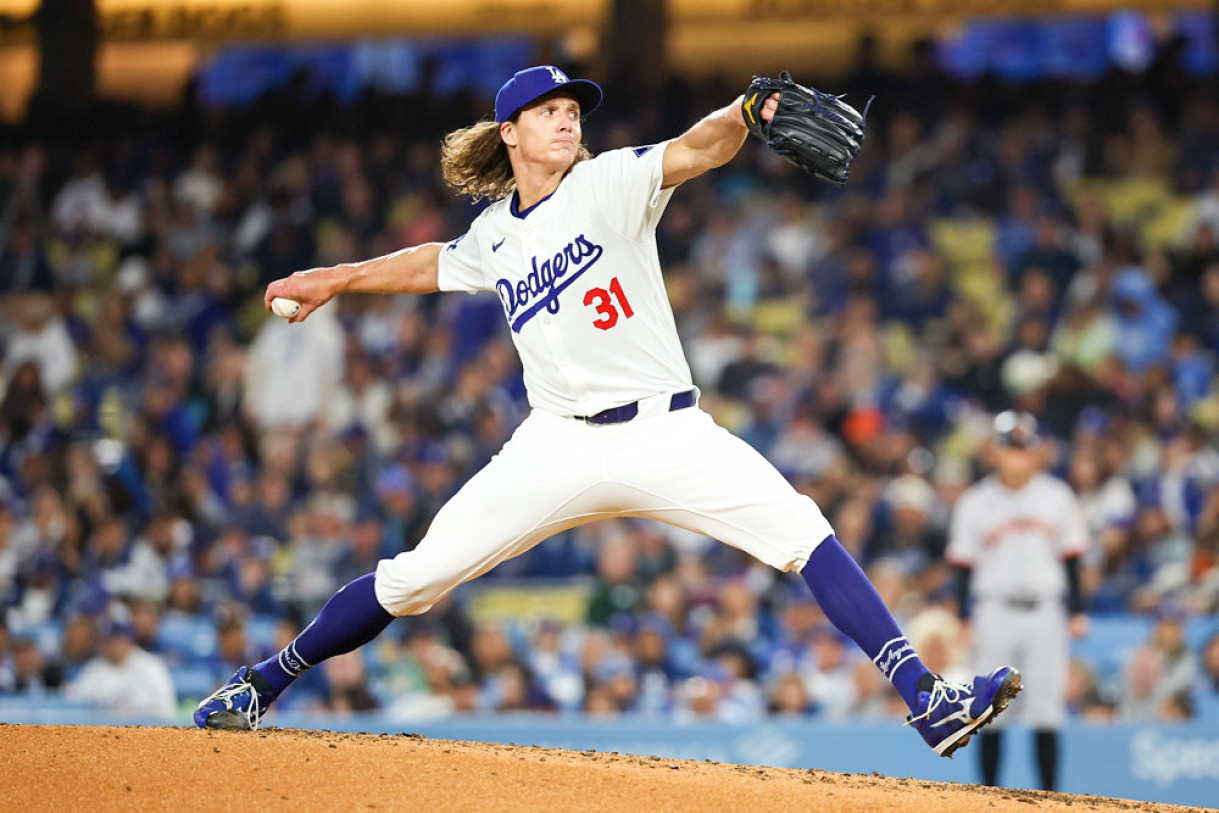
Snell saw a big dip in strikeouts, but his SwStr% remained elite, and his walk rate, while higher than we'd like, remained stable. Snell has always been able to work around the walks, and the underlying numbers check out just fine. It's really just a matter of cost for me, as he's being drafted in the 70-80 range. He logged only 61 innings last season and could be part of a six-man rotation on a loaded Dodgers' team.
There's some room for profit there, but he needs to stay healthy and give us at least 120-130 innings.
Jack Flaherty was definitely not as sharp as he was in his magical 2024 campaign, and it's beginning to look like that year may be the outlier. He was just slightly more wild with walks and less dominant with strikeouts, but Flaherty still delivered the best K-BB% of this entire group at nearly 19%. He was easily the most durable, too, tossing 160+ innings for the second straight season.
The price in drafts is very attractive (NFBC ADP of 227 currently) for a guy with such a high strikeout floor and who should have solid win equity pitching for a good Tigers team.
Verdicts:
Glasnow (OUT), Snell (MAYBE), Imanaga (MAYBE), Flaherty (IN)
From "Good" to "Just Average"
| Pitcher | 2025 ERA |
2024 K-BB% |
2025 K-BB% |
Difference | K% Decrease | BB% Increase |
| Yusei Kikuchi | 3.99 | 22.00% | 13.00% | -9.00% | -5.50% | 3.60% |
| Bailey Ober | 5.1 | 20.90% | 14.30% | -6.60% | -7.70% | -1.10% |
| Tanner Bibee | 4.24 | 20.10% | 14.20% | -5.90% | -5.00% | 0.90% |
| Brandon Pfaadt | 5.25 | 18.80% | 14.30% | -4.50% | -5.10% | -0.70% |
So this is a pretty interesting group, since all four of these pitchers went from really good K-BB% rates around 20% down into the average range. They burned managers last year based on their ADP, and I'd like to personally thank Brandon Pfaadt for crushing my ERA on multiple teams.
Let's start with Kikuchi, who has the most alarming drop in the group. He had tamed his control issues over the last two seasons, but his walk rate jumped to 9.6%, while his K% dropped from 28% to 22%. The 1.42 WHIP was a huge drag on ratios, even if he did turn in a 3.99 ERA (which should likely have been a half-run higher). He's not being drafted until the 340-350 range, but it's for good reason.
He's always battled home run issues and was hit hard by righties last season. I'll pass.
At least Bibee's walk rate held strong, even if he saw a 5% decrease in strikeouts. The SwStr% dipped to 11%, and we might have to live with the fact that he's probably closer to an average strikeout pitcher going forward. But I don't mind drafting Bibee in the same ADP band as Imanaga. He's still just 26 years old, and the Guardians know how to get the best out of their starters.
As my buddy Casey Wilson pointed out to me, Bibee had a really strong close to the year, posting a 20% K-BB% in four September starts. An xERA of 3.62 suggests that he may have had some bad batted ball luck, too.
It was a disastrous year for Bailey Ober as he was knocked around for 30 home runs and an ERA over 5.00. He saw a huge drop in strikeouts, but oddly enough, he finished with a better walk rate than in 2024.
Bailey Ober, Ridiculous 83mph Changeup. 😳
26 Inches of Horizontal Break. pic.twitter.com/rGktpnUpKd
— Rob Friedman (@PitchingNinja) May 19, 2025
I'm not willing to just admit that Ober is a bad pitcher now. He was hurt for most of the season and apparently pitched through significant pain. He lost nearly 1.5 mph on his fastball, and while he's not a flamethrower normally (91-92 mph), he was topping out at 90 mph and living in the high-80s far too often.
Ober still has some very good offspeed stuff, and his 12% SwStr% far outperformed his 21% K% in a big way. I think he's a great value pick around 300 (NFBC). If he's healthy and has corrected his mechanics, I think we could see him bounce back and provide the Twins (and fantasy managers) with some quality ratios (especially WHIP).
The biggest potential bargain on draft day of this group is Pfaadt, who isn't being taken until almost the 400-range. I think the rationale here is "he couldn't possibly be any worse, right?" but I am not sure that's enough convincing for me. His Stuff+ rating of 97 is right there with guys like Randy Vasquez, Walker Buehler, and Tyler Anderson. He has some really solid control, and my hope for him last season was that he'd evolve into a Joe Ryan-type.
But Pfaadt can't afford to be just an average strikeout pitcher with how hard he gets hit. His xERA of 5.25 speaks to the quality of contact that opposing hitters made against him, especially left-handed hitters who had a 52.7% hard-hit rate and 14.9% barrell rate against him last season. I am just not all that interested this year, even at a super low price.
Verdicts:
Kikuchi (OUT), Bibee (IN), Ober (MAYBE), Pfaadt (OUT)
What Happened to These Guys (Below Average)
| Pitcher | 2025 ERA |
2024 K-BB% |
2025 K-BB% |
Difference | K% Decrease | BB% Increase |
| Bryce Miller | 5.68 | 17.90% | 10.20% | -7.70% | -5.40% | 2.30% |
| Taj Bradley | 5.05 | 18.50% | 11.70% | -6.80% | -5.60% | 1.20% |
| Seth Lugo | 4.15 | 15.90% | 11.50% | -4.40% | -1.20% | 3.30% |
| Zach Eflin | 5.93 | 16.10% | 12.00% | -4.10% | -3.40% | 0.70% |
The two guys who I imagine you are the most interested in here are Miller and Bradley, who both fell off the proverbial cliff last season in their K-BB%. Miller was a massive disappointment, as many had viewed him as a third-year breakout candidate coming into the 2025 season, and he pitched only 90 innings, with an ERA of 5.68.
He missed two months of the season in June and July, and was clearly not the same pitcher last year that he was in his first two MLB seasons.
I'm more bullish on Miller's bounce-back than some others. He had shown really good control in his first two seasons, and his SwStr% held strong over 12% despite the dip in K% last season. He had some terrible home run luck with a massive HR/FB on his fastball and splitter. There aren't too many young guns who throw in the high-90s left by the 250-range in the draft. Miller is a strong buy-low candidate there, as long as he's as healthy as he's letting on.
Bryce Miller says that he didn't experience any discomfort this offseason and his pitching "elbow feels 100%."
That led to the decision, after extended consultation with Dr. Keith Meister, to not undergo a procedure to remove the loose bone spurs in the area.
— Daniel Kramer (@DKramer_) February 16, 2026
I was on Taj Bradley to break out last year, and it didn't happen. Now he gets a change of scenery in Minnesota, where they've been known to get the most out of their starters. Like Miller, Bradley continued to have home run issues, but also saw a pretty big dip in his SwStr% that lined up with his drop in K%. I think he probably needs an arsenal tweek and his fastball, cutter, and splitter were all hit hard last year.
He's basically free, going after pick 400, and if I am taking a shot on a total wild card late, I'll take Bradley over Pfaadt.
I'll keep the analysis of the next two pitchers short. Don't draft Seth Lugo! He had been outperforming his underlying metrics for several seasons, and last year, regression finally hit. He's a mediocre pitcher who doesn't get strikeouts, and the fences being moved in at Kauffman Stadium will do him no favors.
I also have very little interest in Eflin. His best quality is his control, but Eflin struggled over 71 innings last season before being shut down in July. Put him on your watchlist in case he can recapture some of his old form, but there's really no reason to draft Eflin this season.
Verdicts:
Miller (IN), Bradley (MAYBE), Lugo (OUT), Eflin (OUT)
More Fantasy Baseball Advice
Download Our Free News & Alerts Mobile App
Like what you see? Download our updated fantasy baseball app for iPhone and Android with 24x7 player news, injury alerts, sleepers, prospects & more. All free!