



 RADIO
RADIO






Corbin's 10 league-winning hitters, fantasy baseball breakouts, values, studs to provide massive return on value in 2026 including Michael Busch, Luis Robert Jr., Colson Montgomery, and more.
We're coming to the close of the fantasy baseball offseason. Many of us spent hours and days researching, monitoring news, and finding potential market values and fades. League winners can have different definitions, but we're looking for hitters that should be priority targets in drafts.
They're targets because they have balanced skill sets or stood out in one way or another throughout the draft landscape. As we move later into the draft, the probability of these players helping win leagues declines unless they're a massive hit. That said, we'll identify 10 hitters that could be potential league winners in 2026 fantasy baseball drafts.
Like usual, we'll touch on a player's skills and underlying metrics to highlight why we want them on our fantasy squads. Let's dive in!
Be sure to check all of our fantasy baseball draft tools and resources:- Fantasy baseball draft kit
- Fantasy baseball rankings
- Team Sync platform and Draft Assistant
- Fantasy baseball mock draft simulator
- Fantasy baseball draft cheat sheets
- Fantasy baseball closer depth charts
- Fantasy baseball prospects
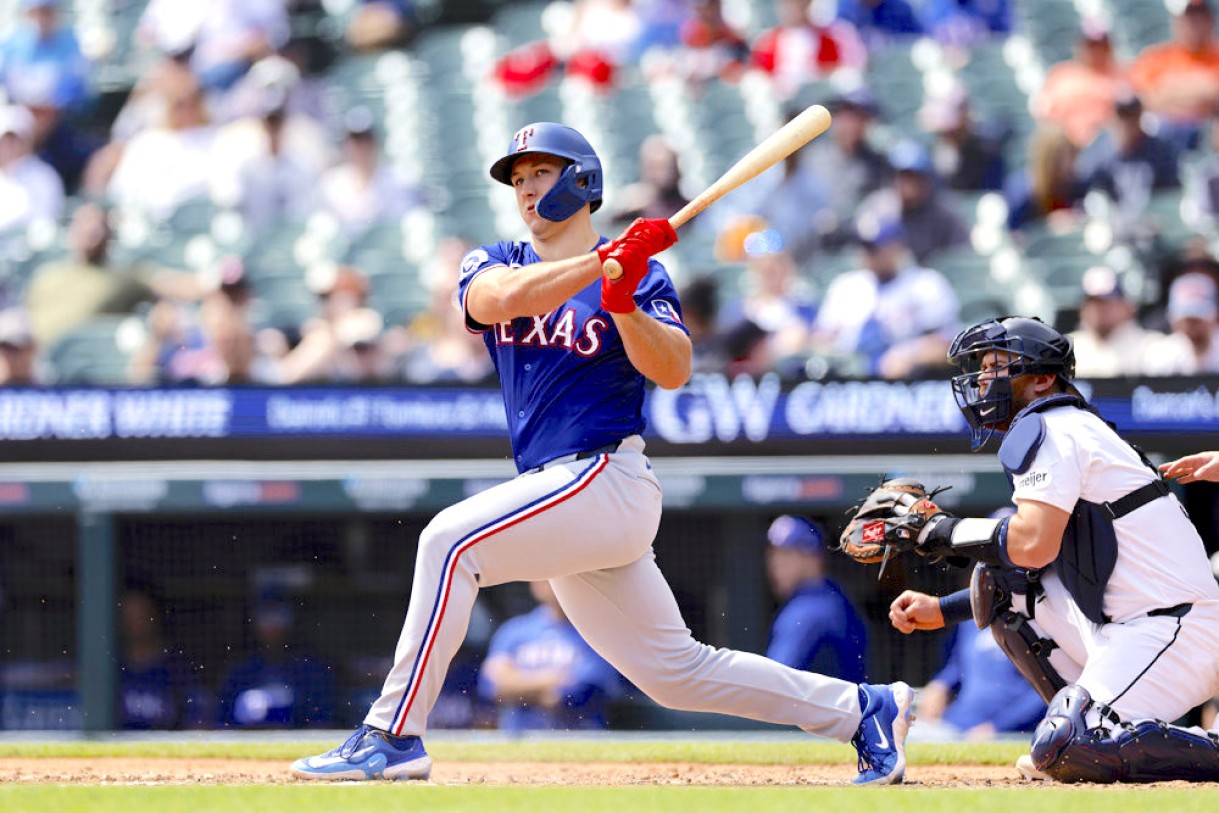
Wyatt Langford, OF, Texas Rangers
NFBC ADP: 41 (Since March 1)
One of the more polished college hitters built upon his rookie season in 2024 (16/19, .253 BA) with 22 home runs, 22 stolen bases, and a .241 batting average in 2025. Langford checks the boxes of a strong hitter, including a league-average 75.8 percent contact rate, yet uses a patient approach by not chasing often (26.2 percent).
The visual below shows Langford's bat speed distribution.
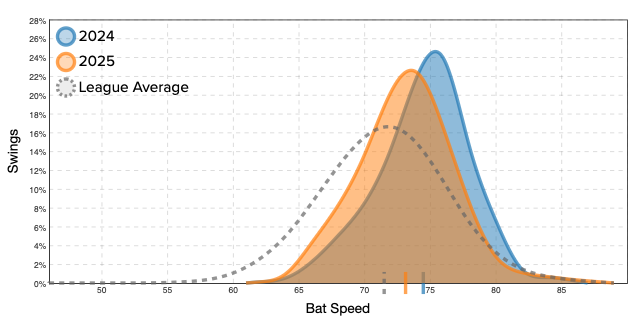
Besides the solid plate discipline, Langford boasts an above-average bat speed (73.1 mph) and an 8.4 percent barrel per plate appearance rate. Furthermore, Langford possesses high-end athleticism with an 88th-percentile sprint speed and 96th-percentile Outs Above Average. He had a 19 percent stolen base attempt rate in 2025 and converted 82 percent of his steals throughout his career.
He landed on the injured list three times with an oblique injury, which raises some concern. Langford spent 28 days on the injured list with an oblique injury in 2025 and a strained hamstring in 2024. A repeat of 2025 seems likely, with the potential for 25/25 and more runs and RBI if he can stay healthy.
Roman Anthony, OF, Boston Red Sox
NFBC ADP: 51 (Since March 1)
Hitting atop an above-average lineup with power and speed, sign us up for Roman Anthony. He used a patient approach with a 22.6 percent chase rate and 37.4 percent swing rate. Anthony's chase and swing rates hovered around 9-10 percentage points below the league average. We would like to see Anthony's contact rate rise, though it's within 3-5 points of the league norm.
In the tiny sample of 415 swings, Anthony boasted a high-end bat speed (75.1 mph) and a 52.5 percent fast-swing rate, which accounts for the percentage of swings at 75 mph or higher. That indicates Anthony's power is legitimate since his bat speed (71.7 mph) and fast-swing rate (23.6 percent) were significantly higher than the league average.
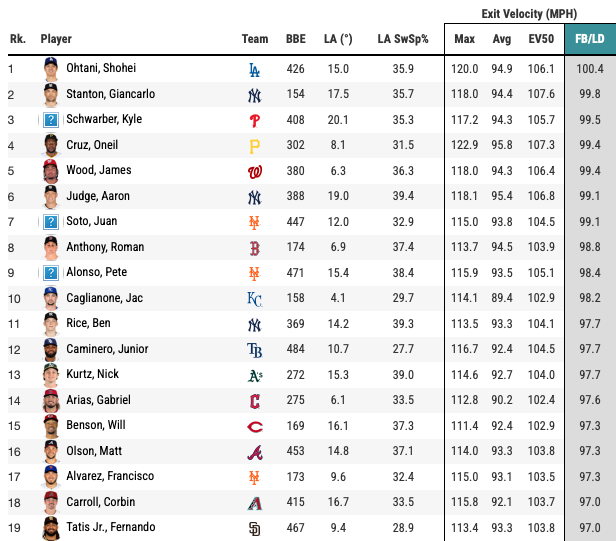
Groundballs have been an issue for Anthony, with a 51.1 percent ground-ball rate in 2025, similar to his minor league track record. We want hitters to destroy the ball when they elevate it. That's what Anthony does, ranking eighth in average exit velocity on flyballs and line drives at 98.8 mph among hitters with 150 batted ball events.
The ATC Projections expect Anthony to have 19 home runs, 11 stolen bases, and a .266 batting average. However, Anthony's power skills suggest there's a 25-30 home run upside in his bat. We'll need to invest heavily in Anthony, but it should be worth it as a potential league winner.
Luis Robert Jr., OF, New York Mets
NFBC ADP: 110 (Since March 1)
Injuries, especially lower-body ones, have been an issue for Robert. He missed two months in 2024 with a strained right hip flexor, then landed on the injured list for 1.5 months in 2025 with a hamstring injury. After hitting 38 home runs in 2023, the power fell off to 14 in each of the past two seasons (2024-2025).
That's notable because Robert has near-elite bat speed (75.6 mph) and a 57.4 percent fast-swing rate, meaning over 57 percent of his swings were 75 mph or faster. Robert's bat speed was five mph faster and double the fast-swing rate compared to the league average. The visual below shows Robert's bat speed distribution.
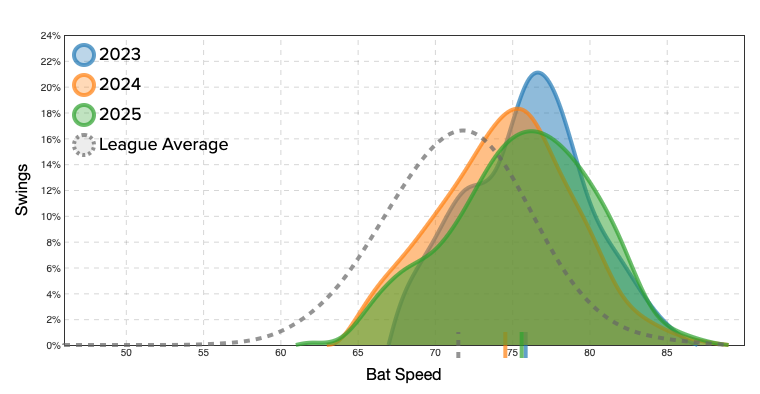
The White Sox home park ranked 18th in home run park factors, with the Mets' home park at No. 7 for right-handed hitters. Theoretically, Robert's elite power should play well in a new home ballpark. Robert hitting 25-30 home runs is within the range of outcomes.
Even with the lower body issues, Robert's stolen base attempt rate was at 34 percent in 2024 and 41 percent in 2025. That's significantly higher than his career average at 25 percent, which helps when he converts 80 percent of the attempts into stolen bases.
With a better lineup and home park, Robert can post a 25/35 season, assuming he stays healthy.
Luke Keaschall, 2B, Minnesota Twins
NFBC ADP: 116 (Since March 1)
The second base position tends to be quite top-heavy, including Jazz Chisholm Jr., Ketel Marte, and Brice Turang going within the top 75 picks. Then we have nine second basemen from picks 100 to 200, with Keaschall being one of them. Keaschall has strong plate discipline, with an 83.6 percent contact rate, nearly seven percentage points above the league average.
Meanwhile, Keaschall's chase rate was nine percentage points below the league norm, showing a patient approach. That will help create a floor for batting average and on-base skills. With Keaschall having a strong OBP, he ran often, evidenced by a 30 percent stolen base attempt across 207 plate appearances in 2025. Keaschall putting up 25-30 stolen bases would be a reasonable outcome.
Unfortunately, Keaschall's power is significantly below average, with a 66.9 mph bat speed, 2.2 percent fast-swing rate, and 3.9 percent barrel rate. Keaschall is a cheaper version of Nico Hoerner, who typically goes 25-30 picks earlier, making him a top value pick.
Sal Stewart, 1B, Cincinnati Reds
NFBC ADP: 171 (Since March 1)
In the minors, Stewart boasted a 93.1 mph average exit velocity and 15.2 percent barrel rate while having league-average contact rates (83 percent). Stewart averaged a 72.1 mph bat speed and 26.3 percent fast-swing rate in his small MLB sample of 99 swings.
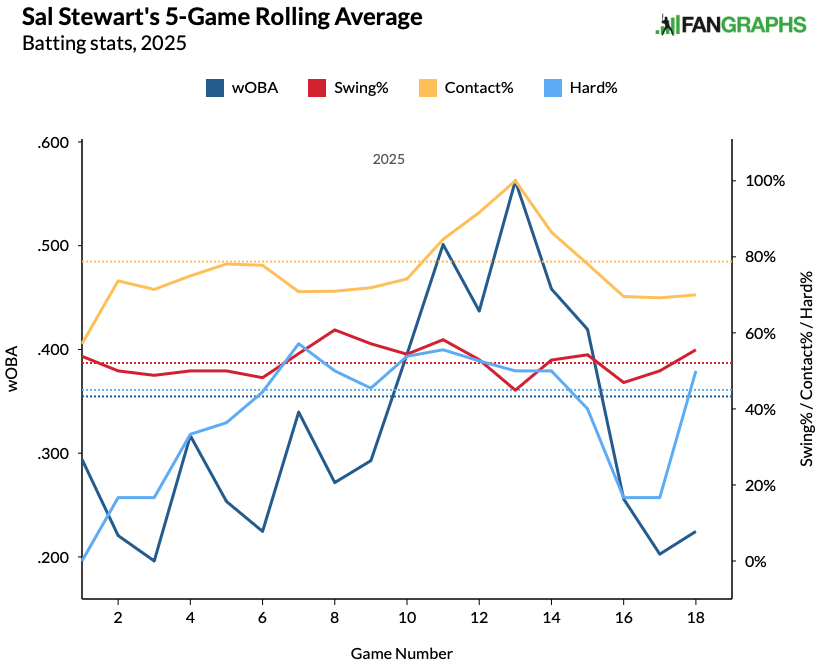
We know Stewart can hit the ball hard. He seems to have a strong hit tool because he uses an aggressive approach by swinging and chasing 5-8 percentage points above the league norm. That can be a fruitful combination when hitters chase and swing often while making contact, showing they're attacking pitches.
Stewart's 50 percent pull rate in his MLB sample and 29.4 percent home run per fly-ball rate might be unsustainable. That's mainly because Stewart's pull rates were closer to 36 to 39 percent in his minor league sample. This is where Stewart's hit tool comes into play.
Stewart hit seven barrels to the opposite field and seven to his pull side in the minor leagues in 2025, showing he can spray it around the park. We expect Stewart to be a four-category producer, with stolen bases being minimal, though he stole double-digit bases throughout his minor league career.
We'll want to lean into the small sample and uncertainty for Stewart at the reduced price.
Michael Busch, 1B, Chicago Cubs
NFBC ADP: 103 (Since March 1)
Busch built on his sophomore season into Year 3 with better production across the board. That helps provide additional data points and reasons why Busch can be a league winner in 2026. Busch improved his contact rates by two percentage points while maintaining his league-average patience in 2025, compared to 2024.
Interestingly, Busch's bat speed in 2025 hovered around his career average (70 mph) with a poor fast-swing rate (9.1 percent). Busch's longer swing can explain that as he attempts to pull the ball. However, Busch's barrel rate jumped to 11.1 percent in 2025, up from 6.7 percent in 2024.
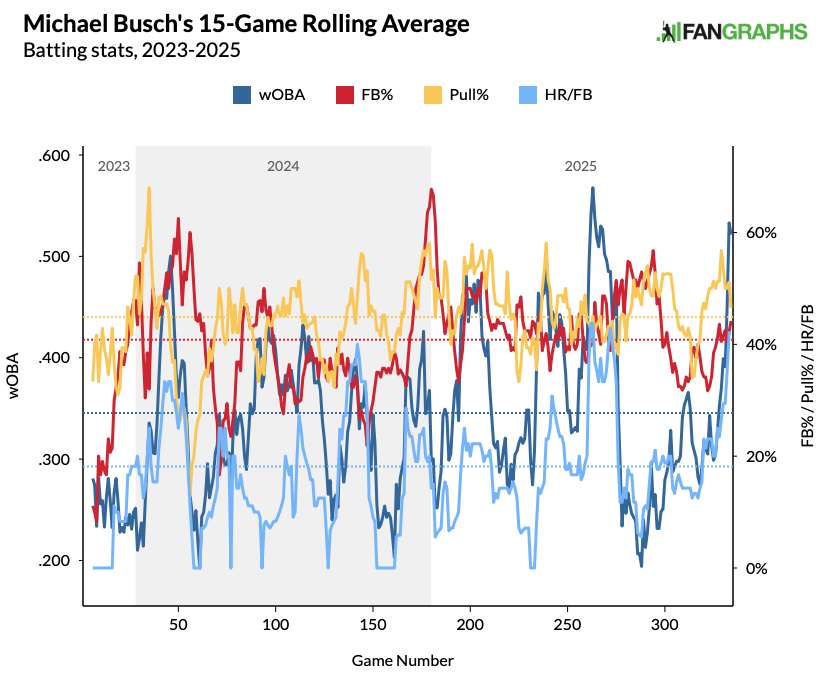
He leans into a pull-heavy (46.8 percent) and flyball-heavy (42.2 percent) approach, aligning with his strong exit velocity on pull attempts. Busch's pulled average exit velocity increased to 93 mph with a 15.5 percent barrel rate and 70.7 mph bat speed. That's not far from Busch's 92.3 mph average exit velocity, 16.6 percent barrel rate, and 69.1 mph bat speed on non-pulled batted balls.
Hitters with Busch's power skills can have higher HR/F, so 25-30 home runs should be the floor, with 30+ likely, as we saw in 2025. The early projections have Busch leading off for the Cubs after hitting leadoff in 222 plate appearances (37.5 percent) in 2025. That should boost Busch's counting stats, specifically runs, and a repeat of 2025 could happen in 2026.
If you miss on a first baseman earlier in drafts, make Busch a priority target that could help win weeks and leagues throughout the season.
Otto Lopez, 2B/SS, Miami Marlins
NFBC ADP: 215 (Since March 1)
Lopez showed us the speed with 20 stolen bases in 2024 and better power in 2025. That's evident in Lopez's 5.6 percent barrel rate, increasing by 1.5 percentage points in 2025. Lopez increased his bat speed by one mph to 71.7 mph with a fast-swing rate, increasing by eight points. The visual below shows Lopez's bat speed distribution.
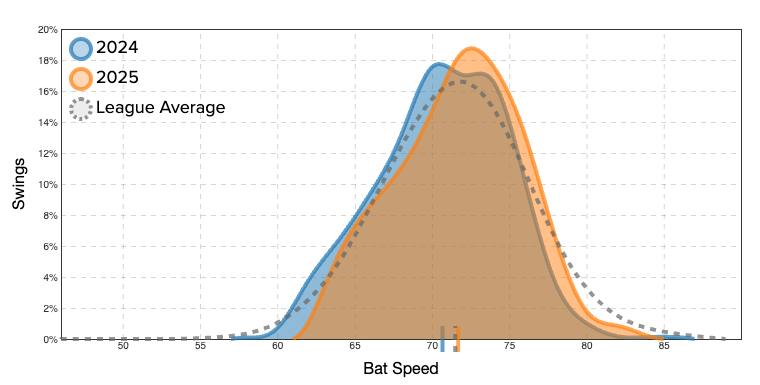
He improved his launch angle by hitting flyballs 34.1 percent of the time in 2025, up from 25.5 percent in 2024. Although Lopez's barrel rate improved, his average exit velocity on flyballs and line drives was at 92.4 mph (No. 174) in 2025, not far from his 93.1 mph (No. 125) in 2024.
We discussed the speed earlier, and that should be a regular part of Lopez's profile. He had a 23 percent stolen base attempt rate in 2024, which dropped to 14 percent in 2025. However, Lopez showed the speed (81st percentile) and defensive athleticism (95th percentile in Outs Above Average), so 15-20 stolen bases should be the expectation.
Lopez might lack a massive ceiling, but there's the potential for 15/20 with a quality batting average, making him a target at the position to use as a deep-league player that could help win leagues.
Matt McLain, 2B, Cincinnati Reds
NFBC ADP: 158 (Since March 1)
After shoulder injuries caused McLain to miss the entire 2024 season, there was injury pessimism for him heading into 2025. McLain gave us a similar power (15 HR) and speed (18 SB) profile in 2025, yet it came with a concerning .220 batting average. What's further concerning is McLain's .202 expected batting average being lower than his actual BA in 2025.
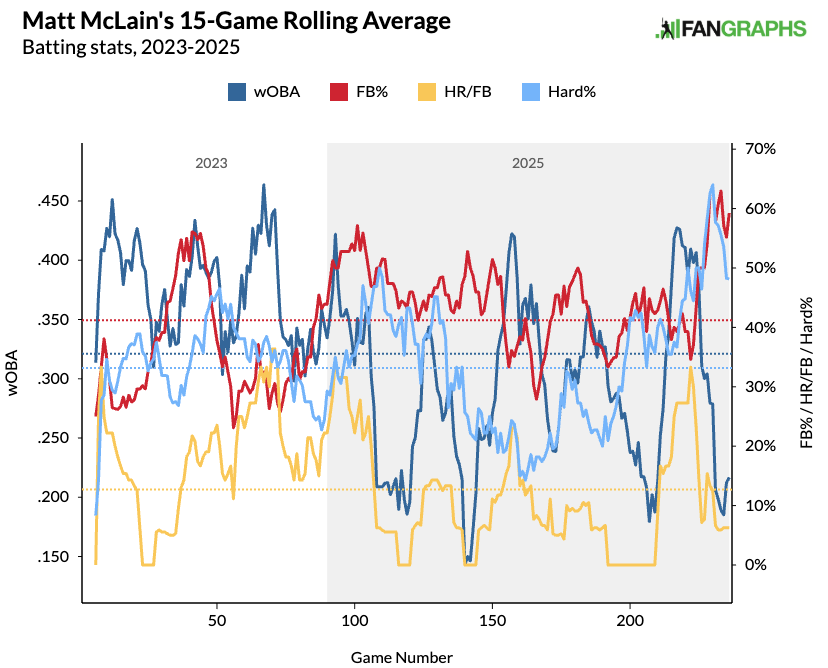
McLain showed similar contact rates to the 2023 season with a similar batted ball approach in terms of pull rates (34-35 percent). However, McLain's launch angle increased in 2025, with a 44.2 percent fly-ball rate, seven percentage points higher than in 2023. Since McLain's 4.7 percent barrel rate (2025) dropped from 6.7 percent (2023), we can guess that he struggles with consistently barreling up the ball.
McLain's speed (93rd percentile in sprint speed) and defensive athleticism (87th percentile in Outs Above Average) indicate he should continue to run. There won't be a high stolen base total. However, McLain's career 17 percent stolen-base opportunity rate and 82 percent conversion percentage suggest 15-20 bags as the norm.
McLain could win leagues by going 20/20, which is within the range of outcomes for him.
Colson Montgomery, SS, Chicago White Sox
NFBC ADP: 229 (Since March 1)
Montgomery's power is legitimate, as we discussed in a previous article. He flashed elite power, with a 77 mph bat speed and 71.7 percent fast-swing rate. That's over five mph higher and nearly 50 percentage points higher than the league average. Montgomery's bat speed and fast-swing rate compare closely to Nick Kurtz, Aaron Judge, and Vladimir Guerrero Jr.
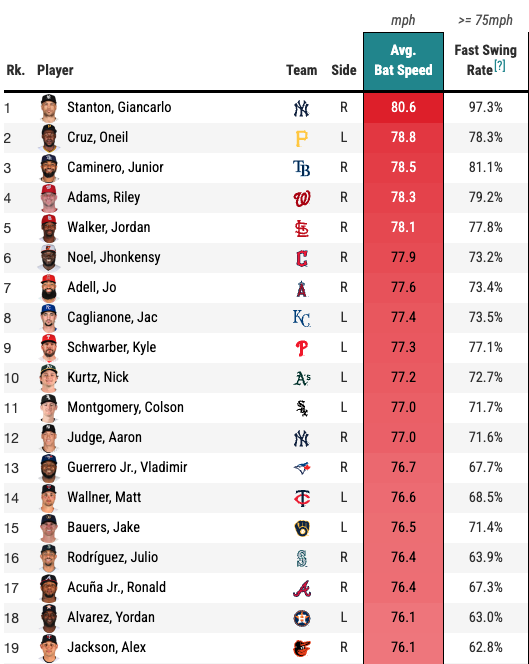
There might be skeptics about Montgomery maintaining a high HR/F (25.9 percent). However, Montgomery's power can lead to home run rate efficiency, given the 46.8 percent fly-ball rate. Based on Montgomery's power skills, his HR/F should be between 17 and 20 percent, with 25 percent as the high-end range.
Making contact has been a concern for Montgomery, evidenced by a 69.5 percent contact rate, seven percentage points below the league average. However, we've seen Montgomery's contact rates be around 74 percent in the minor leagues, so we should expect something in between.
Most projection systems have Montgomery with a .220 batting average, but .230 could be within reason while hitting 30+ home runs.
Evan Carter, OF, Texas Rangers
NFBC ADP: 280 (Since March 1)
Injuries have been a serious issue for Carter, with 111 days on the injured list (lower lumbar sprain) in 2024 and over two months in 2025 (strained quad, back spasms, fractured right wrist). We could argue that Carter hasn't tapped into his potential because of health concerns.
Unfortunately, Carter's season ended in late August due to a wrist injury. Injuries aside, Carter's defense should make him valuable from a real-life standpoint. Carter makes league-average contact (76.6 percent) while showing a patient approach, with a 20.9 percent career chase rate. He hardly swung (38.3 percent) in 2024, but was more aggressive in 2025 with a 44.3 percent swing rate.
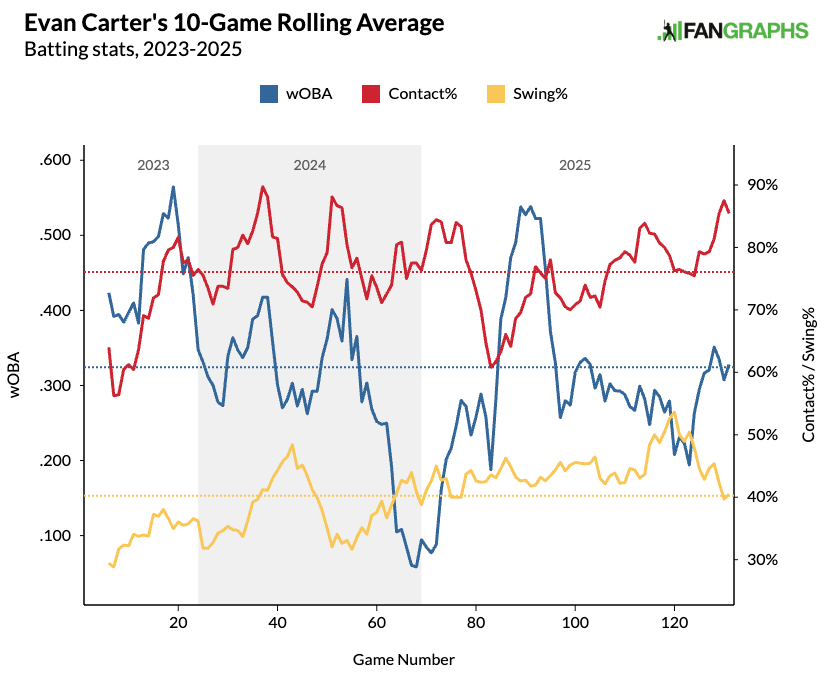
Carter's power has been mediocre to below average, given a 70 mph bat speed and a 4.2 percent career barrel rate. That indicates Carter's home run peak might reach 15 over a full season. Interestingly, given Carter's health challenges, he had a 31 percent stolen base attempt rate, 11 points above his career average. That coincides with his career-high in stolen bases (14) in 2025.
The projections give us a fair expectation of 10/15 or 10/20, but there's 15/25 within the range of outcomes. There was a report from Skip Schumaker (Rangers' manager) talking about Carter garnering opportunities against lefties to begin the 2026 season. The lefty splits (15 wRC+) have been drastically worse compared to the results (121 wRC+) against righties in 2025.
Those numbers were better than Carter's -13 wRC+ against lefties and a 132 wRC+ versus right-handed pitchers. Carter remains a low-risk, high-upside option to lean into the uncertainty about production, given the health history.

More Fantasy Baseball Advice
Download Our Free News & Alerts Mobile App
Like what you see? Download our updated fantasy baseball app for iPhone and Android with 24x7 player news, injury alerts, sleepers, prospects & more. All free!